
Tragedy · 1918
The Bamboo Stand Collapse and the 1918 Happy Valley Racecourse Fire
A temporary bamboo stand collapsed during Derby Day at Happy Valley Racecourse, precipitating a fire and crush that killed 670 people. Tung Wah Hospital organized relief, body recovery, burial arrangements, and the memorial that carried the disaster into Hong Kong’s civic landscape.
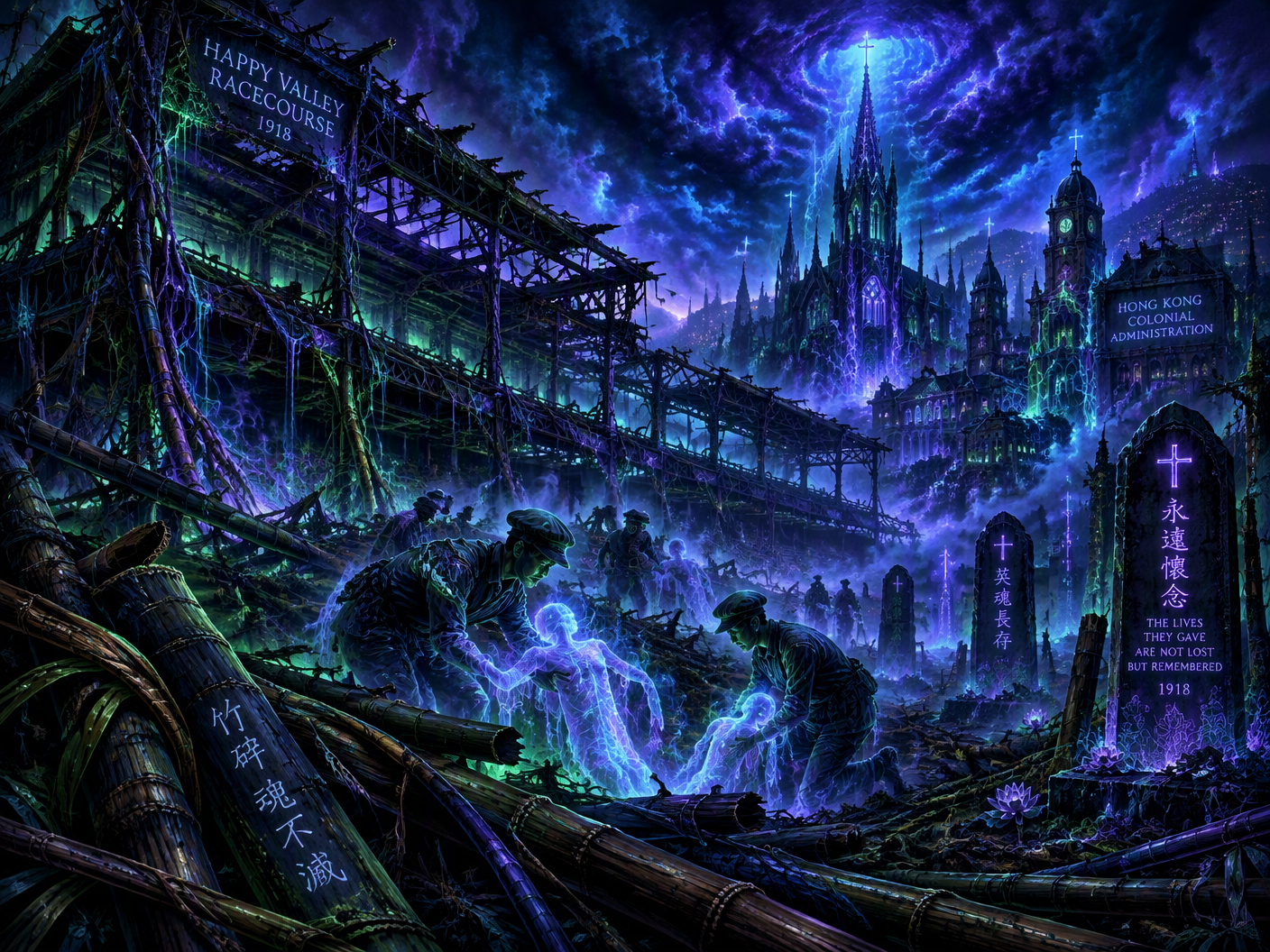
By the time laborers organized by Tung Wah Hospital entered Happy Valley Racecourse, the work had changed from assisting spectators to collecting the dead. The annual Derby Day races on February 26, 1918, had ended in a structural collapse, fire, and crush. A temporary bamboo stand had given way during the event, turning a place of public recreation into a mass-casualty site. The hospital offered help to victims and families, then assembled workers for the physical burden that followed: recovering hundreds of bodies from the racecourse and moving them toward burial.
The collapse exposed the terms on which the gathering had been built. Spectators occupied temporary bamboo seating at one of British Hong Kong’s major public sporting occasions. When the structure failed, the risk embedded in that arrangement passed directly to the people standing and sitting upon it. Fire followed the collapse, and the fallen stand restricted movement as the crowd tried to escape. The decisive failure was not an athletic act on the course but the loss of the structure holding the audience, a public accommodation that could no longer bear the human load placed upon it.
The scale became visible in numbers almost immediately. By February 27, one day after the fire, the reported count had reached as many as 576 confirmed deaths. The final toll stated for the disaster was 670. That figure transformed the racecourse fire from an emergency confined to Happy Valley into a crisis of recovery, burial, and family loss across Hong Kong. Each increase in the count also enlarged the practical demands on the institutions responding: more bodies to retrieve, more relatives requiring assistance, and more space needed for the dead.
Tung Wah Hospital became the central relief institution in that immediate aftermath. It offered assistance to victims and their families and arranged for laborers to collect bodies from the site. The response joined charitable responsibility to difficult manual work. Administrators could organize aid, but workers still had to enter the damaged racecourse and perform the recovery. Families confronting sudden loss depended upon an institution already rooted in Hong Kong’s public life, while the hospital depended upon laborers whose assignment placed them closest to the physical consequences of the failed stand.
Within days, recovery created another civic problem: where to bury so many people. On March 3, 1918, Tung Wah Hospital chairman Tong Yat-chuen appealed to the colonial government to allocate land for a burial site. The request measured the disaster in acreage as well as lives. The racecourse could host a large public event on temporary construction, but the dead required permanent ground controlled by the government. Tong’s appeal moved the consequences from the hospital and bereaved families to the colonial administration, which held the authority to make land available.
That division of responsibility defined the response. Tung Wah Hospital provided aid, organized workers, and petitioned for burial land; the government possessed the power to grant space. The families carried losses that neither institution could reverse. The sequence made public authority tangible through ordinary necessities: hands to recover bodies, land in which to bury them, and an enduring place where relatives and the wider community could locate the dead. What began with temporary seating therefore produced permanent obligations extending beyond the racecourse boundary and beyond the day of the fire.
The immediate cause remained rooted in the material conditions of the event. A temporary bamboo stand collapsed, and the collapse precipitated the fire and deadly crush. The structure separated the commercial and ceremonial purposes of Derby Day from the safety of the people attending it. Once that structure failed, spectators bore the consequence while relief workers inherited the aftermath. The disaster’s social reach came through this transfer: a public sporting occasion depended upon temporary accommodation, and the human cost of its failure moved outward into hospitals, family routines, burial work, and government land decisions.
Four years passed before commemoration acquired a permanent form. The Race Course Fire Memorial was completed in 1922 at So Kon Po. Its construction joined burial and remembrance to the institutional response led by Tung Wah Hospital. The memorial gave the catastrophe a fixed location beyond the racecourse itself, preserving the 670 deaths within Hong Kong’s civic geography. Temporary bamboo had failed in minutes; stone and designated ground answered on a different timescale. Families and relief workers had already carried the immediate burden, while the memorial made that burden visible to later generations.
On October 23, 2015, the Hong Kong Government declared the Race Course Fire Memorial a monument. Nearly a century after the collapse, the site entered the territory’s formally protected heritage. The designation did not begin remembrance; it placed governmental recognition around a memorial created from the earlier work of a hospital, its chairman, laborers, and families seeking burial space after mass death. The same public authority once petitioned for land now protected the place where the consequences of the racecourse disaster had been gathered and preserved.
The laborers organized by Tung Wah Hospital remain at the center of what the fire left behind. They encountered the disaster not as a sporting result or civic ceremony, but as work: collecting the dead after temporary seating collapsed and the racecourse burned. Tong Yat-chuen’s appeal carried that work toward burial; the 1922 memorial carried it toward remembrance; the 2015 declaration carried it into protected public history. The race meeting ended on February 26, 1918. For the workers and families, its final measure was the weight transferred from a failed stand to their hands, homes, and burial ground.
Investigative Dossier & Evidence
Read the companion investigation notes, verified source claims, and primary documents.
Read the Companion Notes & Evidence Record →