
Violence & Brawls · 1972
The Spectrum Melee That Put Blues Players and Fans in Handcuffs
On January 6, 1972, a second-period dispute between St. Louis coach Al Arbour and a referee spilled over the boards at Philadelphia’s Spectrum. Players, fans, and police collided; Blues personnel were arrested, injuries required medical care, and the game resumed before St. Louis won, 3–2.
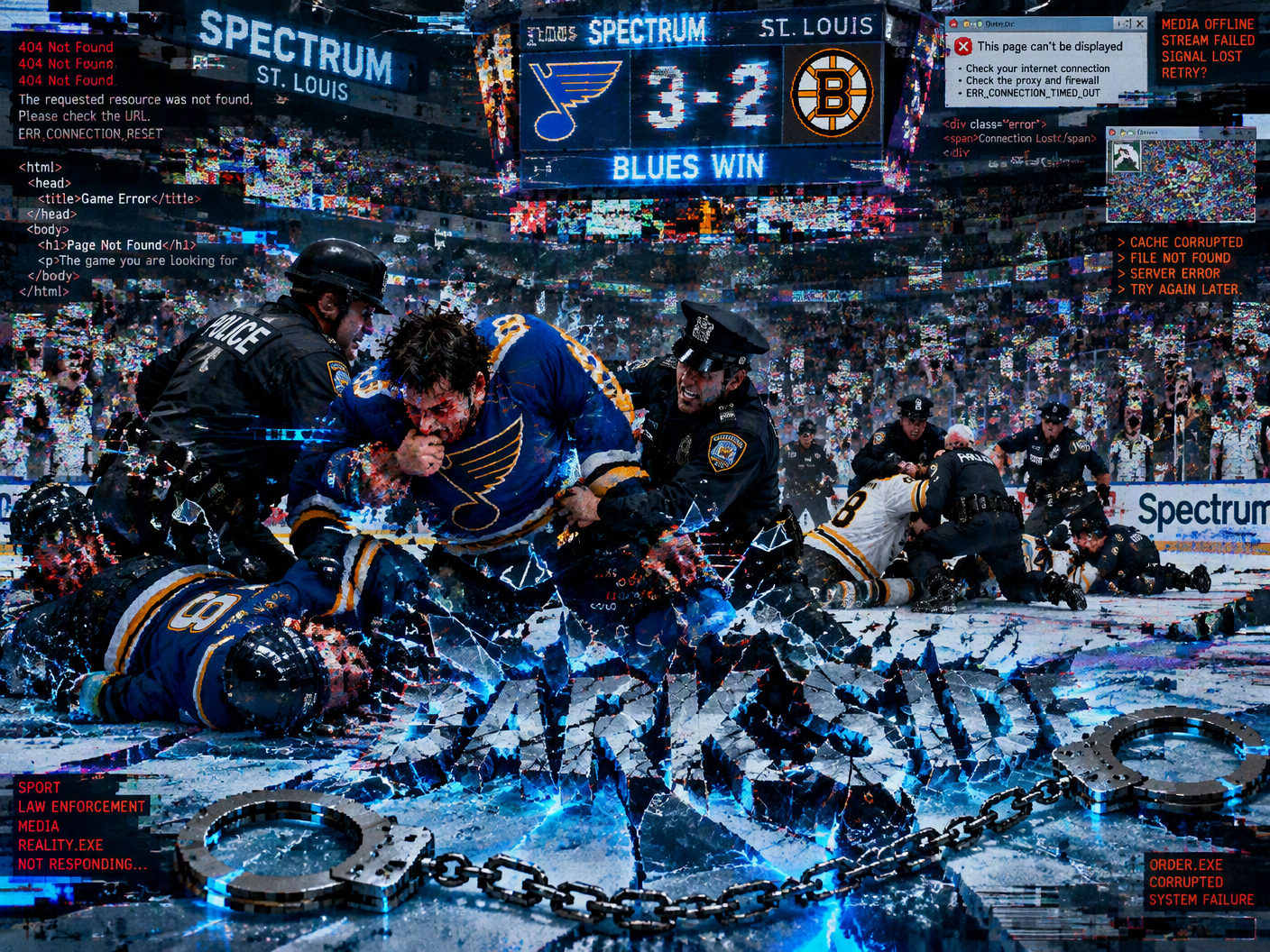
The drinks came first. Then the trash. They flew from the Spectrum stands toward the ice while Al Arbour argued with the referee during the second period, his St. Louis Blues pinned inside a Philadelphia night built for noise and punishment. The building smelled of wet wool, beer foam, and rubber melting under the lights. A complaint became a confrontation. The boards ceased to be a border. Bob Plager and Floyd Thomson were pulled into the crush as players and spectators surged together, sticks and fists disappearing inside the blue-gray mass.
The Spectrum had been designed to hold twenty thousand voices. That night it held something harder to control. Fans leaned over the railings. Blues players climbed toward them. The referees lost the clean geometry of the rink, and the police moved into a fight that no longer belonged to hockey. Arbour, the coach, was not standing behind a bench now. He was in the machinery of the brawl, surrounded by uniforms, leather gloves, and bodies pressed against the glass. The crowd kept feeding the scene with bottles, cups, and loose debris.
Philadelphia police answered in numbers. Approximately two hundred officers were involved in restoring order, forming a dark cordon around the ice while the melee rolled through the arena. Their boots struck the concrete. Their hands reached for players, spectators, and one another. The separation took force. It took time. By then, multiple players had been hurt badly enough to require medical attention. Fans and police were injured as well. The cold brass of the handcuffs replaced the usual sound of skates cutting the ice.
Arbour needed stitches. The cut put a hard line beneath the argument that this had been ordinary hockey roughness. Floyd Thomson was arrested after the violence, as were Arbour and several other Blues players. The charges included disorderly conduct and assault. The arrests shifted the night from penalty minutes to police procedure. Names were taken. Bodies were examined. The coaching staff and players who had come to Philadelphia to work a game were processed as defendants in a public fight, while the arena watched the law sort through the wreckage.
The fans who had thrown drinks and trash were not arrested. The players and Blues coaching personnel were. That uneven exit became part of the incident’s shape: the people in uniforms carried the visible burden of the police response, while the stands emptied without a matching line of handcuffed spectators. The argument over who began what remained lodged in the night. Different accounts disputed the fans’ specific instigating actions, but the immediate machinery was plain enough—an official complaint, a flying barrage from the seats, a rush across the boundary, and arrests on the Blues side.
Still, the rink was not closed. After the police had forced the combatants apart and the injured had gone for treatment, the game continued. The ice carried the marks of the interruption: scattered equipment, churned slush, and the residue of a fight that had placed players, fans, and officers in the same violent knot. The clock started again. So did the contest. Hockey demanded its old rituals back—faceoffs, line changes, the hard scrape of blades—though the building had already shown how quickly those rituals could fail.
St. Louis answered with goals. The Blues scored three unanswered times and won, 3–2. The arithmetic was clean; the evening was not. A scoreboard reduced the aftermath to a result, as scoreboards always do. Behind it stood a coach with stitches, players facing disorderly-conduct and assault charges, injured spectators, injured officers, and a police operation large enough to occupy roughly two hundred men. The final horn did not erase the handcuffs. It only gave the arena permission to pretend the game had been the principal event.
Al Arbour had entered the night as the head coach of the St. Louis Blues, a man whose authority normally ended at the bench door. His complaint to the referee crossed that line. The details of the original grievance mattered less once the crowd and players collided; the consequence was physical and legal. Arbour was arrested. Thomson was arrested. Several Blues players went with them. The coach’s gesture toward an official became the hinge between a disputed call and a police action, between the controlled violence of hockey and the uncontrolled violence beyond its rules.
The incident was contemporaneously treated as one of the worst player-fan-police altercations in NHL history. The phrase belonged to a league accustomed to blood on the ice but less prepared for the stands to become an active side of the fight. Injuries to players, fans, and police made the damage communal. No one group owned the bruises. Yet the arrests fell only on St. Louis players and coaching staff. The old separation between performer and audience had broken, and the response restored order without restoring symmetry.
By the time the Spectrum lights burned over the departing crowd, Philadelphia had seen a hockey game turn into a public-order operation and then turn back into a hockey game. The Blues left with a 3–2 victory. Arbour left with stitches and charges. Thomson and other Blues personnel left under arrest. The fans went home carrying the noise of the brawl, while the police carried the injuries of their intervention. The night’s final score fit on a ticket stub. The rest of it required handcuffs, medical tape, and a room where the clocks kept ticking.
Investigative Dossier & Evidence
Read the companion investigation notes, verified source claims, and primary documents.
Read the Companion Notes & Evidence Record →