
Violence & Brawls · 1993
The Ustawka Years: Violence Around Polish Football
From the 1993 Poland–England qualifier to the death of a fan after a 2015 police intervention, Polish football violence moved through terraces, streets, organized fights, and European sanctions. The investigation establishes a culture in which some hooligan firms joined match-day aggression to far-right and racist politics.
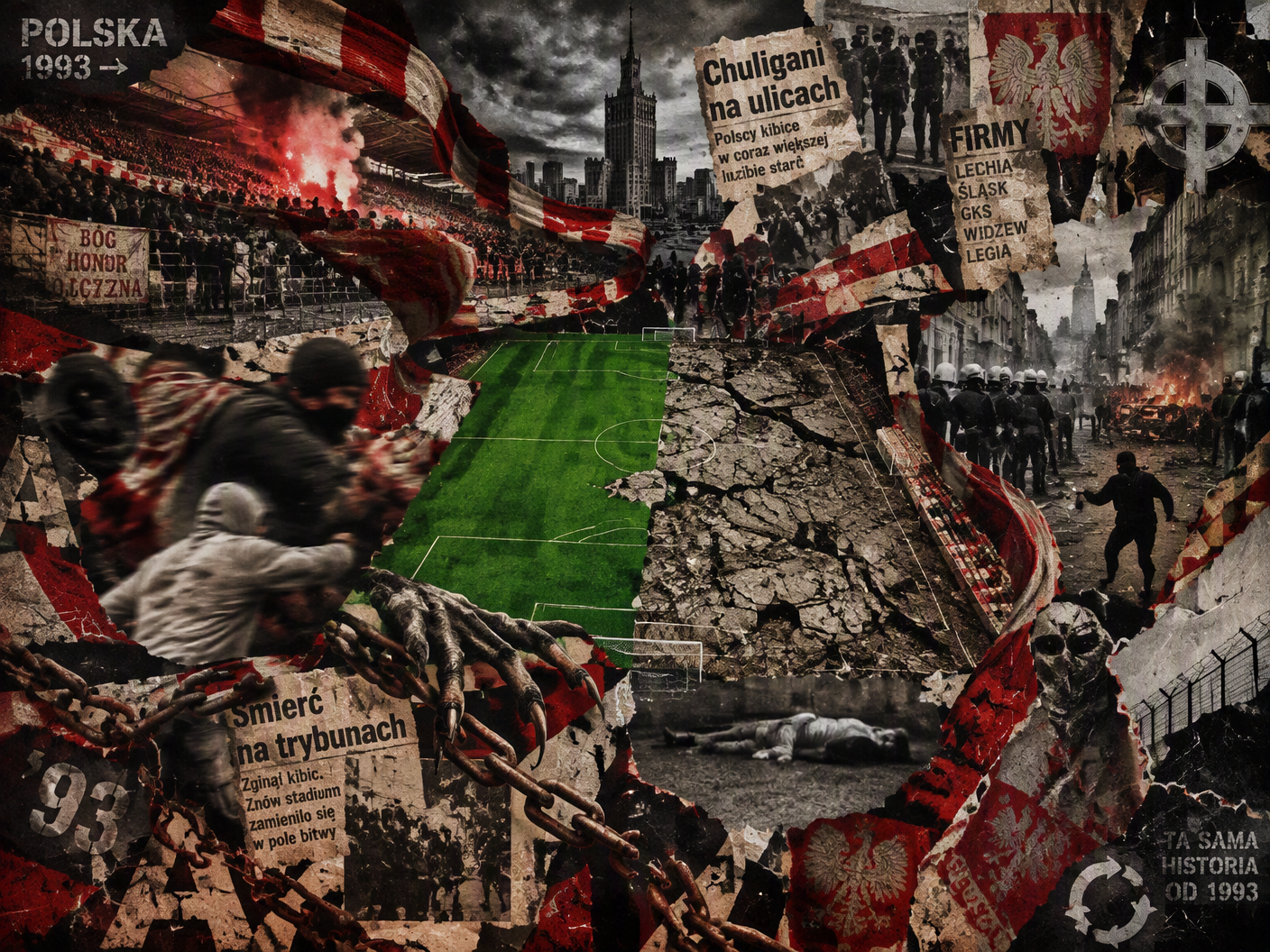
The match was in Chorzów on 29 May 1993. Poland played England in a World Cup qualifier, but the contest outside the football belonged to hundreds of supporters who turned the streets into a hard, shifting front. Scarves became colors. Colors became borders. The violence did not wait for a final whistle. Polish and English fans clashed, and the qualifier entered the decade as a warning written in broken order, shouted threats, and bodies moving through the crowd. Polish football was no longer carrying only the old cargo of rivalry. It was carrying organization.
The 1990s brought a sharp rise in football-related violence across Poland. The firms grew more deliberate. These were not always loose knots of drunk men stumbling out of a match. Groups organized themselves, chose enemies, and treated violence as part of the football calendar. Grzegorz Piatkowski, a fan who participated in hooligan culture, described the violence as integral to Polish fan life. The sentence has the bluntness of a rule posted above a dressing-room door. For men inside that world, the fight was not an interruption to the sport. It was one of the events.
The organized fight acquired its own name: ustawka. Firms arranged encounters away from the formal contest, carrying the rivalry into fields, roads, and other spaces where the referee had no whistle and the league had no reach. The match supplied the grievance, the colors, and the audience. The ustawka supplied the appointment. As the firms became more organized, violence surrounding football escalated with them. The institution sold ninety minutes of competition. The men in the firms built a second fixture, one measured in numbers, nerve, and the damage left behind.
The culture also carried politics. Parts of the Polish hooligan scene became linked to far-right and fascist ideologies. Some groups openly promoted racist agendas. The terrace could operate as a recruiting ground for more than loyalty to a club. It offered uniforms without official uniforms, enemies without a courtroom, and a language of belonging sharpened by exclusion. Football gave the firms a public stage and a steady supply of strangers. The violence was physical, but its message traveled farther: certain people were welcome behind the colors, and others were marked for removal.
Thirteen years after Chorzów, Legia Warsaw won the Polish League title. Celebration became disorder in Warsaw on 13 May 2006. Legia supporters rioted after the victory, damaging public property and injuring police officers. The title had been secured on the field; the consequences moved into the city. Glass, metal, uniforms, and pavement replaced chalk lines and floodlights. A league championship, designed as a clean arithmetic of points, ended with the police absorbing the cost of a crowd that treated the streets as an extension of the terrace.
The Warsaw riot exposed the transfer at the center of the culture. The club collected the title. Supporters claimed the spectacle. Police officers carried the injuries, while public property paid the bill in brick, glass, and bent metal. The damage was not an abstract stain on a competition. It belonged to streets used by people who had not bought a ticket and to officers sent to contain a celebration that had crossed into violence. The football ended when the trophy was won. The civic disturbance kept its own clock.
In 2007, UEFA answered Legia Warsaw's violence beyond Poland with a one-year ban from European competitions. The punishment followed violent incidents during a match in Lithuania. A club that wanted access to Europe found the gate locked by a decision made outside its domestic orbit. Travel, prestige, and the money attached to continental football all ran through that gate. The ban translated terrace conduct into institutional consequence. It also showed the limit of local containment: when violence traveled with a club, the club's football passport could be taken away.
The ban did not erase the firms. Ustawka remained the hard grammar of organized hooligan fighting, and the ideological current remained visible around parts of the scene. Football clubs could be symbols, meeting points, and shields. The names changed. The mechanics stayed recognizable. Rival groups built identity through opposition, then carried that identity into planned violence. The crowd provided noise and cover. The club provided the colors. The wider culture provided the permission structure: a belief that masculine loyalty required an enemy and that the enemy could be handled outside the rules.
On 2 May 2015, the pressure broke at Knurów. During a match involving Concordia Knurów, a fan entered the pitch. Police intervened and shot him. He later died. The death set off riots and widespread unrest in the community. Once again, football's perimeter dissolved. The field was no longer separated from the street by painted lines or barriers. A police action during a match had produced a fatal consequence, and the anger that followed moved outward through Knurów, gathering people who understood the event not as a single confrontation but as proof of a system already loaded with force.
By then, the pattern had accumulated its own architecture. Chorzów had shown hundreds of fans colliding around a national match. The 1990s had organized the firms and given the ustawka its place in the football underworld. Warsaw had turned a league title into damaged public ground and injured officers. Lithuania had brought UEFA's ban. Knurów had ended with a fan dead after police intervention and a community in revolt. The central fact was not that football attracted disorder. It was that football supplied a durable container for rivalry, politics, organized violence, and institutional failure.
The clubs remained visible. The firms worked in the darker space around them. Some promoted racist agendas; some arranged fights; some turned celebration into riots. Fans such as Grzegorz Piatkowski understood the violence as part of the culture rather than an accidental spill from it. That is the machinery of the Polish hooligan scene: a sport capable of producing loyalty, then a network capable of weaponizing it. The pitch stayed green. The streets took the bruises. When the gates closed, the rivalry kept moving, carried by men who had learned to make the crowd into cover.
The story closes in Knurów, where the cost became irreversible. A fan went onto the pitch. Police intervened. He died from the shooting, and riots followed. There is no clean whistle for that sequence. The football calendar continued, but the community inherited the wound. Polish football's violence was built from repeated choices: the arranged fight, the tolerated ideology, the riot after victory, the club carried into European punishment, the force used at the edge of the field. The lights belonged to the match. The consequences belonged to everyone outside it.
Investigative Dossier & Evidence
Read the companion investigation notes, verified source claims, and primary documents.
Read the Companion Notes & Evidence Record →