
Doping & Drugs · 1994
The Boosting Ban and the Blood-Pressure Line in Wheelchair Racing
In 1994, the International Paralympic Committee banned boosting after health risks and competitive advantages made the practice a threat to athletes and the race itself. The ban brought blood-pressure screening to the start line, but the incentive survived: an IPC survey at the 2008 Beijing Games found that 16.7% of respondents had experimented with it.
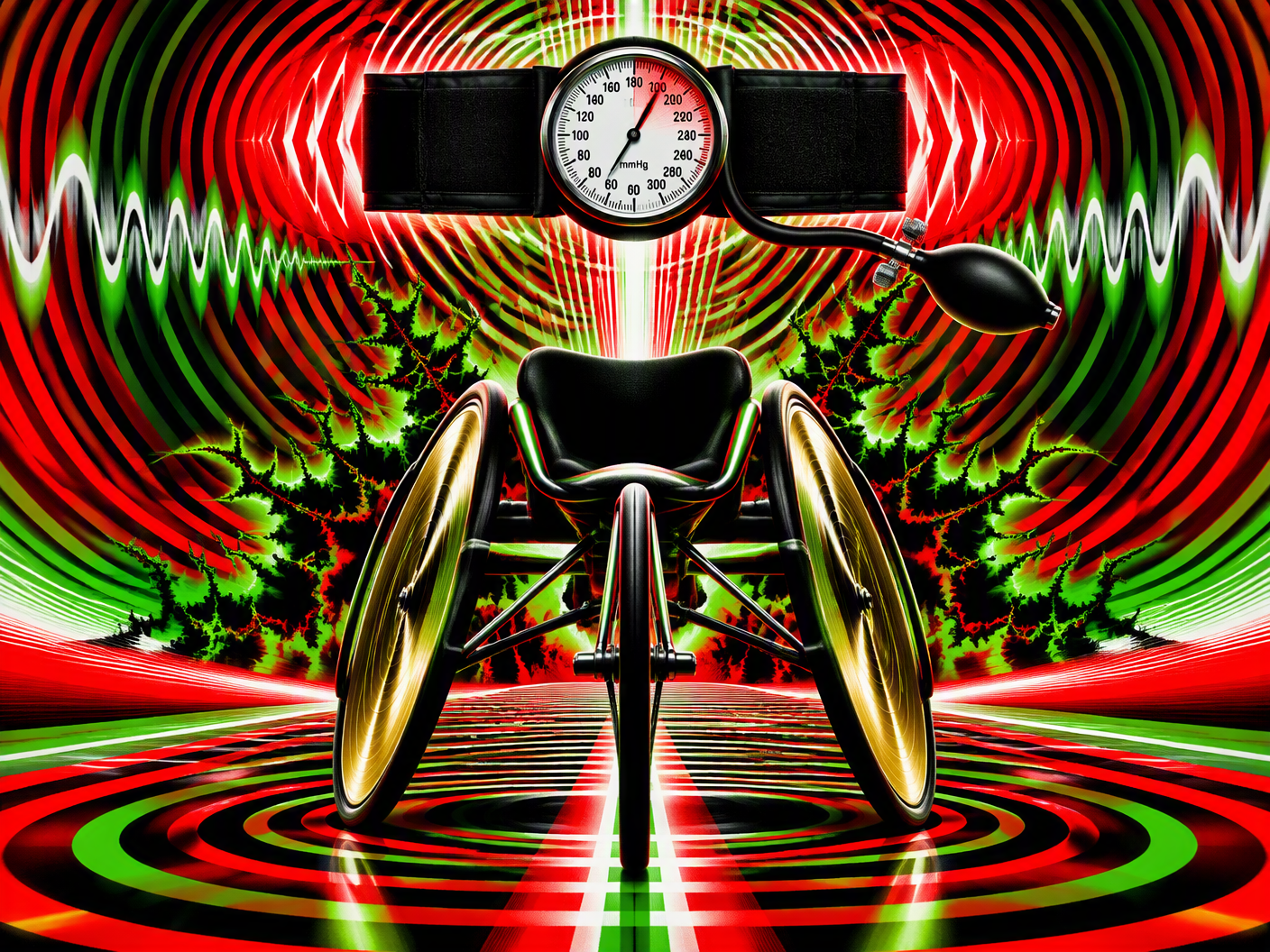
Before the wheelchair racers move, the numbers move first. A cuff tightens around an arm. The machine hums. Beyond the medical station, racing chairs wait beneath hard lights, their frames bright as cold brass, their tires dark against the track. For athletes with spinal cord injuries, the body can become the battleground before the starting gun. Boosting turns that battleground into a weapon. In 1994, the International Paralympic Committee banned the practice. The decision put a line between performance and deliberate physiological danger.
Boosting is not a clever adjustment to a chair or a last-second trick with leather tape. It is an attempt to provoke autonomic dysreflexia, a dangerous rise in blood pressure associated with spinal cord injury. Athletes may use self-harm or other harmful methods to force the response. The purpose is brutally simple: make the body enter a crisis and then race with the gain. The arena rewards fractions. Boosting asks the heart and blood vessels to pay the bill.
The attraction is measurable. Research has found that boosting can improve an athlete's performance by as much as 15 percent. On a track ruled by split seconds, that is not a minor edge. It can change a qualifying place, a medal, a contract, the money that carries an athlete through the next season. The chair still rolls on polished wheels. The crowd still sees control. Underneath, the contest has shifted from trained exertion to a calculated assault on the body's warning system.
That is why the IPC treated boosting as a health problem and an integrity problem at the same time. A dangerous act performed in private can become a competitive advantage in public. The athlete bears the immediate physical risk, while every rival is forced to compete against the possibility that someone has bought speed with injury. The ban in 1994 was an institutional answer to both pressures. It made the practice prohibited, not merely discouraged.
Peter Van de Vliet, the IPC's chief medical officer, has described the need for strict monitoring during events. The medical station became part of the race's machinery. Officials did not have to wait for a chair to cross the line or for a rival to raise a complaint. They could examine the body before competition, when the numbers might reveal what the athlete had tried to conceal. The old sporting ritual—warm-up, tire check, final glance at the clock—acquired another checkpoint.
The checkpoint is blood pressure. Before an event, the IPC can test an athlete's systolic pressure, the top number in the reading. A result over 180 millimeters of mercury can bring disqualification. The figure sits there in black digits, clean and indifferent. It does not know the athlete's ranking or reputation. It does not care how long the chair has been tuned, how much travel came out of pocket, or how many years went into reaching the start line.
The rule carries an ugly contradiction. Screening protects athletes from entering a race in a dangerous state, yet the need for screening exists because the incentive remains powerful. A competitor who can gain up to 15 percent may look at the starting list, the weather, the lane assignments, and the pressure of selection. The choice is made in a body already altered by injury. Boosting offers speed by turning that injury into leverage. The finish line cannot show the price.
At the 2008 Paralympic Games in Beijing, the IPC surveyed athletes about the practice. Sixteen-point-seven percent of respondents admitted they had experimented with boosting. The number landed like a dropped tool in a tiled room. It was large enough to expose the practice as something more than a rumor passed between competitors, yet narrow enough to belong to the people who answered the survey. The finding gave officials a measure of the problem without giving them a complete census.
That distinction matters on the track. A survey can show that athletes have tried boosting. It cannot turn every unopened medical file into a known case or produce an exact count for every racer, every event, every year. The frequency across the entire sport remains difficult to quantify. What the Beijing figure did establish was harder to dismiss: the ban had not erased the practice. It had pushed the practice into the space between ambition, secrecy, and medical control.
The physical risk is not theatrical. Autonomic dysreflexia can bring a severe blood-pressure surge, and athletes may induce it through dangerous methods, including self-harm. The body is being ordered to betray its own alarms for the sake of a faster run. No medal ceremony shows that negotiation. No timing board records the moment an athlete decided the gain was worth the danger. The chair remains elegant. The calculation remains hidden inside muscle, nerve, skin, and fear.
The IPC's response has therefore rested on a simple instrument and a hard threshold. Test the blood pressure. Keep the number under control. Disqualify an athlete whose systolic reading exceeds 180 millimeters of mercury. The procedure cannot reveal every intention, and it cannot measure every attempt that never reaches the medical station. It does create a gate. Before the wheels begin turning, the institution asks the body to prove that it has not been pushed into crisis.
Wheelchair racing is built around precision: gloves, rims, posture, cadence, the thin hiss of tires over pavement. Boosting corrupts that precision by making physiological danger part of the equipment. The 1994 ban named the danger. The Beijing survey showed that prohibition had not killed the incentive. Blood-pressure testing gave officials a practical barrier, while the unanswered question remained spread across the sport: how many athletes had considered the bargain, attempted it, or stopped before anyone saw the numbers?
Investigative Dossier & Evidence
Read the companion investigation notes, verified source claims, and primary documents.
Read the Companion Notes & Evidence Record →