
Violence & Brawls · 1999
The Overtime Loss That Sent the UNH–Maine Rivalry Onto Campus
On April 3, 1999, Maine defeated New Hampshire 3–2 in overtime for the NCAA hockey championship after UNH had beaten Maine twice and won its first outright Hockey East title. The loss was followed by a riot on the UNH campus, where fans overturned cars and launched a flaming snowmobile.
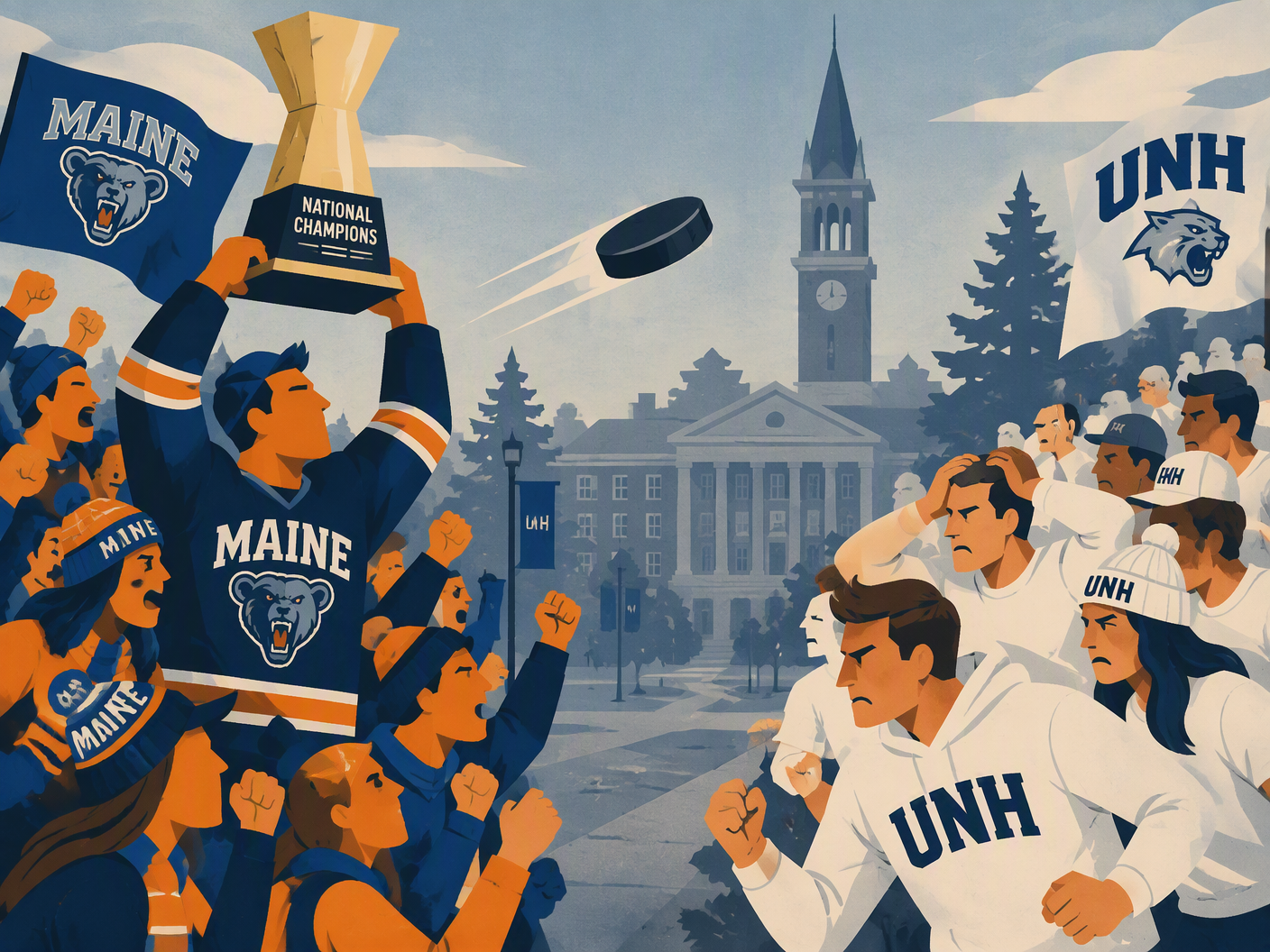
Maine’s championship arrived in overtime, but the game did not contain the night’s consequences. On April 3, 1999, at Arrowhead Pond in Anaheim, California, Maine defeated the University of New Hampshire 3–2 to win the NCAA hockey title. After the final, UNH fans rioted on their campus. They overturned cars, damaged property, and launched a flaming snowmobile into the disorder. The contest ended with a score; the rivalry continued as a public disturbance.
The result contradicted the season UNH had built. Before the championship, New Hampshire had defeated Maine in both regular-season meetings. On March 14, UNH secured its first outright Hockey East Championship, taking the title alone rather than sharing it. Those victories gave the Wildcats a recent claim to control the rivalry. The national final reduced that argument to one night, one opponent, and one goal in overtime.
Maine and New Hampshire had been measuring themselves against each other for decades. Their rivalry reaches back at least to December 15, 1979, and repeated competition kept it active across seasons and generations of players. The schools’ proximity helped turn games into regional events, but the rivalry depended on more than geography. Opposing programs supplied the symbols, and opposing fan bases supplied the participation. Supporters traveled, wore school colors, and treated each meeting as a test of institutional standing.
UNH gave that allegiance a visible uniform through “White out the Whitt,” a tradition the school started to encourage fans to wear white during hockey games against Maine. The custom turned the home stands into a field of collective identification. It was a ritual of support, not a plan for violence. But it showed how the rivalry organized emotion before the puck dropped: spectators did not arrive as isolated customers. They arrived as members of a side.
That identity mattered because the 1999 championship carried two competing stories into the same final. UNH had won the regular-season series and claimed its first outright Hockey East title. Maine still had the tournament’s last game. The earlier victories remained part of the record, but they could not be replayed after the national championship began. Overtime compressed the season’s argument into a single sequence whose winner would own the title and whose loser would carry the unresolved comparison home.
Maine won that final sequence. The 3–2 overtime result gave Maine the national championship and denied UNH the title its season had made plausible. That distinction explains the force of the aftermath without excusing it. A regular-season sweep could establish superiority for months; a championship defeat could still rewrite the public meaning of the rivalry. The tournament did not erase UNH’s achievements. It placed them beneath Maine’s final claim.
Once the game ended, the formal boundaries of competition stopped governing everyone who had invested in it. Officials, penalties, and the clock had controlled the players. The crowd carried the result into a different setting, where the opponent was no longer across the ice and the consequences no longer belonged only to athletes. The rivalry’s symbols—school colors, chants, and shared grievance—moved from a regulated arena into campus space.
On the UNH campus, fans rioted after the loss. The disorder included vandalism, overturned vehicles, and a flaming snowmobile launched during the disturbance. Those acts transferred the cost of a hockey result onto people and property that had no role in deciding the championship. The players had lost a game; bystanders and the campus community confronted damage and danger. The event therefore belonged to sports only at its point of origin. Its consequences became civic and physical.
The riot did not represent every UNH supporter. Most people who wore white did not take part in it, and the tradition itself did not direct anyone toward destruction. Responsibility rested with the fans who committed the reported acts. Yet the crowd culture supplied the setting in which an individual loss could become a group event. “White out the Whitt” made allegiance visible inside the rink; the postgame disorder made the same allegiance visible beyond it, stripped of the game’s controls.
By the end of April 3, Maine possessed the championship that UNH had spent the season positioning itself to win. New Hampshire’s two regular-season victories and first outright Hockey East title remained significant achievements, but neither could alter the overtime result. The rivalry, active since at least 1979, had always joined competition with participation. In 1999, that connection carried the final beyond the ice. Maine took the banner; UNH’s campus absorbed the aftermath.
Investigative Dossier & Evidence
Read the companion investigation notes, verified source claims, and primary documents.
Read the Companion Notes & Evidence Record →