
Violence & Brawls · 2009
The 2009 East Lancashire Derby and the 55 Arrests at Ewood Park
Blackburn Rovers beat Burnley 3-2 in the first top-flight East Lancashire derby since 1966. After the final whistle, violence involving both sets of supporters left 150 seats ripped out, smashed toilet sinks, and 55 people arrested.
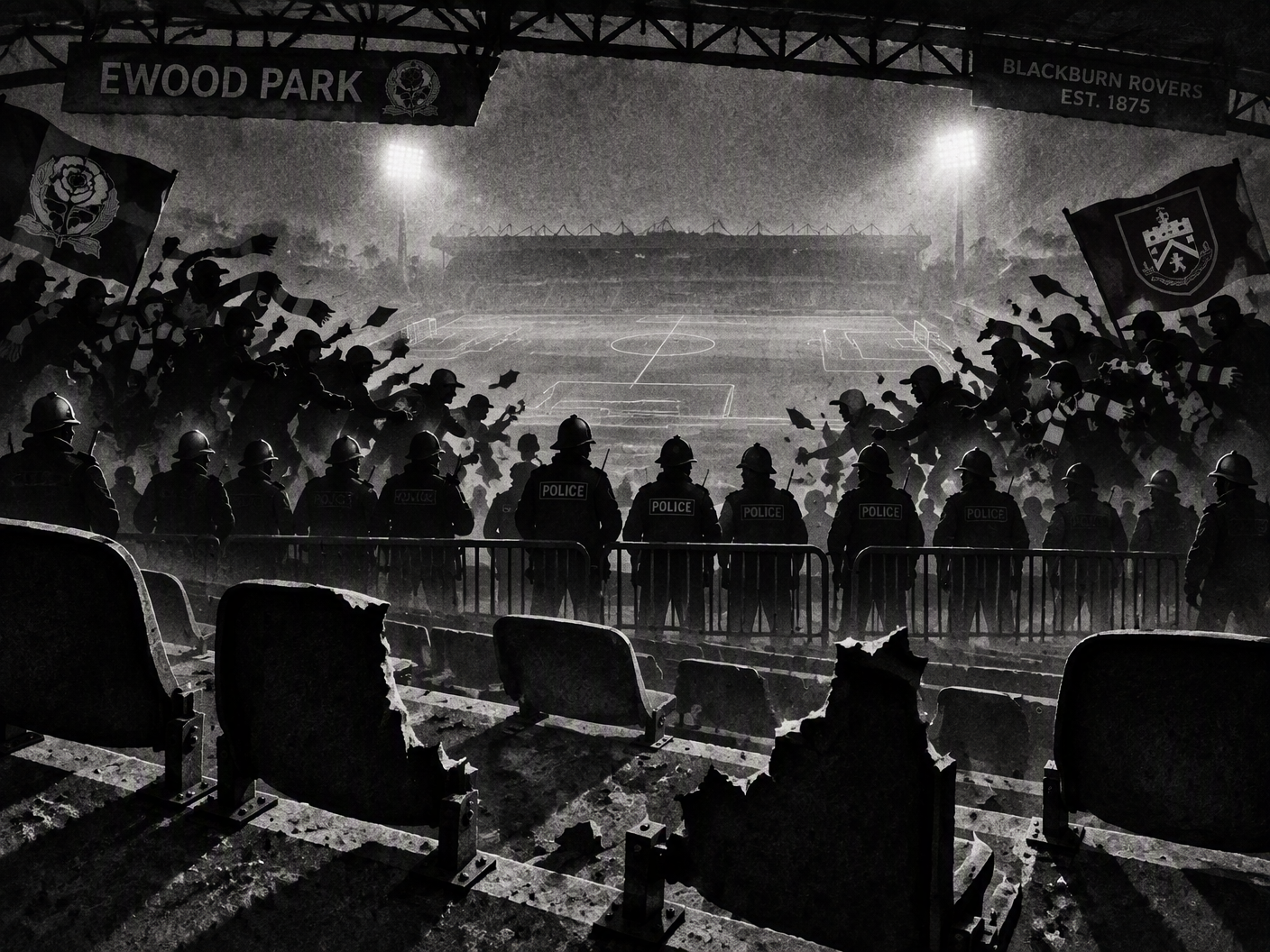
The final whistle went into a stadium already carrying too much voltage. Ewood Park had held the first top-flight East Lancashire derby since 1966, and Blackburn Rovers had beaten Burnley 3-2. Then the football gave way to the old machinery: barriers, boots, broken fixtures, police radios spitting through the cold. Supporters from both clubs turned the ground into a hard corridor of noise and movement. By the time the operation was over, 55 people had been arrested. The score stayed on the board. The damage stayed in the building.
For ninety minutes, Ewood Park had been a pressure vessel with grass at the center. Blackburn and Burnley were separated by geography, history, and the narrow mathematics of league football. The match carried the weight of a fixture that had waited forty-three years to return to the top division. Every tackle fed the room. Every chant crossed the divide. The concrete stands gathered the sound and threw it back. Football supplied the ignition. The crowd supplied the fuel.
Blackburn struck three times. David Dunn scored one of the goals for Rovers, adding his name to a contest that refused to settle cleanly. Burnley answered twice, keeping the match alive until the last exchanges. Blackburn finished ahead, 3-2, but victory in a derby is not a quiet possession. It belongs to the streets, the turnstiles, the packed trains, the pubs with their shutters half-drawn. At Ewood Park, the result moved through the crowd like a lit match passed hand to hand.
Owen Coyle, Burnley's manager, had to speak about the performance after the match while the temperature outside the ground climbed. His job required football language: shape, effort, mistakes, the small mechanics of a defeat. Around him, the larger contest had already escaped those terms. A manager could dissect a 3-2 loss. He could not coach the hands that tore through seats or the fists that broke bathroom fittings. The dressing room dealt in tactics. The concourses dealt in impact.
After the match, 150 seats were ripped from their mountings. They came loose in rows, leaving torn fastenings and bare concrete where the crowd had sat. Toilet sinks were smashed. The fixtures had no tactical value, no bearing on the league table, no place in the old grammar of competition. They were simply objects within reach. A football ground is built to move thousands of people through narrow spaces. Once control breaks, every narrow space becomes a funnel.
The violence involved both fan groups. That was the police position delivered after officers took control of the ground and its approaches. It was not a single flare of disorder pinned to one end of the stadium. The confrontation spread across the boundary between Blackburn and Burnley, with each crowd part of the disturbance. Police required a heavy presence to contain it. More uniforms entered the picture as the football disappeared beneath shouting, damaged property, and the blunt work of arrest.
The number was 55. Arrests turned the derby from a sporting event into a police operation with names, vans, custody rooms, and paperwork waiting under fluorescent light. Each arrest narrowed a chaotic afternoon into an individual encounter with the state. The broken seats remained communal damage. The smashed sinks remained evidence of the crowd's passage. Fifty-five people carried the immediate legal consequence away from Ewood Park, while the clubs were left with a ground to inspect and a rivalry to manage.
The setting mattered. This was Blackburn, not a neutral field scrubbed of local memory. Burnley stood across the East Lancashire divide, close enough for the rivalry to travel by road and rail, old enough to outlive several generations of players. The return to the top flight gave the contest a fresh audience and a larger stage. The football authorities could schedule the fixture. They could not drain it of the neighborhood loyalties that made a 3-2 result feel like property seized from the other side.
The police presence became part of the match's physical architecture. Officers occupied the spaces where supporters might collide, watched the exits, and dealt with the disorder after the whistle. Heavy deployment did not prevent every act of destruction. It gave the response its shape. The derby demanded containment because both groups were involved, and containment is a crude instrument: lines of bodies, raised barriers, commands shouted over diesel engines and the hard scrape of damaged metal.
Blackburn's victory remained official. Dunn's goal remained in the scoreline. Burnley had lost by one. Those facts were clean, fixed, and easy to print. The rest of the night was messier: 150 seats torn out, sinks reduced to broken porcelain and loose plumbing, 55 arrests, and a police operation heavy enough to hold the rival crowds apart. The match had returned to the top flight after four decades. It returned carrying the old arithmetic of belonging, anger, and consequence.
By morning, the stadium would have its inventory. Missing seats. Ruined washrooms. Costs assigned to repairs. The league table would show Blackburn above Burnley in the match itself, a narrow line of numbers preserving the result while the building absorbed the bill. The first top-flight derby between the clubs since 1966 had produced football worth three goals to two. It had also produced 55 arrests. Ewood Park had held the rivalry for an afternoon. It could not make the rivalry behave.
Investigative Dossier & Evidence
Read the companion investigation notes, verified source claims, and primary documents.
Read the Companion Notes & Evidence Record →