
Point Shaving & Fixes · 2012
The Scorecards That Gave Timothy Bradley Manny Pacquiao’s Title
On June 9, 2012, Timothy Bradley received the WBO welterweight title after three judges split over his 12-round fight with Manny Pacquiao. A later WBO video review scored every card for Pacquiao, but the organization could not change the official result.
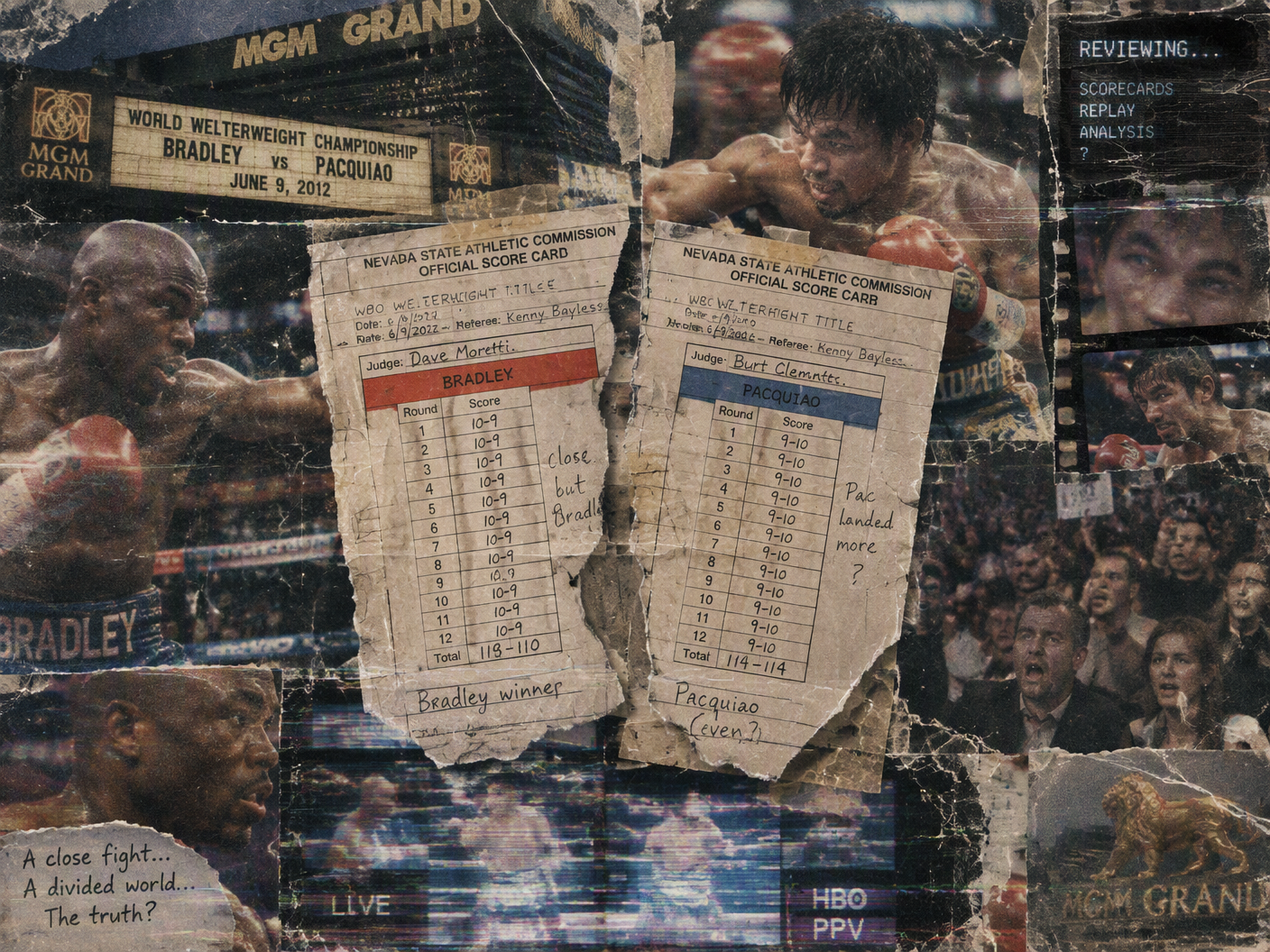
Timothy Bradley left the MGM Grand Garden Arena with the WBO welterweight belt after twelve rounds against Manny Pacquiao. The announcement gave Bradley a split-decision victory, even though the three judges had produced two cards for Bradley and one for Pacquiao. The crowd booed as the result was read. In a sport where a title changes hands through three pieces of paper as much as through punches, the decision turned a night of work into a dispute over who possessed the authority to define what had happened.
The bout had begun as a business arrangement before it became a public argument. On February 6, promoter Bob Arum said negotiations were nearing completion for a June 9 fight at the MGM Grand in Las Vegas. Pacquiao entered as the reigning welterweight champion. Bradley, the WBO junior welterweight champion, was moving up to challenge him. The arrangement connected two labor markets at once: the fighters supplied the physical risk, while the promoter, venue, sanctioning body, and judges supplied the conditions under which that risk would be converted into a title.
By fight night, the question was not simply which boxer had landed more punches. It was which judge's accounting would control the belt. Pacquiao and Bradley fought at the MGM Grand Garden Arena in Paradise, Nevada, over the full twelve rounds. When the totals were announced, Duane Ford scored the contest 115-113 for Bradley. C. J. Ross reached the same score. Jerry Roth scored it 115-113 for Pacquiao. The margin was narrow on every card, but the consequence was absolute: Bradley became champion.
That is the particular power of a scored fight. A boxing match can occupy nearly an hour of physical labor, yet its formal conclusion may be compressed into three numbers from each official. The numbers do not merely describe the action; they determine employment, status, future bargaining power, and the public identity attached to the winner. Bradley's victory gave him the title. Pacquiao, who had entered as champion, left with the official loss. The institutional decision moved the belt even as the people watching it rejected the movement.
The boos came immediately, before the controversy could be softened by distance or organized into competing memories. Ringside observers and media commentators criticized the decision as it was announced. Bob Arum, who had helped bring the matchup toward completion, said afterward that he was worried about boxing's credibility. His concern located the dispute beyond the two fighters. The promoter's business depended on the sport's judgments being accepted as legitimate, while the audience's reaction showed how quickly that acceptance could disappear when the scorecards appeared to contradict what spectators believed they had seen.
Bradley was therefore placed in an awkward position by the same announcement that made him champion. The official result belonged to him, but the public response treated the decision as an institutional failure rather than a settled athletic conclusion. Pacquiao had lost on two of the three cards, yet the third judge had scored the fight for him by the identical 115-113 margin. The structure of the decision left no broad numerical cushion. It produced a winner, but it also preserved a visible disagreement inside the official paperwork.
The World Boxing Organization responded by ordering a video review of the bout. That step acknowledged that the dispute had become a question for the sanctioning body itself, not merely a quarrel between camps or a matter of audience preference. The review panel revisited the rounds and completed five review scorecards. On every one, the panel scored the fight for Pacquiao. The result created a second institutional judgment, one that pointed in the opposite direction from the decision delivered inside the arena.
Yet the review did not return the belt to Pacquiao. The WBO could examine the fight and publish its assessment, but it could not overturn the official Nevada decision. Bradley's split-decision victory remained the formal outcome. This was the boundary between review and authority: five cards could establish a profound disagreement with the original scoring, but they could not erase the announcement that had transferred the title. The organization could add another layer of judgment to the bout; it could not make the first one disappear.
For the fighters, that distinction had practical weight. Bradley remained the man recognized as WBO welterweight champion from the June 9 decision, while Pacquiao remained the boxer whom all five later review cards favored. Their positions were not reconciled by the review. One judgment controlled the title, and another reshaped how the title fight was evaluated. The competing outcomes also exposed the limits of a system that presents scoring as final while retaining procedures capable of declaring, after the fact, that every reviewer saw the contest differently.
The controversy endured because neither side of the institutional record could simply replace the other. The crowd's boos captured the immediate loss of confidence; the official cards fixed Bradley's win; the WBO review placed Pacquiao ahead on all five of its cards. No later review altered the announced result. What remained for Bradley was a championship secured by the Nevada judges and challenged by the organization that governed the belt. What remained for Pacquiao was an official defeat alongside a unanimous internal review in his favor. The title changed hands, but certainty never followed it.
Investigative Dossier & Evidence
Read the companion investigation notes, verified source claims, and primary documents.
Read the Companion Notes & Evidence Record →