
Violence & Brawls · 2017
The Gunfire at the Congressional Baseball Practice
On June 14, 2017, James T. Hodgkinson opened fire on a Republican congressional baseball practice in Alexandria, injuring lawmakers, an aide, and two Capitol Police officers before police shot him. The scene established the attack and its victims; it did not settle the shooter’s motive or the larger political theory attached to it.
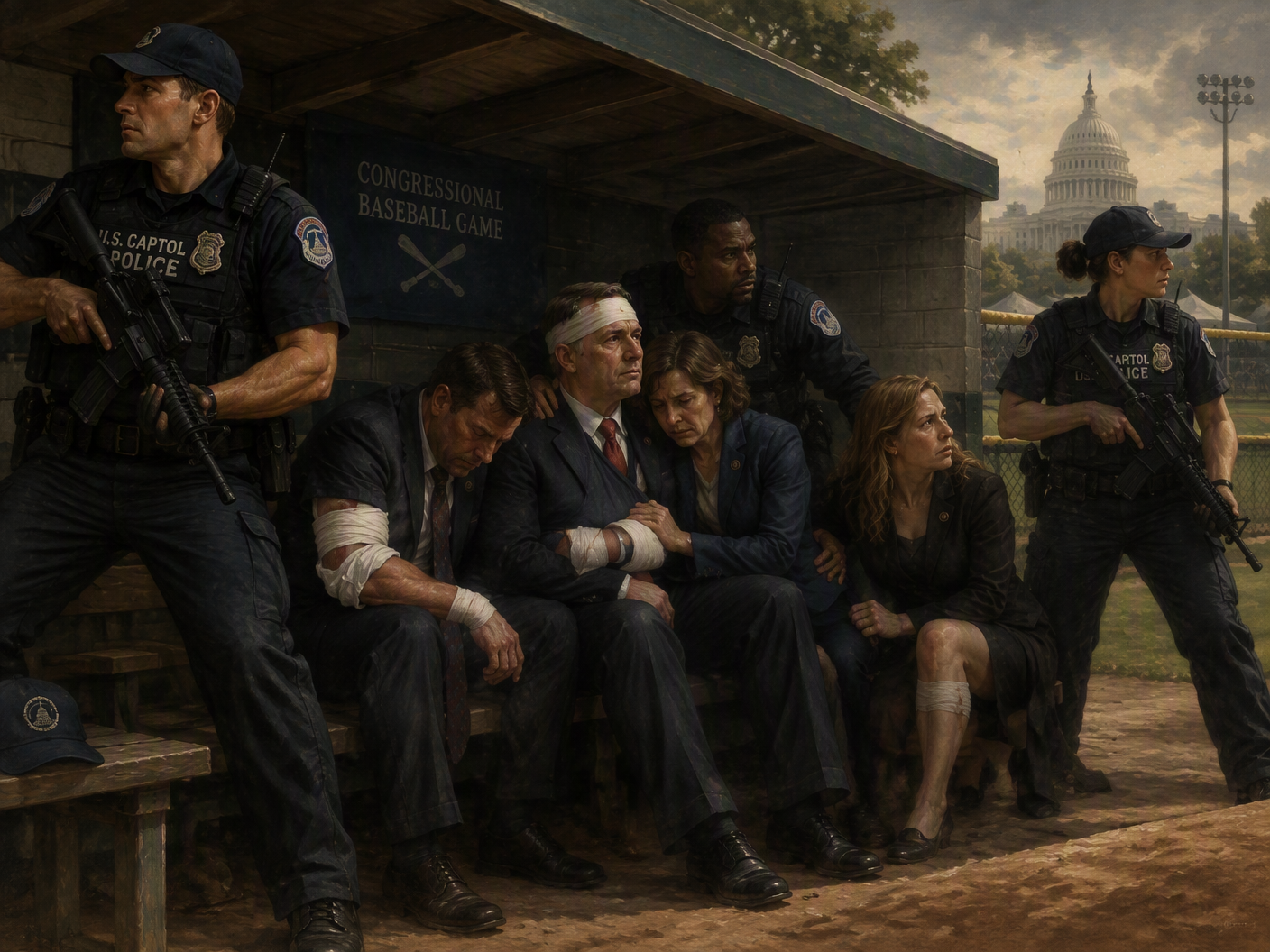
James T. Hodgkinson opened fire from outside the field at Eugene Simpson Stadium Park in Alexandria, Virginia, on the morning of June 14, 2017. Republican members of Congress were practicing for the annual Congressional Baseball Game. The first-base dugout became cover. Men who had arrived with gloves and bats dropped behind its walls while bullets crossed the field. Trent Kelly, a Republican congressman on the diamond, described the team as under attack. The sentence was plain. So was the fact of it: a baseball practice had become a gunfight.
Steve Scalise, the House Republican majority whip, was at the practice. He was shot in the hip. Zack Barth, a congressional aide, was hit in the calf. Matt Mika, a Tyson Foods lobbyist who had come to play, was shot multiple times. The injuries belonged to different men with different jobs, but the distance between them vanished in the dugout. The field offered no protection except whatever cover a body could reach before the next round.
Crystal Griner and David Bailey were assigned to protect Scalise. They engaged the shooter as lawmakers and staff sought cover. The two Capitol Police officers were injured during the exchange, but they kept Hodgkinson occupied while the people behind them moved away from the open field. Other officers—Henry Cabrera, Kevin Jobe, and Alexander Jensen—were part of the response. Their presence changed the shape of the attack. It was no longer a gunman firing into an exposed group. Police were firing back.
Hodgkinson was identified by law enforcement as the shooter. The exchange ended at the scene with his death after a shootout with police. There would be no arrest, arraignment, or trial to supply a courtroom account of his choices. The immediate facts came from the field, the wounded, the officers, and the hospitals that received them. The shooter was dead. The people he had shot were being carried or driven away.
Scalise was taken to MedStar Washington Hospital Center in Washington, D.C. He underwent surgery after the hip wound. The hospital said the bullet fractured bones and injured internal organs. That description fixed the damage beneath the public language of an attack on Congress. A wound that entered at the hip had moved through bone and into the body’s interior. The majority whip was no longer on a baseball field. He was under surgical care.
Mika went to George Washington University Hospital. He had been shot multiple times and underwent surgery there. Barth’s calf wound and the injuries to Griner and Bailey completed the known list of wounded. None of those injuries required a theory to explain them. They were the immediate result of the gunfire at the park. The annual game had been built around a familiar congressional ritual—teams, practice, a contest for charity and visibility. By midday, its participants were patients and witnesses.
The sequence was short. Hodgkinson fired from outside the field. Lawmakers and staff ran or took cover in the first-base dugout. Capitol Police officers assigned to Scalise engaged him, and the exchange ended when police shot him. The response was not an extended siege. It was a rapid collision between an exposed group, a gunman beyond the field, and officers who had been placed near one particular lawmaker because of his public position.
That assignment mattered in the only way that counts during an attack: Griner and Bailey were close enough to return fire. They were not spectators or distant security names added after the fact. They were on the field’s edge, protecting Scalise, and they were injured while engaging Hodgkinson. The distinction between player and protector disappeared under fire. The men and women in the dugout depended on the officers’ decision to confront the rifleman rather than retreat with them.
The wounded carried the rest of the story into Washington. Scalise’s surgery followed a bullet wound that fractured bone and injured internal organs. Mika required surgery after being shot several times. Barth was wounded in the calf. Griner and Bailey were injured while responding. These details gave the incident its human scale without needing a larger slogan. Congress had sent its members to a ballpark. Hodgkinson left five injured people behind, including two officers who had moved toward him.
Hodgkinson’s identity became part of the established account. His political posts and prior record entered the public argument, and people tried to use them to explain the attack. But the shooting itself settled fewer questions than the first hours demanded. It established who fired, where he fired, who was wounded, and how police stopped him. It did not produce a definitive motive at the scene. His death closed the gunman’s side of the event before investigators or prosecutors could test it in court.
The same limit applied to the language of political assassination. Hodgkinson attacked a Republican congressional practice, and the men on the field were under attack because they were there. That fact carried political weight without proving every theory built around it. No broader ideology, conspiracy, or legally settled explanation followed from the gunfire alone. The reliable account remained narrower and harder: a man opened fire at a public practice, injured five people, fought the police, and died at the park.
By the end of June 14, the park had lost its ordinary purpose. Scalise was in surgery at MedStar Washington Hospital Center. Mika was in surgery at George Washington University Hospital. Barth was wounded. Griner and Bailey were injured. Hodgkinson was dead after the police shootout. The baseball game was still the reason the men had gathered, but the game no longer governed the day. The field had become the place where an aide’s calf, a lawmaker’s hip, and two officers’ bodies entered the public record.
Investigative Dossier & Evidence
Read the companion investigation notes, verified source claims, and primary documents.
Read the Companion Notes & Evidence Record →