
Violence & Brawls · 2000s
The 268 Penalty Minutes Behind Boston University–Maine’s Record Brawl
Boston University defeated Maine 1–0 on January 24, 2004, but the game became known for what followed the final horn. A post-game brawl produced 268 penalty minutes, turning a familiar college hockey rivalry into a test of discipline, institutional control, and player safety.
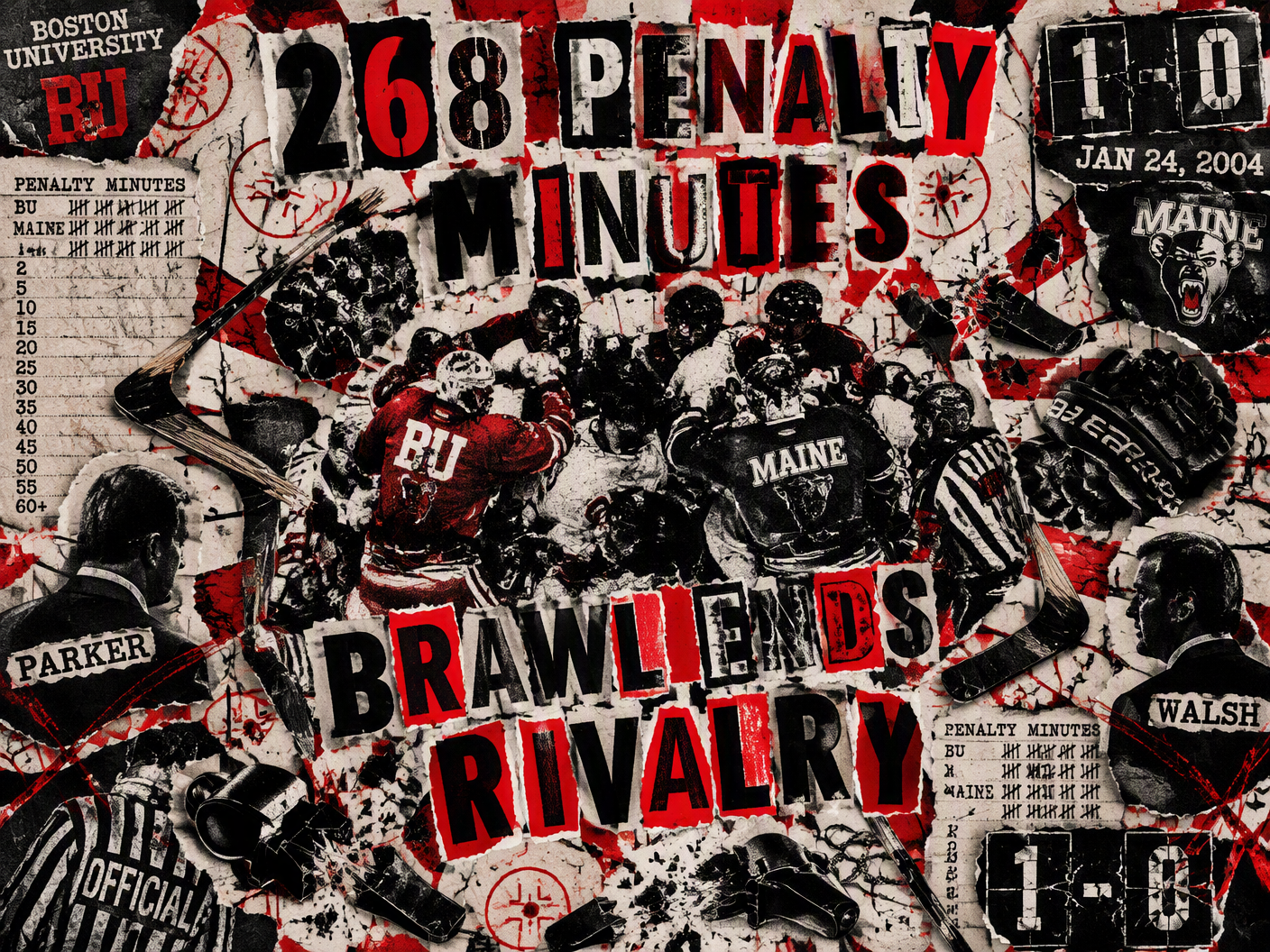
The scoreboard recorded a Boston University victory, 1–0. The official arithmetic of the game, however, did not end with the goal or the final horn. At the close of the January 24, 2004 meeting, players from Boston University and Maine became involved in a brawl. Most of the night’s penalty minutes came from that confrontation, transforming a one-goal result into the record for the most penalty minutes in a single men’s college hockey game.
The setting mattered. Boston University and Maine were not casual opponents passing through a schedule. Their men’s hockey rivalry had accumulated its own history, with each meeting carrying the pressure of an established contest between programs that understood the stakes beyond one night. That history does not identify a single cause for the brawl, and it does not assign uniform responsibility to every player. It does explain why the confrontation became a defining episode in the relationship between the teams.
The game itself remained close. Boston University won by one goal, 1–0, a score that left no room for a comfortable interpretation of the contest. The result belonged to the Terriers; Maine absorbed the loss. Yet the narrow margin soon became secondary to the events surrounding the ending. The score established the competitive outcome, while the brawl supplied the incident that endured in accounts of the rivalry.
At the end of the game, the teams’ separation broke down. A brawl involving players from both sides followed the conclusion, and the ordinary categories of hockey—lines, positions, possession, and the limits imposed by the whistle—gave way to a collective confrontation. The available public descriptions establish the timing and scale of the incident, but not a complete individual-by-individual sequence of actions. That distinction matters: the event can be documented without inventing motives or assigning unverified blame.
The penalty total was 268 minutes. That number set the record for the most penalty minutes in a single men’s college hockey game. It was not a statistic produced by an isolated infraction or a rough shift. The majority of the minutes accumulated because of the end-of-game brawl, making the record a measure of how extensively the contest had departed from controlled competition.
Penalty minutes are an administrative language for disorder. They convert conduct on the ice into suspensions, exclusions, statistical entries, and institutional decisions. In this case, the conversion produced a figure that could be carried into record books long after the ice was cleared. The number did not explain what each player intended, nor did it settle every question of responsibility. It established something narrower and more durable: the scale of the official response to the confrontation.
The brawl also altered the public meaning of the result. Boston University still had the win, and Maine still had the loss, but neither fact could absorb the incident that followed. The game’s most persistent image became the confrontation rather than the goal that separated the teams. In a rivalry already defined by tension and physicality, the ending became a symbol of how competitive intensity can overwhelm the structures meant to contain it.
The aftermath moved the discussion beyond the record book. Questions arose about disciplinary action and the safety of college hockey environments. Those discussions involved the teams and their institutions, with sportsmanship and player safety becoming part of the response to what had occurred. The surviving public material does not provide a complete account of every administrative decision, but it places the incident within a broader concern: how college programs should respond when a rivalry produces conduct that continues after competition has formally ended.
That institutional question is central because the brawl was not simply an unsanctioned extension of ordinary play. It occurred after the game, when the formal contest had already produced a winner. Officials and administrators were left to restore boundaries that the players had crossed collectively. Discipline was therefore not only about assigning penalties. It was also about defining the limits of acceptable conduct in a sport that permits force within rules and depends on institutions to distinguish competition from violence.
The confrontation marked a significant moment in the Boston University–Maine rivalry because it gave physical form to the competition’s accumulated intensity. That symbolism should not be mistaken for a complete explanation. No public account supplied here establishes a single instigator, a unified motive, or identical conduct by every participant. What can be stated plainly is the sequence: Boston University won 1–0; a brawl followed; the penalties reached 268 minutes; and the incident prompted discussion of discipline and safety.
The record that lasted was not the final score alone but the collision between the score and what followed it. Boston University’s victory remained official. The penalty total became historic. The brawl became part of the rivalry’s identity, while the questions about discipline and player safety extended beyond the two teams. On January 24, 2004, the game demonstrated how quickly a controlled contest can become an institutional problem once the whistle no longer commands the conduct it was meant to govern.
Investigative Dossier & Evidence
Read the companion investigation notes, verified source claims, and primary documents.
Read the Companion Notes & Evidence Record →