
Tragedy · 1980s
The Terminal Tower Softballs That Turned Ted Stepien’s Promotion into a Street-Level Hazard
In 1980, Cleveland Cavaliers owner Ted Stepien promoted his professional softball team by dropping softballs from Terminal Tower’s 52nd floor for players to catch below. One ball was caught; others damaged cars and injured several spectators.
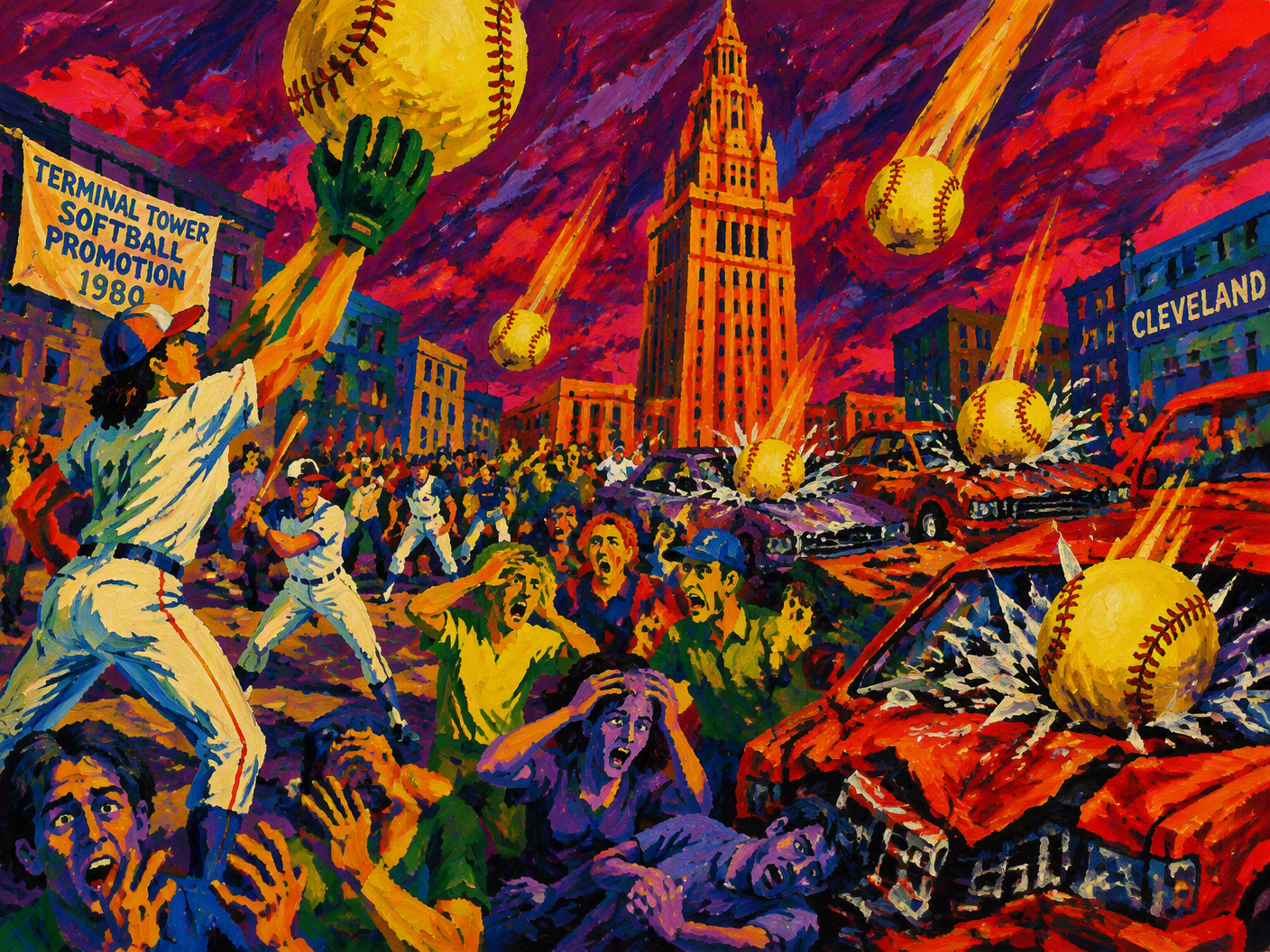
In 1980, Ted Stepien turned Terminal Tower into the launch point for a Cleveland softball promotion. From the building’s 52nd floor, softballs were released toward the street below, where outfielders from his Cleveland Competitors were supposed to catch them. The event had been designed as a public display of athletic skill and distance. By the time the balls reached the ground, they had become objects traveling at an estimated 144 miles per hour. One was caught. The others reached a street shared by spectators, parked cars, and ordinary city traffic.
Stepien had entered Cleveland’s men’s professional softball business two years earlier. For the 1978 season of the American Professional Slo-Pitch Softball League, he bought the Cleveland Jaybirds franchise. The purchase gave him a team, a league platform, and a sporting property that could carry his name beyond the basketball operation for which he was already known. The softball club was not an anonymous traveling act. It was a Cleveland franchise under the ownership of a man who treated promotion as part of the product.
In 1979, the Jaybirds became the Cleveland Stepien’s Competitors. The new name made the owner’s identity part of the club’s public face. A conventional team name could belong to a city or an institution; this one attached the franchise directly to its proprietor. By the following year, the team’s promotional event at Terminal Tower carried the same personal imprint. The ballplayers were not merely performing a stunt for a league. They were performing within a brand built around Stepien’s name and his appetite for attention.
Terminal Tower supplied the vertical scale. The balls were dropped from the 52nd floor, high above the intended receiving area. At street level, Cleveland Competitors outfielders were positioned as the designated catchers. The arrangement depended on a narrow idea of control: a ball released from a fixed point would descend toward trained players waiting below. It left less room for the conditions that exist wherever a public exhibition meets a city street—movement, obstructions, vehicles, and people who were not participants.
The fall changed the nature of the object. A softball made for a controlled athletic contest became a hard projectile gathering speed over the height of the tower. Its estimated street-level velocity was 144 miles per hour. That figure gave the promotion a physical consequence independent of the players’ intentions or the event’s publicity value. Catching the ball required one precise meeting between an outfielder’s glove and a descending object. Everything outside that meeting remained exposed to the same fall.
The intended result occurred once: one softball was caught. The other descents did not end in gloves. They struck the public environment around Terminal Tower, damaging cars and injuring several spectators. The event therefore produced two different outcomes at the same street corner. For the players, there was a successful catch that could be displayed as proof of the stunt’s premise. For people and property below, there were impacts that the performance had not contained.
The injuries were not incidental to a game already in progress. The spectators had been placed near a promotion whose central action occurred overhead, and the falling balls did not distinguish between a player waiting for a catch and a person standing outside the playing formation. Cars likewise became part of the exposure. Their presence converted the stunt from a contest of coordination into an uncontrolled interaction with the surrounding street. The reported damage and injuries marked the point at which publicity entered the lives of people who had no role in completing the play.
Stepien’s ownership connected each stage of the episode. He had acquired the Jaybirds in 1978, renamed them the Stepien’s Competitors the next year, and then held the Terminal Tower event under that Cleveland softball identity in 1980. The sequence was brief, but it was not detached from the club’s development. Franchise purchase, personal branding, and public promotion formed a single line of action. The name on the team and the decision behind the stunt belonged to the same owner.
The episode has sometimes been reduced to its absurd image: softballs falling from a landmark while players waited below. The more consequential fact is less theatrical. The promotion placed a high-speed object into a public space and relied on a successful catch to make the danger disappear. One outfielder did make the catch. That success could not cancel the balls that missed, the cars they struck, or the spectators who were injured when the arrangement failed at ground level.
The documented event supports the existence of the promotion and the harm that followed it: cars were damaged, several spectators were injured, and one ball reached a player’s glove. It does not supply a precise injury count, medical diagnoses, or a total for the vehicle damage. Nor does it establish that the stunt was intended to hurt spectators. What remains is a narrower and more durable account: in Cleveland in 1980, a professional softball promotion sent balls from the 52nd floor of Terminal Tower into the public realm, where the distinction between spectacle and hazard disappeared on impact.
Investigative Dossier & Evidence
Read the companion investigation notes, verified source claims, and primary documents.
Read the Companion Notes & Evidence Record →