
Doping & Drugs · 1980s
Nikolay Gulyayev’s Calgary Gold and the 700 Dianabol Capsules
Nikolay Gulyayev arrived at the 1988 Calgary Olympics as a proven World Cup winner, set an Olympic record in the 1,000 metres, and took Soviet gold. During the same Olympic period, a reported attempt to smuggle 700 capsules of Dianabol placed his victory beside an allegation that never became a documented conviction or formal Olympic sanction.
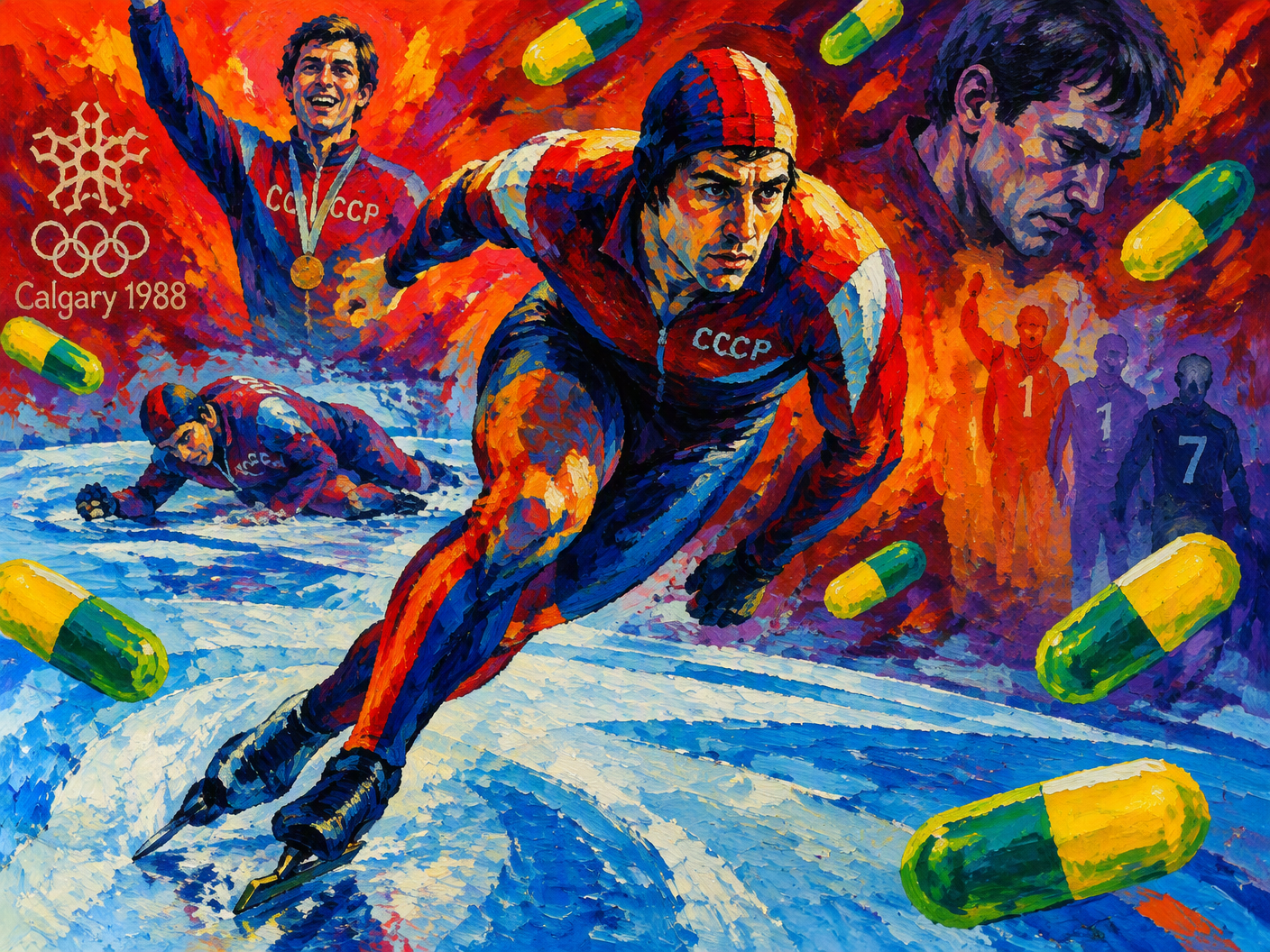
In February 1988, at the Winter Olympics in Calgary, Nikolay Gulyayev won the men’s 1,000 metres in 1 minute 13.03 seconds. The time set an Olympic record, and the Soviet speed skater left the ice with the medal that defined his Games. Yet the Calgary competition carried another fact into the same narrow historical frame: Gulyayev was reported to have been caught trying to smuggle 700 capsules of Dianabol, an anabolic steroid. His Olympic performance and the steroid allegation would remain joined in public memory, though they followed different paths through the institutions of sport and law.
Gulyayev had arrived with evidence of form rather than reputation alone. One month before the Olympics began, he won both relevant distances at the World Cup meeting in Inzell. Those victories established him as a serious contender in the events that would soon be contested in Calgary, where fractions of a second separated medals and ordinary finishes. The Soviet delegation brought a skater already capable of winning at the highest international level. His preparation did not begin with the Olympic starting gun; it had been measured in competition before the teams reached Alberta.
The Calgary program did not proceed cleanly for him. In the 500 metres, Gulyayev fell and did not finish. The result removed one distance from his Olympic campaign, but it did not remove him from the Games. He returned for the 1,000 metres, the event in which his speed and preparation had the clearest opportunity to converge. There, the earlier failure became part of the sequence rather than its conclusion: the same skater who had been unable to complete the shorter race produced the Olympic record in the next one.
Gulyayev’s winning time, 1:13.03, gave the race a precise historical boundary. He was not simply listed as the champion after the results were calculated; he won by setting the Olympic mark for the distance. The number fixed the achievement to Calgary and made the medal legible beyond the ceremony itself. In speed skating, a record compresses an entire contest into a figure: the course, the skater, and the limits reached on that day. For Gulyayev, the figure became the cleanest statement of what he had done on the ice.
The other Olympic distances supplied a less orderly portrait. After the 500-metre fall and the 1,000-metre victory, Gulyayev finished seventh in the 1,500 metres. His Calgary results therefore contained three separate outcomes: an incomplete race, a gold medal and Olympic record, and a seventh-place finish. The sequence resisted the simple shape later retellings often impose on champions. He was neither an undefeated figure nor a single-race accident. He was a competitor whose Olympic record included physical failure, exceptional success, and an ordinary placement in the space of several days.
During that same period, the Dianabol allegation entered the story. Gulyayev was reported to have been caught trying to smuggle 700 capsules of the drug. Dianabol was an anabolic steroid, and the quantity gave the allegation a scale that made it relevant to more than a private possession dispute. It placed a substance associated with performance enhancement beside an Olympic result achieved under international scrutiny. The reported incident did not occur in a separate sporting life belonging to another season; it was attached to the weeks in which Gulyayev was competing for the Soviet Union in Calgary.
The distinction between a reported smuggling attempt and a proven doping violation shaped what happened next. Gulyayev had never tested positive for steroid use. Without that positive test, the International Olympic Committee could not refuse him participation in the 1988 Winter Olympics. He remained eligible to compete, took the start in Calgary, and won the 1,000 metres. The Olympic system acted through the evidence available to it: the allegation occupied public space, while the test result determined whether participation could be denied.
That arrangement left two different forms of knowledge side by side. The public could hold the smuggling allegation and the Olympic result in the same account, while the competition authorities held to the absence of a positive steroid test. Gulyayev’s eligibility was not an abstract question; it had a direct consequence on the Calgary ice. He competed because no positive test barred him, then produced the fastest 1,000-metre Olympic performance to that point. The medal therefore survived the immediate institutional test even as the allegation continued to alter how the performance was discussed.
His later seventh place in the 1,500 metres did not erase the gold, just as the fall in the 500 metres did not prevent it. The complete Olympic sequence remained uneven: Gulyayev failed to finish one race, established the event record in another, and ended the longer distance seventh. The reported Dianabol incident added a second kind of complication, one involving the boundary between possession, testing, eligibility and judgment. In Calgary, those questions were not resolved by a single ceremony or a single result. They traveled with the athlete beyond the medal presentation.
The enduring public file is consequently divided but not symmetrical. Gulyayev’s victory in the men’s 1,000 metres is an Olympic result, fixed by a recorded time of 1:13.03 and accompanied by a gold medal. The 700 Dianabol capsules belong to the history as a reported smuggling incident, carrying serious implications because Dianabol was an anabolic steroid. His fall, his seventh-place finish and his Inzell victories supply the surrounding chronology. The Calgary medal remains the established sporting outcome; the allegation remains the unresolved charge that followed it into later retellings.
Investigative Dossier & Evidence
Read the companion investigation notes, verified source claims, and primary documents.
Read the Companion Notes & Evidence Record →