
Violence & Brawls · 2000s
Green Street Hooligans and the Fictional Violence Attached to a Real London Street
Green Street Hooligans turned football hooliganism into a 2005 crime drama built around petrol bombs, rival firms, and a fatal beating. Its release also produced a dispute in Newham, where local officials, residents, and traders rejected the film’s portrayal of Green Street as a living center of violence.
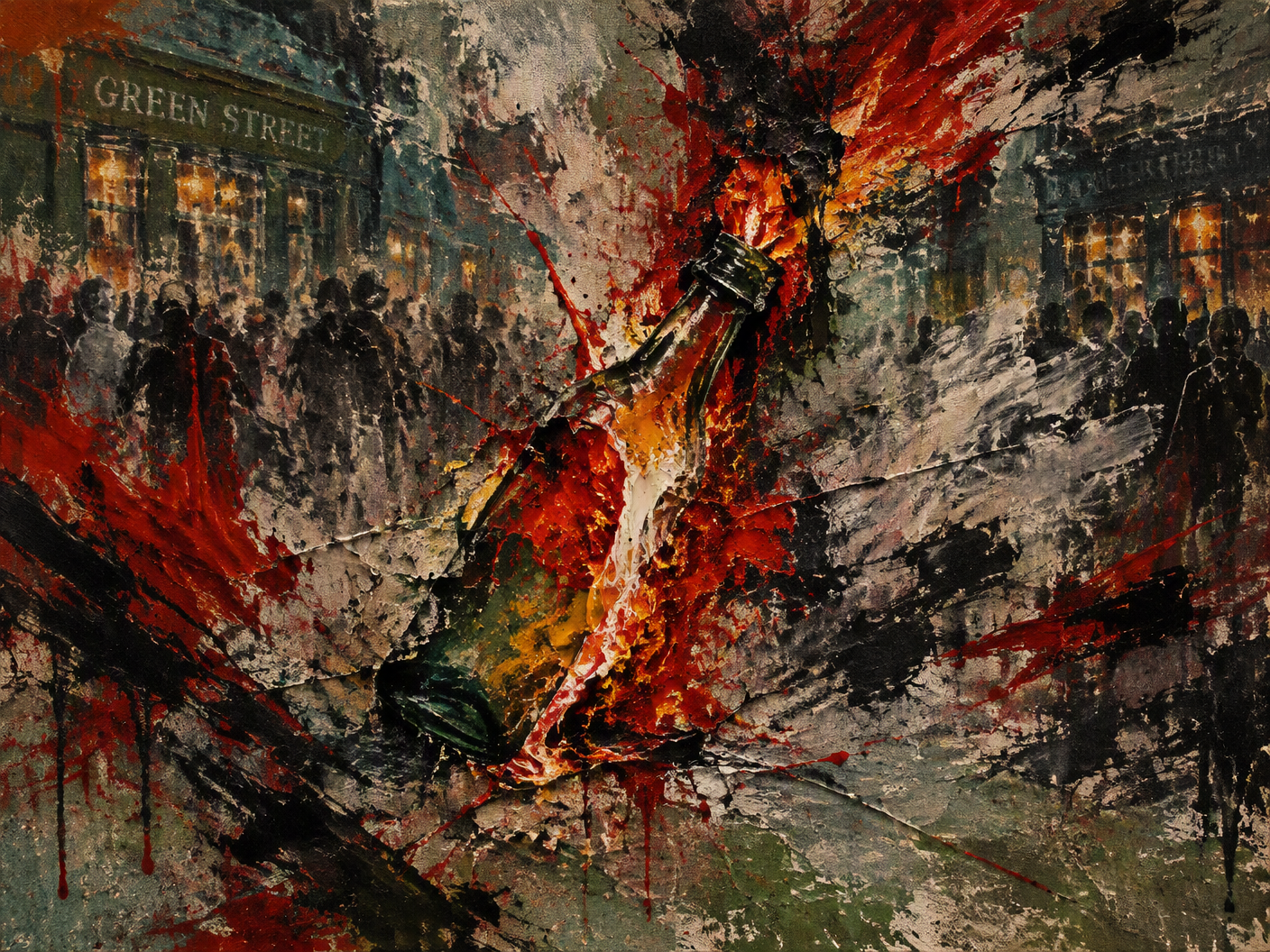
In Green Street Hooligans, rival football firms petrol-bomb the Abbey, a pub at the center of the film’s violence. The attack drives the story toward its final killing: Pete Dunham, the fictional leader of a West Ham firm, is beaten to death by Tommy Hatcher, the fictional head of a rival group. Those events are constructed for the screen. They supplied the film with its central threat, but they did not document an actual attack on Green Street in Newham.
The film was a 2005 crime drama about football hooliganism in the United Kingdom. Lexi Alexander directed it and received screenplay and story credit, placing her at the center of the film’s construction. Elijah Wood played Matt Buckner, the American student drawn into the firm, while Charlie Hunnam played Pete Dunham. Claire Forlani also appeared in the leading cast. The production used recognizable football culture as its setting, then organized that culture around invented characters and escalating violence.
The business decision that carried the film into release came in July. On July 11, Odd Lot Entertainment acquired Hooligans and announced that it would distribute the picture under the title Green Street Hooligans. Gigi Pritzker and Deborah Del Prete were identified in the distribution chain, while Alexander remained attached to the film. The retitling connected the fictional story to a specific east London address before audiences had seen the completed release.
That address was not an invented neighborhood. Green Street runs through Newham, an area associated with West Ham United and its supporters. By placing the film’s firms, pubs, and confrontations there, the production gave its fictional violence a precise geographic label. The choice made the title legible to viewers who knew the club’s culture, but it also transferred the film’s imagined conduct onto residents and businesses that had no role in the story.
The dispute became public on August 26, before the United Kingdom release. Sir Robin Wales, the mayor of Newham, criticized the film for labeling a real east London street as a violent place. His objection concerned the setting itself: a commercial and residential street was being used as the name and visual shorthand for organized football violence. The criticism moved the argument beyond film content and into the question of who had authority to define a neighborhood’s public identity.
Residents and traders gave the objection a narrower, more concrete meaning. Violence associated with West Ham supporters, they said, belonged to the past rather than the present. Their position directly challenged the film’s implied geography, in which Green Street functioned as an active territory of rival firms and reprisals. The conflict was therefore not a claim that football hooliganism had never existed. It was a rejection of the suggestion that the street remained accurately represented by the film’s present-tense violence.
The film reached United Kingdom cinemas on September 9, 2005. Its content classification made the intended register explicit: an R rating for brutal violence, pervasive language, and some drug use. The rating did not treat the violence as incidental background. It identified the elements that shaped the film’s commercial presentation and warned audiences that the story depended on physical brutality, coarse language, and drug use as part of its depiction of hooligan culture.
Within the plot, Matt Buckner’s entry into Pete Dunham’s firm provides the route through which the audience encounters that culture. Pete is not a historical figure recovered from a police file or a supporters’ archive. He is a fictional leader whose authority organizes the film’s rivalries, and whose death gives the story its final cost. Tommy Hatcher’s role is equally constructed: he participates in the Abbey attack and kills Pete during the film’s concluding violence.
That distinction controls what the film can establish about real-world hooliganism. The Abbey petrol-bombing is a plot event. Pete Dunham’s killing is a plot event. Their force comes from the actors, editing, dialogue, and classification that presented the incidents as brutal criminal violence, not from proof that they occurred on Green Street. The film dramatized a social history of football conflict while attaching its most consequential acts to invented people and circumstances.
The release also exposed the economic exchange beneath the controversy. The film earned $4.333 million worldwide, giving the fictionalized violence a measurable commercial life beyond the street named in its title. Odd Lot’s acquisition had converted the original project into a marketable release, while the R rating defined its public presentation. Newham’s officials, residents, and traders absorbed the reputational burden of that marketable premise without controlling the story or its distribution.
Green Street Hooligans therefore occupied two places at once. On screen, Green Street became the headquarters of a violent football firm, with a petrol-bombed pub and a dead leader marking the film’s narrative limits. Outside the film, it remained a real Newham street whose representatives disputed that description and located the relevant violence in the past. The 2005 release did not resolve the conflict. It fixed the fictional version in the title and left the neighborhood to answer for an identity it had not chosen.
Investigative Dossier & Evidence
Read the companion investigation notes, verified source claims, and primary documents.
Read the Companion Notes & Evidence Record →