
Violence & Brawls · 1970s
The Spectrum Brawl That Put Four Blues Personnel in Custody
A January 6, 1972 game between the St. Louis Blues and Philadelphia Flyers ended with a fight involving players, fans, and police, followed by the arrests of coach Al Arbour and three Blues players. The charges—disorderly conduct and assault and battery on police officers—were later dropped.
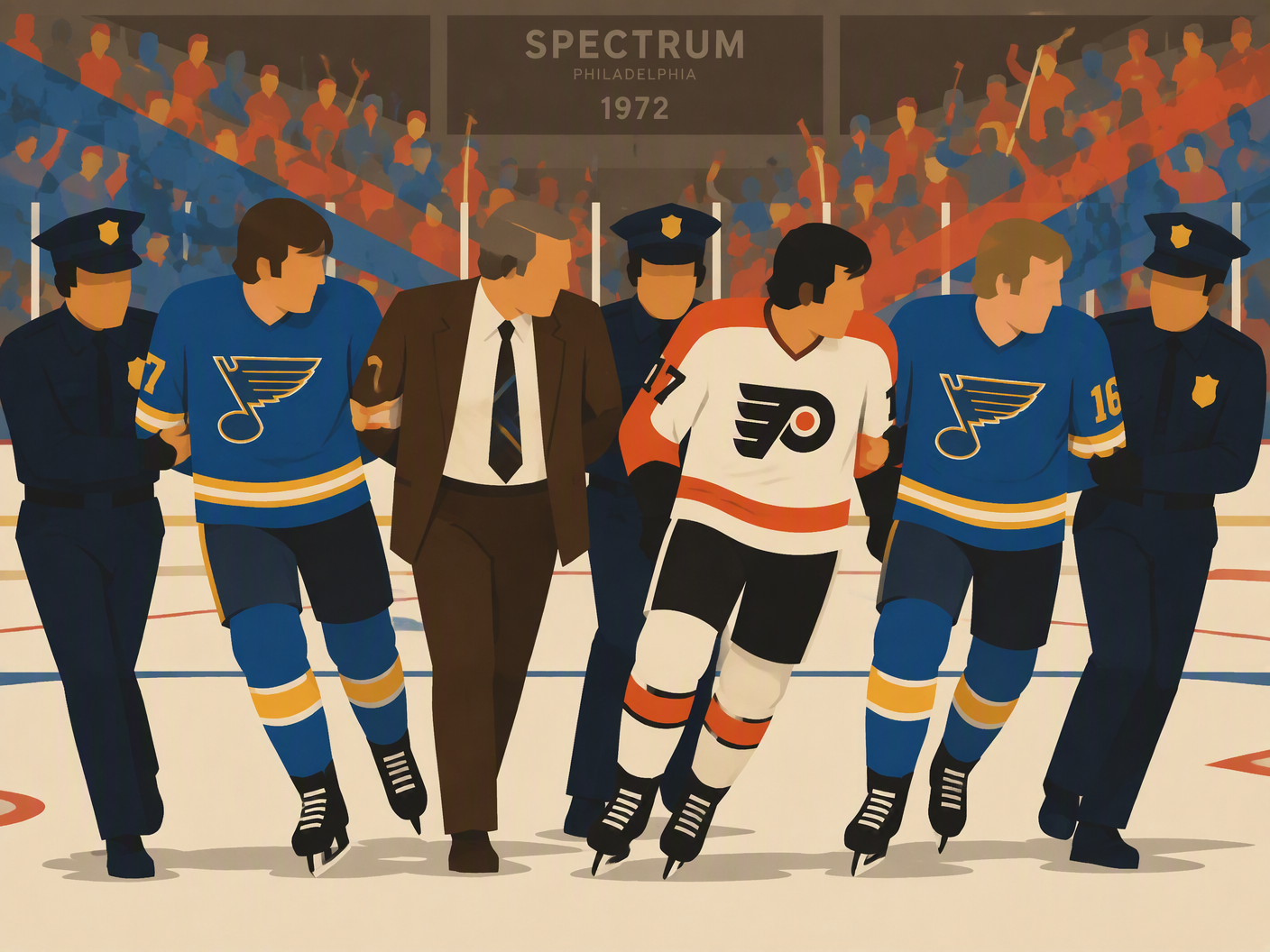
The fight began at the Spectrum and did not stay on the ice. On January 6, 1972, the St. Louis Blues played the Philadelphia Flyers in Philadelphia. By the end of the night, players, fans, and police were involved in a broad confrontation, and four members of the Blues organization were in custody. The men were coach Al Arbour and players John Arbour, Phil Roberto, and Floyd Thomson. The hockey game became a police matter before the building had finished with them.
Philadelphia police answered the disturbance and took control of the aftermath. The arrests came after the game, when the conflict had moved beyond the ordinary violence of professional hockey and into the hands of municipal law enforcement. Arbour, John Arbour, Roberto, and Thomson were processed by police, fingerprinted, and interrogated before they were arraigned. The old rink had produced its usual collisions. This time, the uniforms waiting afterward belonged to the city.
The charges were disorderly conduct and assault and battery on police officers. Those words carried the night away from the rink and into the precinct, where the players and their coach had to answer for conduct alleged to have crossed the line into violence against law enforcement. A conspiracy allegation also entered the early proceedings and was removed before the hearing stage. The public story narrowed quickly: a fight, four arrests, and a criminal case attached to the names of the Blues personnel.
Al Arbour occupied a particular position in the episode. He was not one of the players sent onto the ice to absorb or deliver punishment; he was the St. Louis coach, responsible for the club as it entered the postgame disorder. Police arrested him alongside John Arbour, Phil Roberto, and Floyd Thomson. The coach and the players went through the same hard administrative sequence—custody, fingerprints, questioning, arraignment—while the hockey organization moved from competition to legal exposure.
The event involved more than the two teams. Fans became part of the brawl, and police entered the confrontation. That combination gave the night its particular shape. A fight between athletes can be contained by penalties, suspensions, and the authority of officials. Once spectators and officers were drawn in, the consequences changed. The Blues personnel were no longer dealing only with an opposing bench or a league office. They were dealing with arrests made by Philadelphia police after a disturbance at the Spectrum.
The immediate legal process was plain. The four men were arrested after the game, charged, and later arraigned. Their names remained attached to the allegations while the criminal matter moved through Philadelphia. The case did not produce a conviction or a sentence. The charges against Arbour, John Arbour, Roberto, and Thomson were eventually dropped. The arrest survived as the fixed point of the story; the prosecution did not.
Arbour continued in hockey. He coached the St. Louis Blues for parts of three seasons before joining the New York Islanders, where his career took a different course. From 1980 through 1983, he coached the Islanders to four consecutive Stanley Cup titles. The coach arrested in Philadelphia became the man behind one of the most successful runs in the sport, and the later victories gave his name a larger public life than the night at the Spectrum ever could.
That later success did not rewrite the arrests. It simply placed them in the long career of a man who went on to win four straight championships. The Philadelphia case remained a closed legal episode, a piece of baggage carried quietly behind the trophies and the coaching records. The charges were dropped in 1972. No courtroom finding of guilt followed them into Arbour's years with the Islanders.
Late in life, Arbour lived far from the Spectrum. He was being treated for dementia and Parkinson's disease at a retirement home in Florida. The details belonged to another period and another kind of physical cost, but they returned his story to the body: the coach who had spent decades in hockey's hard rooms, who had stood behind benches and championship teams, now receiving care in retirement. The arrest in Philadelphia and the illness in Florida were separated by years, but both remained part of the public account of him.
The Blues-Flyers game left no proven conspiracy behind it, and the dropped charges left no conviction. What remained was more concrete and less complete: a January night at the Spectrum, a fight involving players, fans, and police, four Blues personnel taken into custody, and charges that later disappeared from the criminal calendar. Arbour's later championships changed the weight of his name. They did not change what happened after the game, when the coach and three players were fingerprinted, questioned, and led into the Philadelphia night as defendants.
Investigative Dossier & Evidence
Read the companion investigation notes, verified source claims, and primary documents.
Read the Companion Notes & Evidence Record →