
Violence & Brawls · 1925
The Barracas Brawl: How a 1925 Copa América Final Became an Eleven-Year Rupture
A foul on Brazilian forward Arthur Friedenreich drew Ramón Muttis into an altercation that exploded into a mass brawl, temporarily stopping the 1925 Copa América final. The match resumed at 2-2, a result that awarded Argentina its second title and kept the two national teams apart for 11 years.
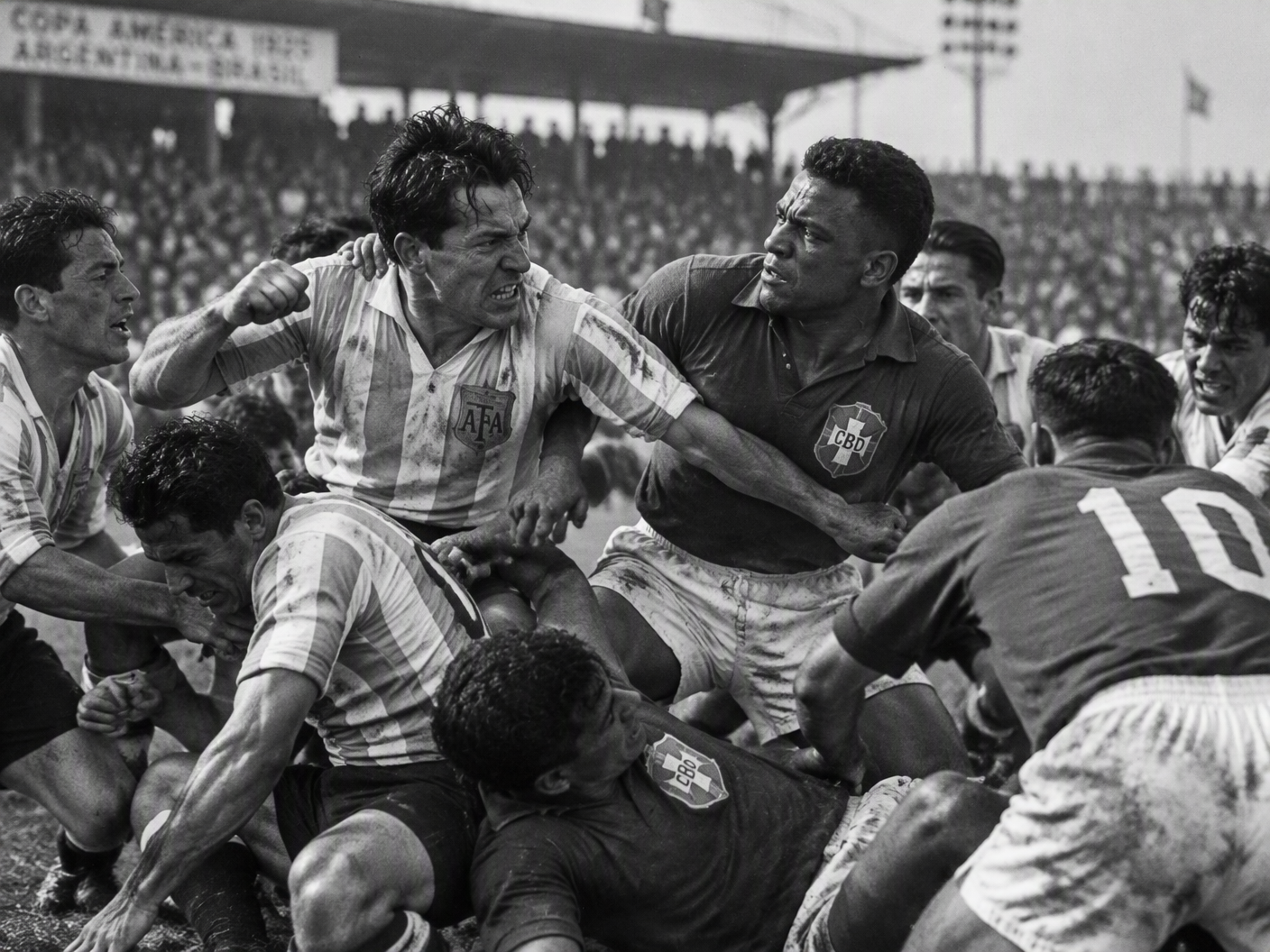
The match is already burning when the violence arrives. At Sportivo Barracas Stadium in Buenos Aires, Argentina and Brazil are locked inside a final that has become too tight for the bodies carrying it. Arthur Friedenreich, Brazil’s forward, has scored the opening goal. Then a foul catches him, and Ramón Muttis answers. The gesture lasts seconds; the consequences will occupy the next eleven years. Players converge. The field fractures into knots of shirts, arms, boots, and rage. The Copa América final is suspended while the crowd watches the competition dissolve into a mass brawl.
This is not the clean geometry of a football match anymore. It is a human pileup under the hard December light, the kind of sudden disorder that turns every uniform into a target and every spectator into a witness. Friedenreich stands at the center of the original collision, the Brazilian forward who had put his side ahead. Muttis responds to the foul on him, and the response becomes the spark. The players abandon their positions. The boundary between contest and confrontation vanishes across the Barracas grass.
For a time, the final cannot continue. The match is stopped amid the fighting, the tournament suspended inside its own decisive afternoon. There are no dismissals when play eventually resumes. No official red card removes the figures from the field; no formal expulsion converts the brawl into a neat sequence of punishments. The teams return to the match carrying the violence with them, and the game proceeds toward the strange arithmetic that will decide the championship: Argentina and Brazil finish level, 2-2.
A draw in an ordinary match might have left only a scoreline. In this tournament, the scoreline carries the title. The rules award Argentina the Copa América when the final ends level, and Argentina claims its second championship. The players have fought through the afternoon, the field has been temporarily emptied of play, and yet the official ending is not a knockout, a replay, or a winner’s goal. It is a tie that becomes Argentine triumph by regulation—the calm sentence placed over a violently uncontrolled event.
That is the first strange machine of Barracas: the spectacle produces chaos, then the rules translate the chaos into a champion. Argentina leaves with the trophy. Brazil leaves with a 2-2 final and a match that cannot be reduced to the clean romance of national colors. The contest has been interrupted but not annulled, scarred but completed. The field has absorbed the fury, and the result survives it. In the official shape of the tournament, Argentina wins. In the memory of the afternoon, the brawl remains inseparable from the title.
Brazilian newspapers give the violence a name with the weight of a military dispatch: “The Barracas War.” The phrase carries the stadium beyond its physical boundaries. Sportivo Barracas becomes not merely the place where Argentina and Brazil met for a continental championship, but the location attached to a rupture between national teams. A foul, a retaliation, and a field-wide eruption become a political vocabulary of sport—war reduced to a nickname, war made portable in headlines, war carried home by readers who had not stood beneath the Buenos Aires sky.
The nickname survives because the match refuses to behave like a finished event. A final should close a tournament; this one opens a long corridor of consequence. Argentina has the second Copa América title. Brazil has been part of the match that produced it. Friedenreich’s opening goal, Muttis’s response, the swarm of players, the temporary suspension, and the resumed 2-2 draw remain locked together. The score says equality. The title says Argentina. The nickname says something more volatile happened between those two facts.
After Barracas, the rivalry does not simply cool. Argentina and Brazil refrain from officially playing each other for eleven years. The silence becomes its own kind of arena: no whistle, no opposing shirts, no new result to dilute the old one. The absence allows the 1925 final to harden into legend. Each season without a meeting leaves the brawl undisturbed, suspended in the same violent instant, while the title remains attached to the draw and the draw remains attached to the fight.
Eleven years is a long time in football. Players disappear from squads; bodies change; crowds inherit stories from men who were there. Yet the Barracas War keeps its electrical charge because the consequences are institutional as well as physical. Two national teams that had met for a championship stop officially meeting one another. The rupture is not announced by a single final whistle. It accumulates through the empty space afterward, through fixtures that do not happen and through the durable knowledge that the last encounter ended with combat on the field.
The final image is not a trophy lifted cleanly above a victorious team. It is the field at Sportivo Barracas after play has resumed, the grass carrying the imprint of a fight while the match moves toward its 2-2 ending. No player is dismissed. Argentina receives its second Copa América title. Brazil and Argentina then vanish from the official schedule against each other for eleven years. The crowd’s noise drains into distance, but the name remains—The Barracas War—an old scoreline vibrating beneath the silence.
Investigative Dossier & Evidence
Read the companion investigation notes, verified source claims, and primary documents.
Read the Companion Notes & Evidence Record →