
Violence & Brawls ·
The Photograph of Carlo Picornie at Beverwijk
Kees Spruijt entered the field where Ajax and Feyenoord hooligans fought in March 1997. He saw the attack on Picornie, took a photograph and later recalled threats and months away from his work.
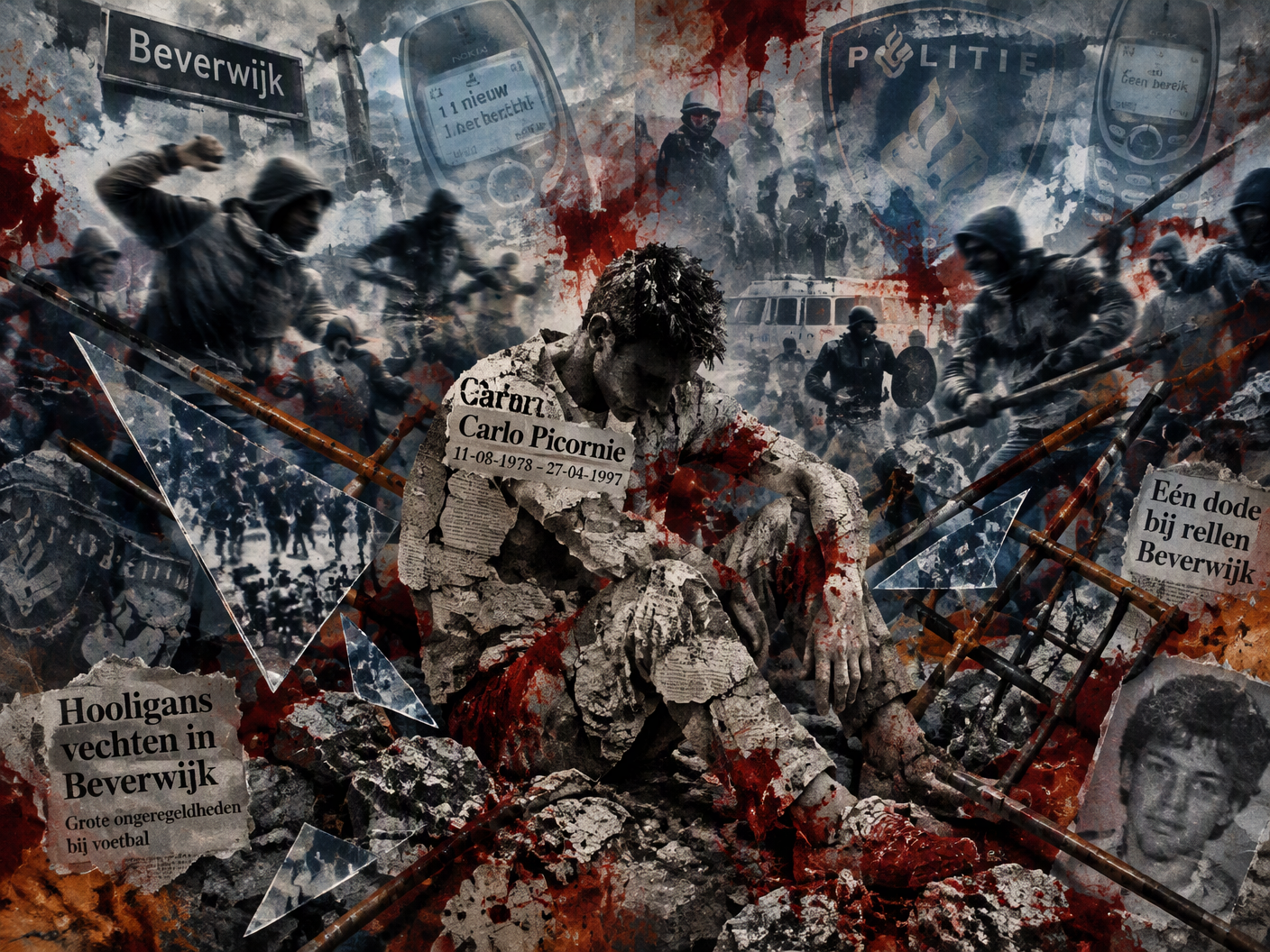
On 23 March 1997, hundreds of Ajax and Feyenoord hooligans met to fight in a meadow beside the A9 motorway near Beverwijk. Carlo Picornie, a 35-year-old Ajax supporter, was fatally injured. Photographer Kees Spruijt went into the field that day and saw Picornie sitting on the ground while several people struck and kicked him. The photograph he took appeared in newspapers the next morning.
Spruijt had been following Rotterdam hooligans for some time. Recalling the day for Rijnmond in 2022, he said he had sensed nervousness and knew many Feyenoord supporters would be heading there, though he did not know exactly what would happen. Feyenoord was due to play AZ in Alkmaar. Spruijt drove among supporters who had gathered at a restaurant spanning the A4; later, cars stopped on the motorway near Beverwijk and men ran into the meadow.
The police had expected a confrontation. According to NRC Handelsblad’s report the following day, officers initially thought the Ajax supporters would appear at the A4 gathering point. Instead, the groups used mobile phones to direct one another to a field near Beverwijk’s bazaar. Witnesses told the newspaper that only two officers were present when the fighting began. The combatants carried knives, stones, reinforcing bars, hammers and clubs.
Spruijt saw hundreds of men running at one another. “I’ve seen quite a few fights, but I had never seen anything like this,” he told Rijnmond. As he took his cameras into the field, the first injured men were already returning to their cars. He remembered chains, tools, steering locks and a jack being used alongside fists.
Then a small group of younger hooligans noticed him. “Away with that camera,” he recalled them shouting. He stayed where he was, thinking he knew many of the people there. His camera was taken, he was hit, and someone struck his knee with a baseball bat. Spruijt said he recovered the camera and continued farther into the meadow, where he saw the attack on Picornie and took a photograph of him.
Picornie suffered a head injury and died later in hospital, NRC reported. Other men were injured; one was admitted with serious brain damage and placed under police guard because he was also a suspect. Picornie belonged to the first generation of Ajax’s F-side. In its 9 April 1997 issue, the supporters’ magazine De Ajax Ster described him as “a figurehead of the Ajax supporters” and “a boy who never abandoned his mates.”
Justice minister Winnie Sorgdrager called the violence “total madness,” but said she wanted to establish what had happened before announcing measures. She also cautioned that officers trying to separate two groups deliberately attacking each other had to avoid becoming victims themselves.
Back at his car, Spruijt had a headache and vomited, unable to make sense of what he had seen. Some Feyenoord supporters continued to Alkmaar for the match; Spruijt went to the ANP news agency to develop his film. Afterwards came police attention and, he said, threats from supporters on both sides. By 2022, he no longer sold the photograph of Picornie and did not keep its negative at home. “I didn’t take photographs for a few months,” he said.