
Tragedy ·
Summerland: an escape, two losses and a contested verdict
Fifty people died in the 1973 fire in Douglas. Survivors and relatives have challenged the finding of misadventure; the Attorney General says it placed no blame on the victims.
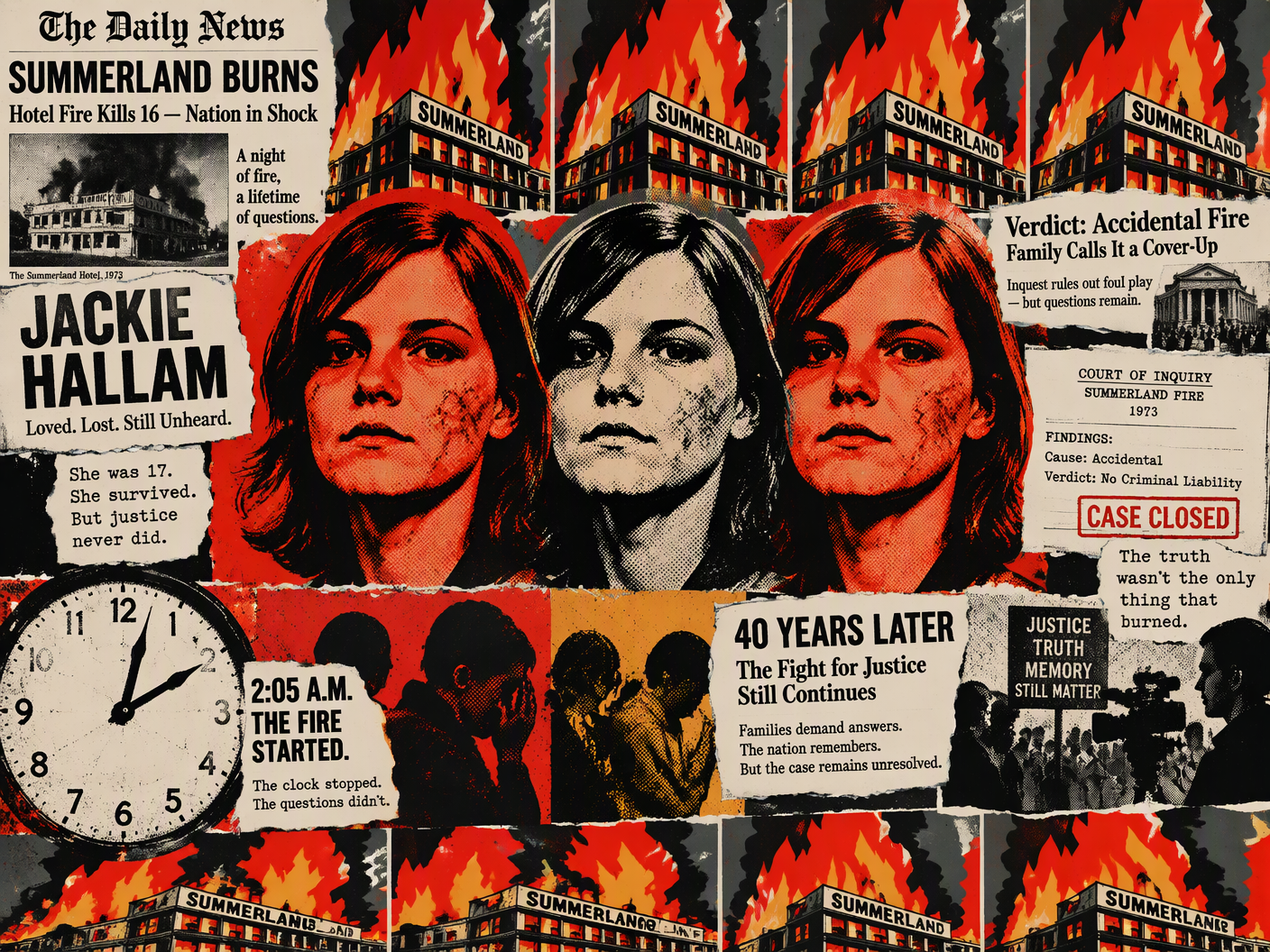
About 3,000 people were inside Summerland, the entertainment complex on Douglas Promenade, on the evening of 2 August 1973. Fire spread rapidly through the building. Fifty people died, many of them holidaymakers, and scores more were injured.
Jackie Hallam was 13 and on holiday from Huddersfield. She escaped but suffered severe burns. Her mother, Lorna Bryson Norton, and her friend Jane Tallon, also 13, were killed. Decades later, Hallam would lead a campaign challenging the verdict returned at the 1974 inquest: misadventure.
For another family, the loss was followed by a long silence. Anne Barber, known as Nancy, died alongside her friend Elsie Stevens while holidaying on the island. Her son David travelled from Halifax to learn his mother’s fate. His daughter Jane Stevenson was seven at the time. “My father shut down, didn’t talk about it,” she recalled. “All we knew is that granny had died in Summerland on the Isle of Man. We knew little else for 50 years.”
The Summerland Fire Commission produced its report in May 1974, and it was admitted as evidence at the inquests. In explaining his later refusal to order fresh inquests, the island’s Attorney General described the commission’s work as a thorough, effective and proportionate inquiry into how the fire took hold, spread and became so fatal. In his assessment, its public findings identified responsibility for numerous shortcomings and revealed how those who died had lost their lives.
The meaning of the inquest verdict remained disputed. Hallam said the word misadventure had a negative connotation, suggesting that risks had been taken. The Attorney General’s position was explicit: as a matter of law, the 1974 verdicts placed no responsibility on the victims.
On 2 March 2025, Justice for Summerland, representing some victims and survivors, applied for fresh inquests. The Attorney General declined to direct them. He said the application presented no fresh evidence revealing relevant or material errors in the commission’s detailed findings; speculation that such evidence might exist did not constitute fresh evidence.
The group appealed against that refusal. The case was heard in the Isle of Man courts in May 2026, and First Deemster Andrew Corlett reserved judgment for a later written ruling.
Stevenson had joined the campaign after visiting the island for the fire’s 50th anniversary. She said her father began to speak more about his memories, including returning for the 1974 inquest and feeling devastated and angry at its result. By the time of her May 2026 interview, he had died without learning the outcome of the challenge. “But at least he knew we were doing something and that meant the world to him,” she said.
For Hallam, the demand for a different verdict remained rooted in what she and those she lost had gone to Summerland to do. “We went into a building to use it for its intended purpose,” she said. “That is all.”