
Point Shaving & Fixes · 1970s
The 1974 Gay Future Betting Coup and the 1976 Cartmel Fraud Convictions
On 26 August 1974, Gay Future won the Ulverston Novice Hurdle at Cartmel amid a coordinated betting operation involving trainer Tony Collins and businessman Tony Murphy. Bookmakers withheld payment; in February 1976, the men were convicted, and the Jockey Club later imposed ten-year bans from British racecourses.
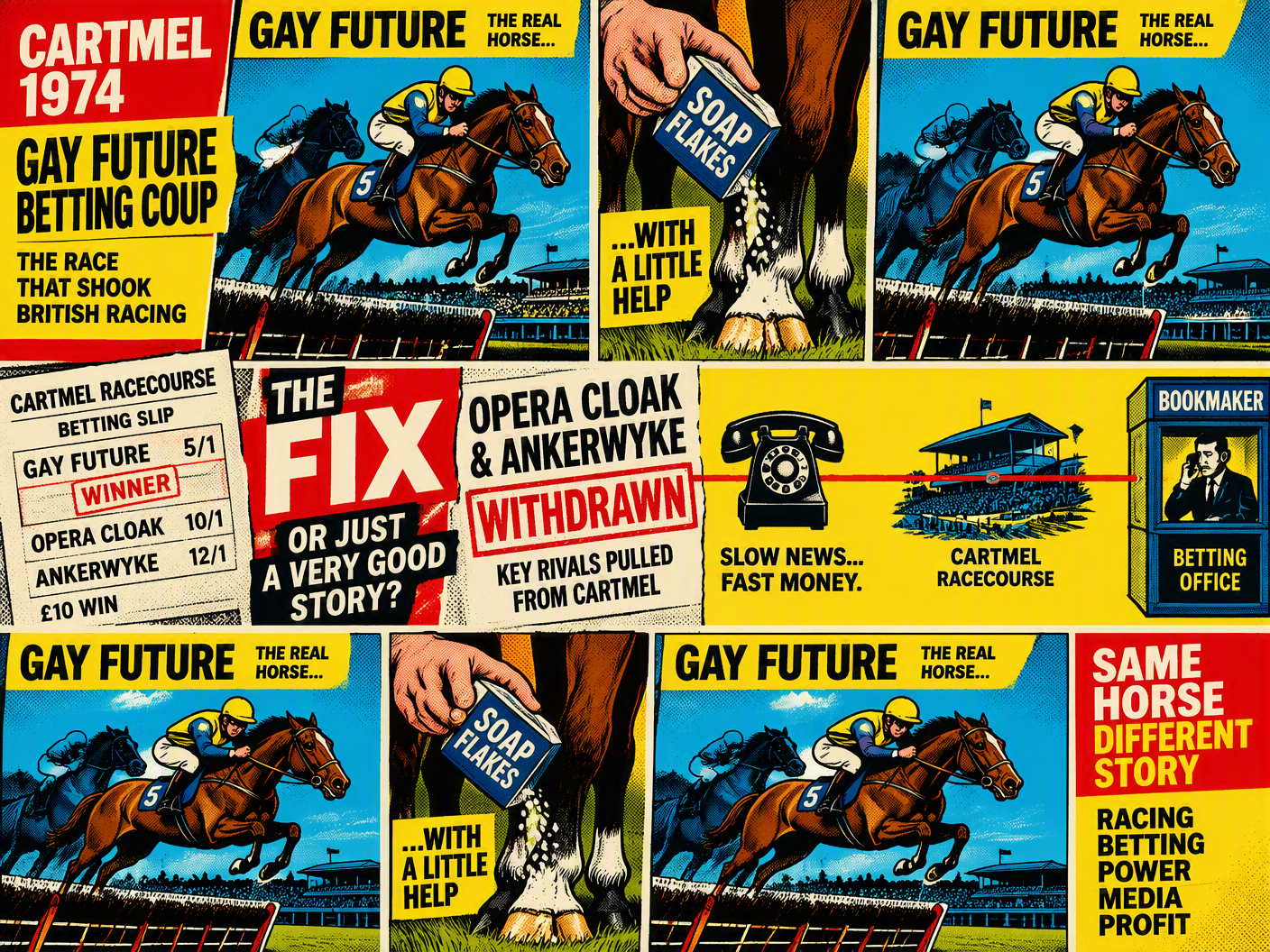
The bookmakers refused to pay. Gay Future had won the Ulverston Novice Hurdle at Cartmel on 26 August 1974, but the result did not produce the ordinary transfer of winnings. Payment stopped while the betting was examined. The horse had not simply appeared at a small Cumbrian course and outrun its field. Before the race, trainer Tony Collins and Irish businessman Tony Murphy had helped construct a betting position around the horse. The refusal converted a winning ticket into an inquiry and placed the race under a question that money alone could not settle.
The operation depended on controlling what different people believed they were seeing. A lookalike horse was presented as Gay Future before the race, creating one version of the animal for observers while the genuine runner was held back for Cartmel. Collins also entered two other horses, Opera Cloak and Ankerwyke, at separate meetings. Both were withdrawn before their races. The entries and withdrawals shaped the surrounding betting information: horses appeared in the market, then disappeared, while the intended runner remained available for a wager built on better knowledge.
Another preparation was more physical. Soap flakes were rubbed into Gay Future’s legs before the race. The treatment was intended to make the horse look sweaty or unsettled, an appearance that could discourage confidence in its chances. It was not an alteration to the course or a change to the rules of hurdling. It was a signal placed on the horse itself, designed to influence how the animal was read by people who judged form through condition, behavior, and visible readiness.
Cartmel’s communications system gave the operation time to develop before outside scrutiny could catch up. At the time, the racecourse had a single telephone line connecting it with the outside world. Information moved through that narrow channel, carrying results and betting news beyond the course. A limited line did not determine the race, but it slowed the circulation of information after the horse ran. The distance between the course and the bookmakers became part of the opportunity Collins and Murphy exploited.
When Gay Future entered the Ulverston Novice Hurdle, the central act of the plan took place in public. The horse ran, cleared its obstacles, and won. Descriptions of the margin place the victory between 10 and 15 lengths, a variation that does not change the essential result: Gay Future finished decisively ahead. The performance supplied the visible conclusion to a concealed arrangement. It also gave bookmakers a reason to examine not only the winning horse, but the bets and withdrawals that had preceded it.
The withheld winnings created immediate financial pressure. A bookmaker who paid a routine winner accepted the result; a bookmaker who refused payment forced the betting operation into review. Gay Future’s victory therefore became a disputed transaction rather than a settled one. The question was not whether the horse had crossed the line first. It had. The question was whether the bets had been placed through a planned deception that made the bookmakers’ prices vulnerable before the race began.
The investigation followed the conduct around the race rather than treating the result as an isolated sporting surprise. Collins supplied the entries, including Opera Cloak and Ankerwyke, and was connected to Gay Future’s preparation. Murphy, a businessman and racing enthusiast, was identified as a leading figure in the betting operation. The lookalike horse, the soap flakes, the withdrawals, and the concentrated betting activity formed a connected method. Each detail addressed a different part of the same problem: how to create misleading information and then profit from it.
The legal case reached Preston Crown Court in February 1976. After the investigation, Collins and Murphy were convicted of conspiracy to defraud the bookmakers. The conviction gave the episode a criminal endpoint distinct from the bookmakers’ earlier refusal to pay. One was a commercial decision made while the wagers were examined; the other was a judgment imposed through the criminal courts. The two actions met at the same point: the Cartmel result had been produced within a betting scheme, not merely followed by an argument over an unexpected winner.
The racing authorities imposed a separate consequence. The Jockey Club banned Collins and Murphy from British racecourses for ten years. The sanction removed both men from the venues where professional racing, betting, and access to horses converged. It also demonstrated that the sport treated the conduct as an attack on the betting system itself, not as a private disagreement between a trainer and bookmakers. Criminal punishment addressed conspiracy to defraud; the racecourse ban addressed their continued place inside British racing.
In January 1976, while the criminal case was moving toward the February proceedings, Gay Future broke its neck and died during a racing event at Wetherby. The death ended the horse’s racing career before the convictions were entered. It was a separate event in the horse’s life from the legal proceedings against Collins and Murphy, which concerned the earlier Cartmel betting operation. Gay Future’s final place in the case is therefore fixed in time: the horse ran and won at Cartmel in August 1974, died at Wetherby in January 1976, and did not survive to the convictions that followed one month later.
Investigative Dossier & Evidence
Read the companion investigation notes, verified source claims, and primary documents.
Read the Companion Notes & Evidence Record →