
Violence & Brawls ·
An Arrow and Tear Gas at Brasília’s World Cup Protest
Indigenous land-rights protesters joined an anti-World Cup march on May 27, 2014. An arrow struck a mounted-police officer, police fired tear gas, and the trophy exhibition closed early.
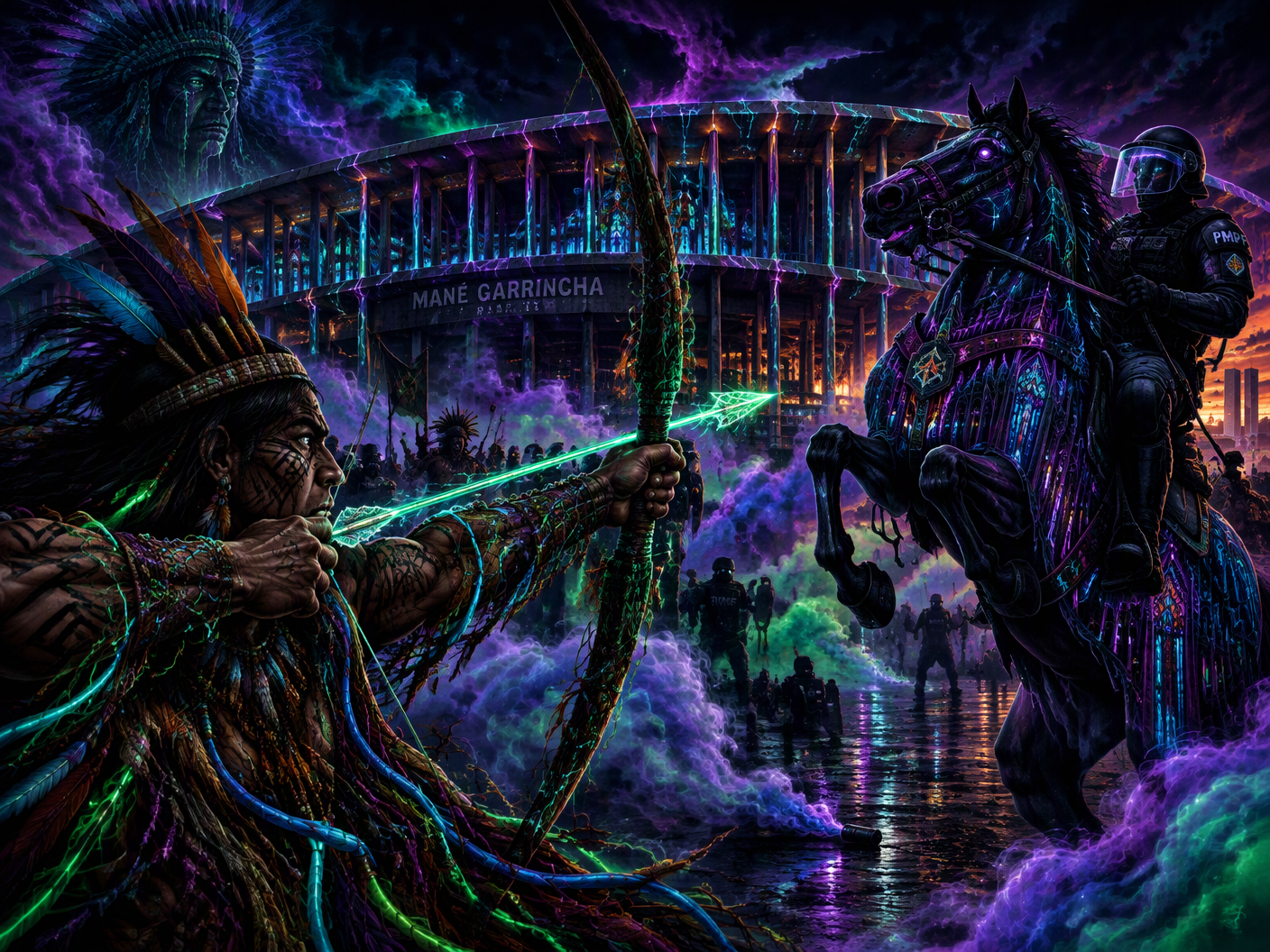
Mounted police blocked the route to Brasília’s Mané Garrincha stadium on May 27, 2014, as Indigenous protesters joined a march against the World Cup. An arrow struck an officer in the leg, while police fired tear gas to keep demonstrators from approaching the arena. Outside the stadium, where fans had lined up to see the World Cup trophy, organizers closed public access, citing a lack of security.
The tournament was due to begin on June 12. The march had gathered late that afternoon at the Rodoviária do Plano Piloto, bringing together objections to public spending on the World Cup and complaints about housing, health and education. Indigenous participants had come to the capital to protest changes to the rules for demarcating their lands. Earlier that day, some had climbed onto the Congress building before coming down and joining the march.
Their demands overlapped without being identical. The Homeless Workers’ Movement said stadium construction was too expensive, had driven up property prices and had forced lower-income families from their homes. Indigenous protesters were defending land rights. “Before organizing the World Cup, Brazil should have thought more about health, education and housing,” Neguinho Truka, a leader of the Truka people in Pernambuco, told Agence France-Presse.
The demonstrators moved along the Eixo Monumental toward the stadium, blocking all six lanes in one direction and causing a large traffic jam. The arena had cost the Federal District government about 1.2 billion reais, according to G1, and its construction was being questioned by the district’s audit court over suspected inflated costs. The trophy was on display in the stadium parking lot.
Folha de S.Paulo reported that the confrontation began when Indigenous demonstrators tried to pass a barrier formed by mounted police. Police used tear gas; protesters threw sticks and stones, and some fired arrows toward the horses. G1 reported that an arrow fired by an Indigenous protester struck an officer from the cavalry unit. Police said he received treatment from an ambulance crew and was doing well. Agence France-Presse separately reported that he underwent surgery to remove the arrow.
The Indigenous Missionary Council told G1 that two Indigenous protesters were also injured by tear-gas munitions fired by riot police. In an official statement, the Federal District’s public-security department said officers had acted “strictly within the protocol provided for demonstrations.” It said police had contained the protest at the boundary of the trophy’s visitor area and preserved participants’ physical safety.
The confrontation ended the trophy viewing early that day. Coca-Cola, which was responsible for the exhibition, described the demonstrations as part of the “democratic process” but said the protest had prevented hundreds of people from visiting. The company said viewing was still scheduled to resume the next morning.