
Violence & Brawls · Ancient Rome
Roman Boxing and the Studded Cestus
In ancient Rome, boxing was staged before spectators in amphitheatres, where fighters wrapped their fists in leather strips. The hand covering later associated with the cestus is described as a harder, studded form, while modern boxing preserves a different kind of technical inheritance through numbered punches and combinations.
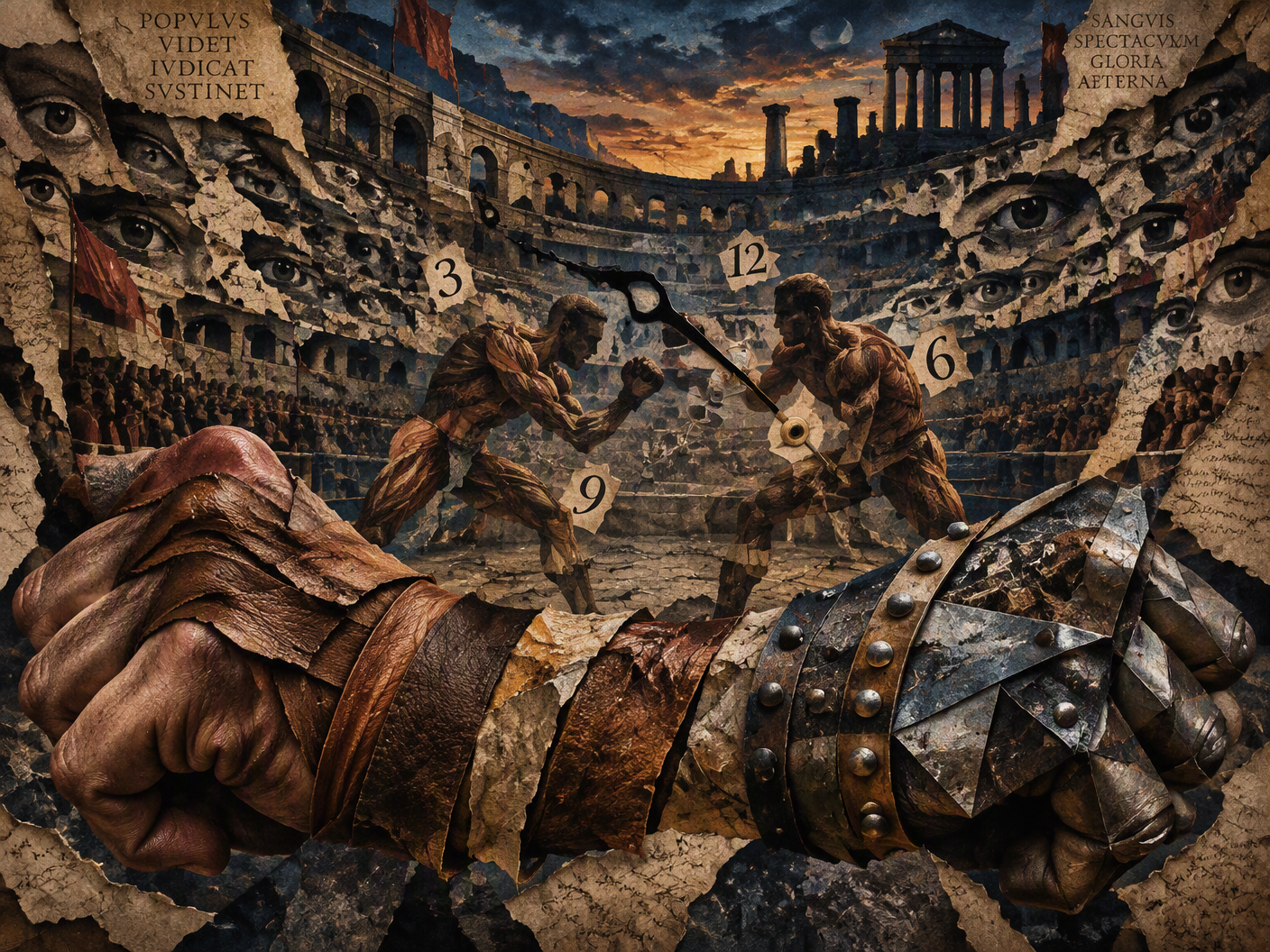
In the ancient Roman era, boxing moved into the amphitheatre as a public contest. The men who entered did not carry the gloves familiar to modern spectators. They wrapped leather strips around their fists, binding the hand before it met another body. The wrapping protected the knuckles, but it also placed a material boundary between bare flesh and the force of the blow. Around that practice grew a sport watched by Roman spectators, with the amphitheatre serving as both competition ground and public stage.
The first implement was therefore simple in its construction: leather wound around the hand. It belonged to a world in which a fighter's equipment began with the body and was fastened directly to it. The strips covered the knuckles and gave the fist support, but the account of Roman boxing places them within an evolving practice rather than a fixed design. The material could change. What began as protection did not remain only protection.
At a later stage, harder leather entered the wrapping. The change was small in description and large in consequence. A fist covered with soft or ordinary strips was one thing; a fist reinforced by denser material carried another potential into the contest. The historical account then identifies the addition of metal studs, producing what became known as the cestus. Roman boxing had not simply acquired a more elaborate glove. Its hand covering had become an instrument with a harder edge.
The cestus occupies the darkest point in this short sequence because its significance lies in the alteration of contact. Leather separated knuckle from target. Harder leather increased the firmness of that separation. Metal studs changed the surface again, placing metal at the point where one fighter's hand reached another person's body. The surviving description establishes that progression, but it does not turn every Roman contest into the same encounter or show that every boxer used the studded form. It preserves an evolution in equipment, not a complete inventory of practice.
What can be placed firmly around that equipment is the setting. Roman boxing was a spectator sport, and its contests were held in Roman amphitheatres. The fighters therefore performed within an institution of public entertainment, before spectators who came to watch combat rather than private exercise. The amphitheatre gave the contest its civic scale. A hand strip tied in preparation for a fight became part of a public event, and the alteration of that strip changed an object used under the gaze of the crowd.
The account does not supply a dated sequence of individual bouts, named champions, or a technical rulebook governing the cestus. It gives instead a compact history of the hand: leather strips, harder leather, then metal studs. That limited sequence is important precisely because it resists the later temptation to supply details that are not present. The cestus can be identified as a studded form of Roman boxing hand covering. Its exact frequency, construction, and use across contests remain outside the established narrative.
The modern boxing gym uses a different language to organize the fist. Coaches commonly call combinations by number, allowing beginners and professional boxers to receive instructions without a long description of each movement. In the six-punch system, 1 is the jab, 2 the cross, 3 the lead hook, 4 the rear hook, 5 the lead uppercut, and 6 the rear uppercut. The numbered call turns a sequence of bodily actions into a short command.
That numbering system also assigns the hands. In an orthodox stance, odd-numbered punches are thrown with the left hand and even-numbered punches with the right. A coach calling 1-2 is therefore naming a jab followed by a cross; a call involving 3 and 4 identifies the lead and rear hooks. The method belongs to contemporary training, not to Roman amphitheatre practice. It offers a point of comparison between two eras: one marked by hand coverings, the other by a coded vocabulary for directing movement.
The contrast clarifies what changed and what did not. Modern trainers use numbers to break a combination into teachable parts. Roman fighters used leather strips around their fists, with harder leather later associated with the studded cestus. One system organizes instruction; the other concerns the material placed over the hand. Neither supplies a continuous technical record linking ancient contests to modern gyms. The comparison is useful only when the boundaries remain visible: a Roman boxing implement and a modern coaching shorthand belong to separate contexts.
The central fact of Roman boxing is therefore not a single famous bout but the relationship between public combat and the prepared hand. Spectators gathered in amphitheatres to watch boxing. Fighters entered with leather around their fists. Over time, the hand covering is described as becoming harder and then studded, giving the cestus its defining form. The surviving historical account supports that outline while leaving the broader practice less certain: no complete catalogue of venues, bouts, or equipment survives within this account.
Centuries later, a boxing coach can call the first punch simply “one,” meaning the jab, and build a combination through six numbered movements. The Roman boxer had no such modern code in the account before us. What remains instead is the physical vocabulary of leather, harder leather, and metal studs, set against the amphitheatre's public purpose. The enduring record is modest but exact in its outline: Rome made boxing visible to spectators, and its hand coverings could transform the nature of the blow.
Investigative Dossier & Evidence
Read the companion investigation notes, verified source claims, and primary documents.
Read the Companion Notes & Evidence Record →