
Scandals & Feuds · 2010s
Ángel Hernández, MLB, and the Confidential Call Dispute
A 2019 game delay led Major League Baseball into an internal investigation and a later accusation that umpire Ángel Hernández stayed on a confidential interview with Ed Hickox. The dispute unfolded alongside Hernández’s discrimination lawsuit, continuing scrutiny of his work, and the financial settlement that preceded his retirement.
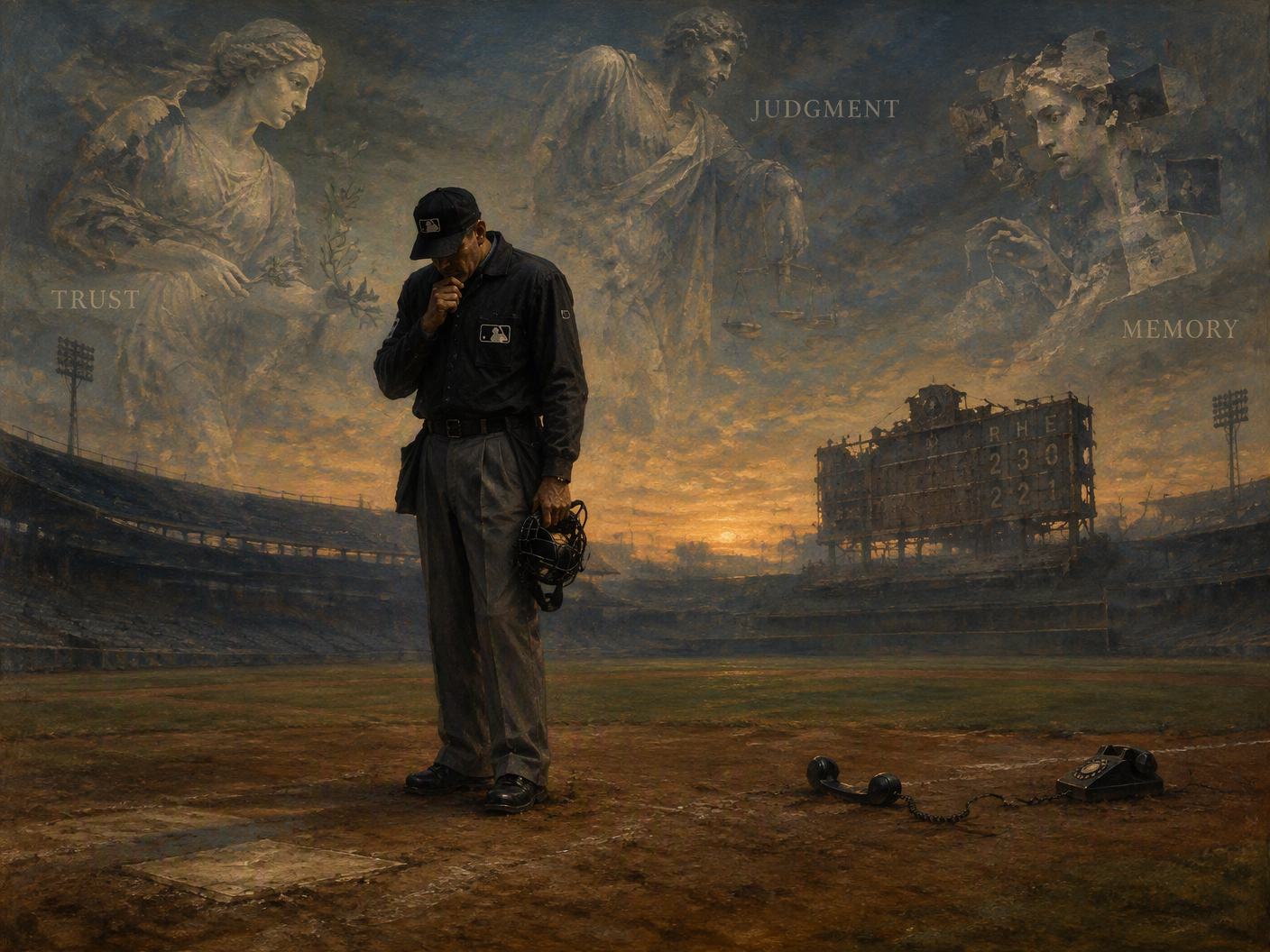
For nearly 20 minutes on July 24, 2019, a Boston baseball game stopped while the umpires tried to determine which rule applied. The Red Sox and Tampa Bay Rays waited through the dispute, with Ángel Hernández serving as acting crew chief. The delay was an on-field failure of administration, but it did not remain on the field. Major League Baseball opened an internal investigation connected to the episode, and months later the dispute became part of a separate question: whether Hernández had remained on a confidential call involving another umpire.
The difference between those two events mattered to Hernández’s working life. A rule confusion could be judged through the ordinary vocabulary of baseball—an error, a delay, a bad night. A confidential call belonged to the employer’s private channels, where an accusation could affect trust, assignments, and the standing of an official already operating under unusual scrutiny. MLB later said Hernández stayed on the line during an interview with umpire Ed Hickox, turning a game-management incident into an employment dispute that reached beyond the diamond.
Joe Torre, then MLB’s chief baseball officer, put the league’s position in writing. MLB had concluded that Hernández remained connected to the interview in order to intentionally and deceptively eavesdrop on a confidential conversation. The language described deliberate conduct rather than an accidental failure to hang up. It also gave the league a formal explanation for how Hernández had supposedly obtained access to a conversation concerning Hickox, another member of the umpiring workforce.
Hernández’s lawyer rejected that account. MLB had invited Hernández onto the call, the lawyer said, and Hernández had not eavesdropped. The two descriptions placed the decisive question in a narrow space: not whether the call existed, but how Hernández came to be on it and what he understood his presence to mean. One side described intentional deception; the other described an invitation. The accusation carried institutional authority, but the competing account left the central act contested rather than converted into a criminal case.
The conflict had a longer history. In July 2017, Hernández filed a federal lawsuit against Major League Baseball alleging racial discrimination in promotion and postseason assignments. Those assignments were not ceremonial. Postseason work brought visibility, compensation, and professional status, while promotion shaped which umpires received authority and opportunity inside a league with a limited number of major-league jobs. Hernández’s lawsuit placed his relationship with MLB inside the larger labor question of who advanced, who waited, and whose mistakes became part of an official judgment.
That lawsuit remained active as the call dispute entered public view. In March 2021, United States District Judge J. Paul Oetken granted summary judgment in MLB’s favor, ending the case at the district-court level. The ruling did not settle the factual disagreement over the confidential interview. It did, however, close one legal route through which Hernández had challenged the league’s treatment of him, leaving the employment relationship to continue under the weight of both institutional criticism and his own response to it.
Hernández continued to work, but the terms of that work grew more difficult to separate from public evaluation. After missing time with a back injury, he appeared in only ten MLB games during the 2023 season. A public tally of his umpiring that year counted 161 missed calls. Those numbers became another form of professional pressure, translated into grades and totals that followed an official from one ballpark to the next. They described performance; they did not resolve what happened on the confidential call.
This is how a modern sports workplace can narrow around a person. The umpire stands in a uniform visible to players, managers, cameras, and paying customers, yet the most consequential decisions about his employment may occur in private interviews, legal filings, assignment lists, and settlement negotiations. Hernández’s lawsuit made race and advancement part of the dispute. The call accusation made confidentiality and institutional trust part of it. His game performance supplied another stream of judgment. Each arena used a different standard, but the consequences accumulated around the same job.
MLB and Hernández never turned the eavesdropping accusation into a criminal prosecution. The public dispute remained an employment and legal conflict: the league’s written conclusion against Hernández, his lawyer’s denial, and the surrounding history of litigation and performance criticism. That distinction shaped the meaning of the allegation. A league can discipline or distance an employee through its own employment authority, while a court requires a different procedure and a criminal case requires a higher public threshold. The private accusation could still alter a career without producing an arrest or conviction.
On May 27, 2024, Hernández announced his retirement after reaching a financial settlement with MLB. The settlement closed the employment relationship without transforming the disputed call into a settled public fact. It also ended a career that had carried him through a rule delay, a federal discrimination lawsuit, a back injury, harsh evaluations, and years of argument over the league’s treatment of his work. The money changed hands; the disagreement retained its two versions.
For Hernández, the July 2019 game began with a rule question and ended in a chain of consequences that extended far beyond Boston. The players eventually resumed their game, but the official who had been responsible for restoring order carried the dispute into the employer’s offices, the federal courthouse, and the public judgment attached to every later assignment. By the time he left MLB, he had a settlement and a completed career. He also left behind the unresolved burden of an accusation that the league defined as deception and he answered as an invitation.
Investigative Dossier & Evidence
Read the companion investigation notes, verified source claims, and primary documents.
Read the Companion Notes & Evidence Record →