
Violence & Brawls · 2020s
The Croke Park Tunnel Melee and the GAA’s Pending Disciplinary Response
After Armagh and Galway’s All-Ireland quarter-final reached the end of normal time at Croke Park, a confrontation near the tunnel produced television images of apparent eye-gouging, while an earlier on-field challenge had resulted in a red card. By 28 June 2022, the GAA disciplinary process remained unresolved as lawmakers used the scenes to question how Irish sport handles abuse and disorder.
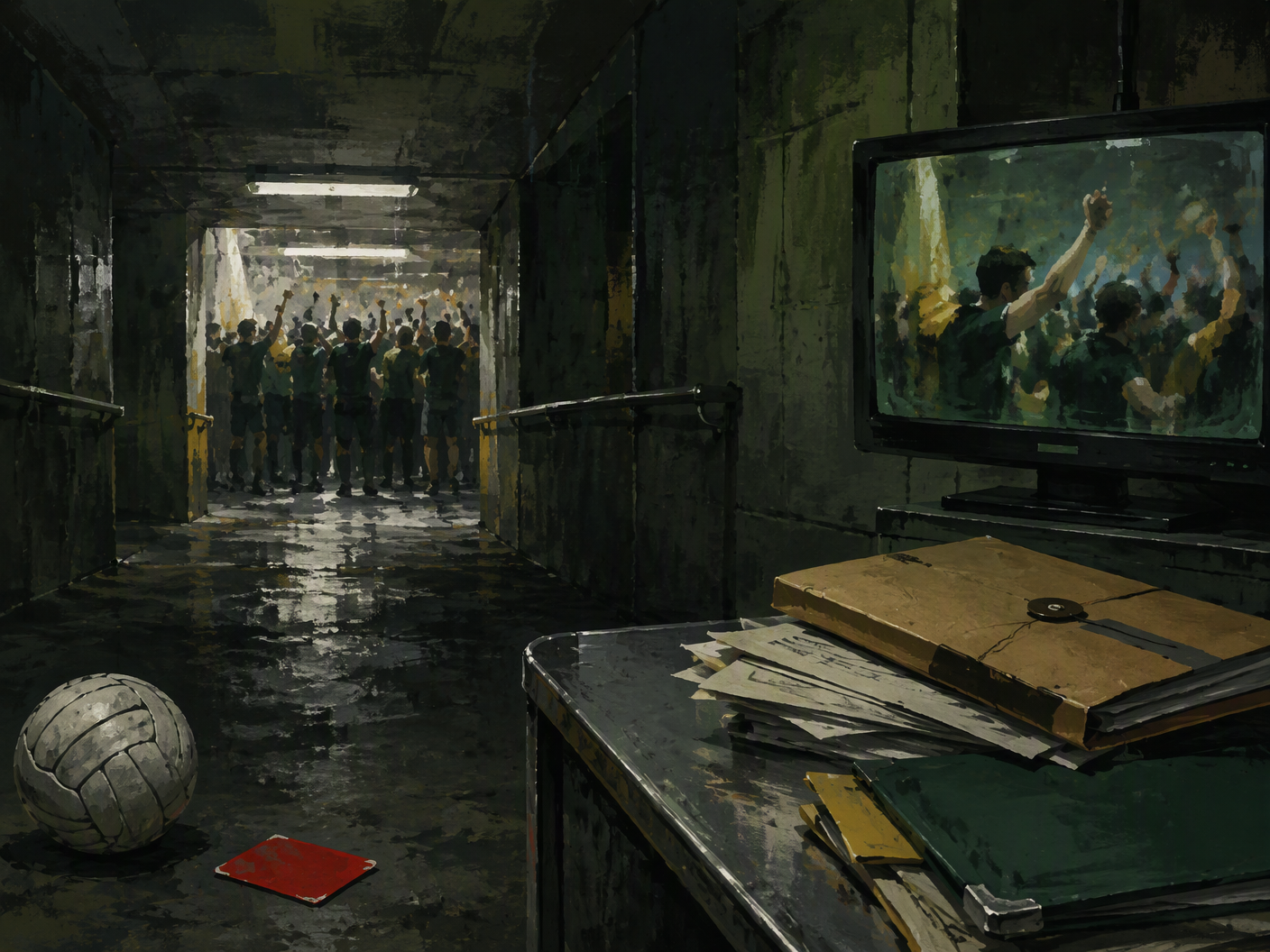
Normal time had ended, but the match was not yet fully concluded when the space between competition and disorder collapsed. On 26 June 2022, Armagh and Galway had met at Croke Park in an All-Ireland Senior Football Championship quarter-final, a high-stakes afternoon played inside Ireland’s national stadium. As the teams left the field after normal time, members of both sides became involved in a fight near the tunnel. Extra time followed the end of regulation play. The confrontation carried a different kind of uncertainty: who had crossed the line, who had joined in, and how far the GAA would reach to answer it.
The late-match flashpoint had come before the tunnel scenes. Armagh defender Greg McCabe challenged Galway’s Matthew Tierney, and McCabe’s shoulder made contact with Tierney’s head. Referee David Coldrick sent McCabe off with a straight red card. The collision belonged to the visible grammar of a Gaelic football match—speed, bodies, impact, the immediate judgment of an official—but contact with the head gave it a consequence beyond an ordinary contest for possession. One player left the field because of the challenge. The remaining players carried the tension toward the exit.
On The Sunday Game, Ciarán Whelan, Colm Cooper, and Seán Cavanagh each said the sending-off was warranted. Their agreement documented a shared view among the three analysts about the red card, even as the larger confrontation remained unsettled. They were evaluating a particular act: a shoulder challenge that reached Tierney’s head. They were not adjudicating every movement captured around the tunnel, nor assigning responsibility to every person in the wider group. In the hours after the quarter-final, those two episodes—the challenge and the melee—became linked in public discussion, though they required separate judgments.
Near the tunnel, the fight involved members of both teams as they moved away from the field. The location mattered. A pitch is bounded by lines, officials, and the formal machinery of the game; the tunnel is a passage into the less visible world of changing rooms, staff, substitutes, and squad members. What happened there was witnessed through fragments rather than a single public account. Bodies converged. The route narrowed. The boundary between those who had played and those who accompanied them became part of the argument that followed.
Television footage gave the confrontation its most discussed image. During the post-match scenes, Galway player Damien Comer appeared to be subjected to an eye-gouging incident. The footage did not arrive as a private allegation passed between clubs; it entered homes through live broadcast and circulated afterward, converting a moment in a crowded passageway into a public spectacle. The image fixed attention on Comer, but it did not by itself identify every participant in the melee or resolve the disciplinary question. Subsequent coverage and political discussion focused on what the footage appeared to show.
The response moved quickly from the field to online discussion. RTÉ reported that online attacks were directed at Tiernan Kelly, an Armagh player associated in public discussion with the tunnel incident. Clann Éireann later condemned the attacks and asked the public to allow the GAA disciplinary process to run before reaching judgment. The online reaction added a second setting to the dispute: alongside the footage and the physical confrontation, a player’s name was being discussed before the association had completed its process. The record documents that vilification, but not whether Kelly committed the conduct attributed to him online.
Clann Éireann, Kelly’s club, condemned the online vilification directed at him. The club asked the public to allow the GAA disciplinary process to run before reaching judgment. Its statement did not settle what had happened near the tunnel, and it did not erase the footage of Comer or the red card shown to McCabe. It drew a line around a different question: whether public anger should be permitted to decide a player’s responsibility before the sport’s own authorities had completed their work. By then, the incident had become both a contest over conduct and a contest over who was entitled to name the offender.
Two days after the quarter-final, the scenes at Croke Park were absorbed into a larger political conversation. On 28 June, reporting on an Irish parliamentary sports-committee discussion placed the Armagh-Galway incident alongside concerns about abuse and ill-discipline involving referees, officials, and players. The melee was no longer only a matter for two counties or a disciplinary body. It had become evidence in an argument about institutional control: whether governing bodies could police their own environments when the people involved were athletes, officials, and members of extended squads operating under intense competitive pressure.
Deputy Alan Dillon called the Croke Park scenes ugly and focused on the people around the tunnel as well as those who had taken part in the match. He said the GAA needed to address the involvement of non-playing squad members entering the field and mixing with players around the tunnel area. The concern was structural rather than theatrical. A game’s rules govern the players who take the field, but a post-match passageway can contain a wider group whose authority, access, and responsibility are less easily read. The question became how an organization disciplines disorder when the crowd around the game has expanded.
The committee report recommended withholding public funding from sports governing bodies that failed to tackle abuse and appointing a disciplinary ombudsman. These were proposed instruments of pressure, not rules already imposed on the GAA. They reflected a political demand that institutions responsible for sport should be answerable when internal discipline appeared inadequate. At Croke Park, the fight had lasted moments. The governance question was slower and more durable: whether consequences should remain inside the association, or whether public money and independent oversight should be used to force a harder response.
By 28 June, the GAA disciplinary process concerning the incident was still pending. No final ruling had yet closed the gap between what television appeared to show, what witnesses or participants might say, and what the association’s rules could establish against particular individuals. Due process remained unfinished, leaving the public with the footage and the reactions it had generated while the outcome remained undetermined. At Croke Park, normal time had ended on the field, but the consequences moved into the tunnel, the broadcast, the online discussion, the committee room, and the disciplinary system that had not yet decided what the sport had witnessed.
Companion notes
What the Croke Park Record Shows—and What It Had Not Yet Decided
The available record establishes the match, the late on-field dismissal, the tunnel-area fight, the television images involving Damien Comer, and the institutional reaction through 28 June. It does not provide a final disciplinary adjudication or establish that every player or squad member participated in the melee.
The match and the immediate sequence
The Wikipedia reference entry for the 2022 Armagh–Galway fixture identifies the event as the All-Ireland Senior Football Championship quarter-final played at Croke Park on 26 June 2022. Independent contemporary reporting in the Irish Examiner and the account summarized by Balls.ie identify the same match and date. Taken together, those sources securely establish the event boundary, while the Wikipedia entry remains a secondary reference source rather than a primary institutional record. [S1], [S4], [S5]
The captured reporting places the fight near the tunnel as both teams left the field after normal time and describes involvement by members of both teams. It does not identify every participant or establish that all players, substitutes, officials, or wider squad members took part. The same reporting states that Armagh defender Greg McCabe was sent off after his shoulder made contact with Galway’s Matthew Tierney’s head. Balls.ie adds the reported opinion of Sunday Game analysts Ciarán Whelan, Colm Cooper, and Seán Cavanagh that the red card was correct; that is expert commentary, not an independent legal or disciplinary finding. [S1], [S4], [S5]
The television image and its limits
The Wikipedia entry on eye-gouging in Gaelic football and the match reference entry describe television footage involving Galway player Damien Comer. The Irish Examiner uses more careful wording, reporting that Comer appeared to be gouged. That distinction is material: the sources establish what the footage appeared to show, but the supplied record contains no criminal charge, court finding, forensic examination, or completed GAA adjudication establishing the identity, intent, or disciplinary liability of a person involved. [S1], [S2], [S5]
Political and institutional response
The Irish Examiner’s 28 June report places the Croke Park scenes within a Joint Committee discussion and report concerning abuse and ill-discipline in sport, including conduct involving referees, officials, and players. It reports Deputy Alan Dillon describing the scenes as ugly and calling on the GAA to address non-playing squad members entering the field and mixing with players around the tunnel. Dillon’s comments document a governance concern; they do not prove that the presence of those squad members caused the disorder. [S5]
The same report says the committee recommended withholding public funding from governing bodies that failed to tackle abuse and appointing a disciplinary ombudsman. Those measures were recommendations reported in the committee context, not evidence that they had been enacted by 28 June or imposed on the GAA. The record therefore supports an institutional debate about oversight, but not a completed regulatory intervention. [S5]
Online abuse and pending due process
RTÉ reported that Clann Éireann condemned online attacks directed at Tiernan Kelly and asked the public to allow the GAA disciplinary process to run before making judgment. That establishes the club’s statement and the reported existence of online vilification. It does not establish whether Kelly committed the conduct attributed to him online, nor does it substitute the club’s position for a disciplinary finding. [S6]
By 28 June, the Irish Examiner reported that the matter was to be dealt with by the GAA disciplinary body, while RTÉ reported the club’s request that the process be allowed to take place. Neither source in the supplied record reports a final decision. The investigation can therefore describe the incident, public reaction, and pending machinery, but cannot assign final responsibility to unnamed or named participants beyond the specific red-card action documented in the reporting. [S5], [S6]
Source key
The associated evidence packet contains visible source URLs, source roles and the complete claim ledger.