
Violence & Brawls · 1790s
Pato: From Live Duck and Knife Fights to Argentina’s National Sport
Argentina’s horse-mounted game of pato moved from colonial public disorder to a regulated four-player sport, then received the state’s highest sporting endorsement. The transition ran through bans, written rules, a national federation, and Juan Domingo Perón’s 1953 decree.
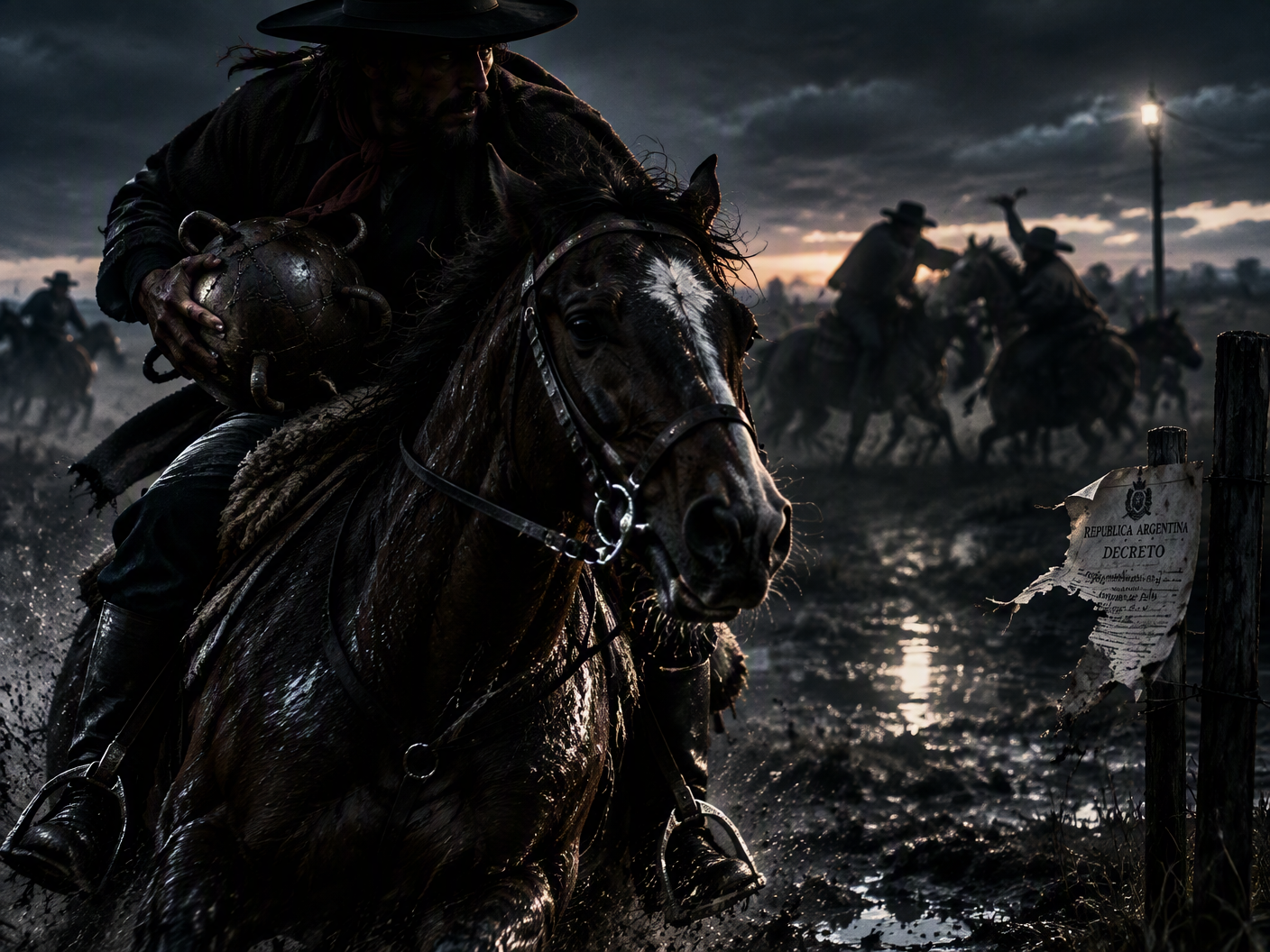
On 16 September 1953, President Juan Domingo Perón signed Decree 17468 and made El Pato Argentina’s national sport. The state had thus elevated to patriotic ceremony a pastime once associated with public disorder, trampling, and knife fights. Somewhere between the polished rhetoric of national identity and the practical business of keeping riders from murdering one another, pato had acquired paperwork. The game would now stand beside the flag, the anthem, and the usual solemn officials in bad suits—though its older equipment had included a live duck and its older rules could be summarized as: seize it, ride away, and hope everyone survives.
The game was played on horseback by gauchos, whose working lives already demanded balance, speed, and a tolerance for weather that would have embarrassed most modern office workers. By 1610, historical accounts placed pato-like play in Buenos Aires. The object was a duck, sometimes carried in a basket, which riders fought to capture and transport. It was not a delicate exercise in rural recreation. The contest gathered horses, men, momentum, and a portable animal into one moving argument, then released them across open ground with the sort of supervision normally reserved for thunderstorms.
The duck was not merely symbolic. It was the central piece of equipment, which gave the game its name and supplied the spectacle with a disagreeable biological dimension. Riders reached, tugged, wheeled, and collided while trying to carry it away. The sport’s later transformation would replace the animal with a ball fitted with handles, but the original contest belonged to an era when entertainment did not require a licensing agreement, an ambulance stationed nearby, or a committee explaining that no birds had been harmed during the official presentation.
Authorities repeatedly discovered that mounted men competing over a duck were not inclined toward civic restraint. On 23 February 1739, municipal authorities in Santiago del Estero banned the game, declaring that playing pato in the middle of the city was madness. Municipal and religious authorities restricted it elsewhere during the eighteenth and nineteenth centuries because the contests produced violence and disorder. The phrase “public safety” had not yet become a modern bureaucratic industry, but its earliest practitioners understood the basic arithmetic: horses plus crowds plus knives rarely produce a quiet afternoon.
Buenos Aires eventually supplied the most formal rebuke. On 21 June 1822, Mayor Martín Rodríguez prohibited pato in the city and attached labor penalties to repeat offenders. A pastime that had begun as rough rural competition had become a municipal nuisance with a decree, a punishment schedule, and the full ceremonial weight of government attempting to regulate men who preferred settling sporting disputes at gallop. The ban did not erase the game. It merely placed pato in the familiar Argentine category of activities that become more persistent after a respectable authority declares them unsuitable.
For more than a century, the contradiction remained neatly arranged: officials condemned pato’s violence while riders preserved the contest that produced it. The problem was not simply that people enjoyed danger. The game had no stable boundary, no universally enforced field, and no common language for deciding when competitive enthusiasm had become an assault conducted at speed. Without rules, every collision could be called part of the sport, and every injury could be filed under the ancient administrative theory that men on horses had chosen their own fate.
The change began in the 1930s, when Alberto del Castillo Posse, a ranch owner and organizer of pato exhibitions, helped draft rules influenced by modern polo. The inspiration mattered because polo had already demonstrated that aristocratic danger could be made presentable with boundaries, uniforms, and officials. In 1938, rules were drawn up for pato in its modern regulated form, while city mayor Manuel Fresco lifted the ban. The same society that had once tried to suppress the game now began preparing it for exhibition, governance, and the inevitable commemorative trophy.
The new version retained the horse-mounted contest but discarded the live duck. In its place came a ball with six handles, allowing riders to seize, protect, pass, and throw the object without converting the match into a struggle over an animal’s neck. Each side would have four players. The change was not sentimental so much as operational. A ball could be manufactured, inspected, replaced, and described in a rulebook. A duck could object, escape, or become the subject of an embarrassing municipal inquiry.
On 3 April 1941, the Argentine Pato Federation was founded. This was the moment when the game acquired an institution capable of doing what institutions do best: defining the field, standardizing the equipment, appointing authority, and ensuring that disputes could be conducted through forms rather than knives. The federation became the sport’s governing body. Pato was no longer merely an inherited spectacle of gaucho force; it was now an organized competition with an address, a hierarchy, and people whose principal athletic skill involved deciding which other people had violated the rules.
The surviving codified rules give the modern game its bureaucratic skeleton. Four players constitute a team. The field, goals, ball, and timing of play are standardized. The pato must be handled with the right hand during play and passed or thrown from that hand. These details may appear fussy beside the old scenes of riders hauling away a duck, but fussy details are how violence is converted into sport. A contest becomes governable when an official can point to a line, a goal, a clock, or the hand with which someone committed the offense.
By 1953, the transformation was complete enough for the national government to give it a seal. Perón’s decree did not invent pato, rescue it from obscurity, or turn a harmless village amusement into a national tradition. It formalized a process already visible in the written rules and the federation’s creation: the conversion of a violent horse game into a regulated sport that could be administered, displayed, and praised from behind a government desk. The old disorder had not vanished; it had been given field dimensions and a timetable.
That is the peculiar achievement of pato’s history. The game survived not because authorities misunderstood its violence, but because they eventually found a way to package it. The duck disappeared. The handles multiplied. The players were reduced to four per side. The field acquired borders, the match acquired time, and the state acquired a decree with which to announce that a former public nuisance represented the nation. Argentina did not abolish the old contest; it taught it to wear a uniform, obey an official, and accept the occasional whistle as civilization.
Investigative Dossier & Evidence
Read the companion investigation notes, verified source claims, and primary documents.
Read the Companion Notes & Evidence Record →