
Scandals & Feuds · 2020s
The Michigan Sign-Stealing Inquiry and the Central Michigan Sideline Photograph
In 2023, an NCAA investigation into Michigan football’s sign-stealing allegations moved from staff scrutiny to resignation, conference discipline, and a contested sideline episode involving Connor Stalions. The inquiry altered who could coach Michigan and left questions about surveillance, institutional knowledge, and competitive effect unresolved into 2025.
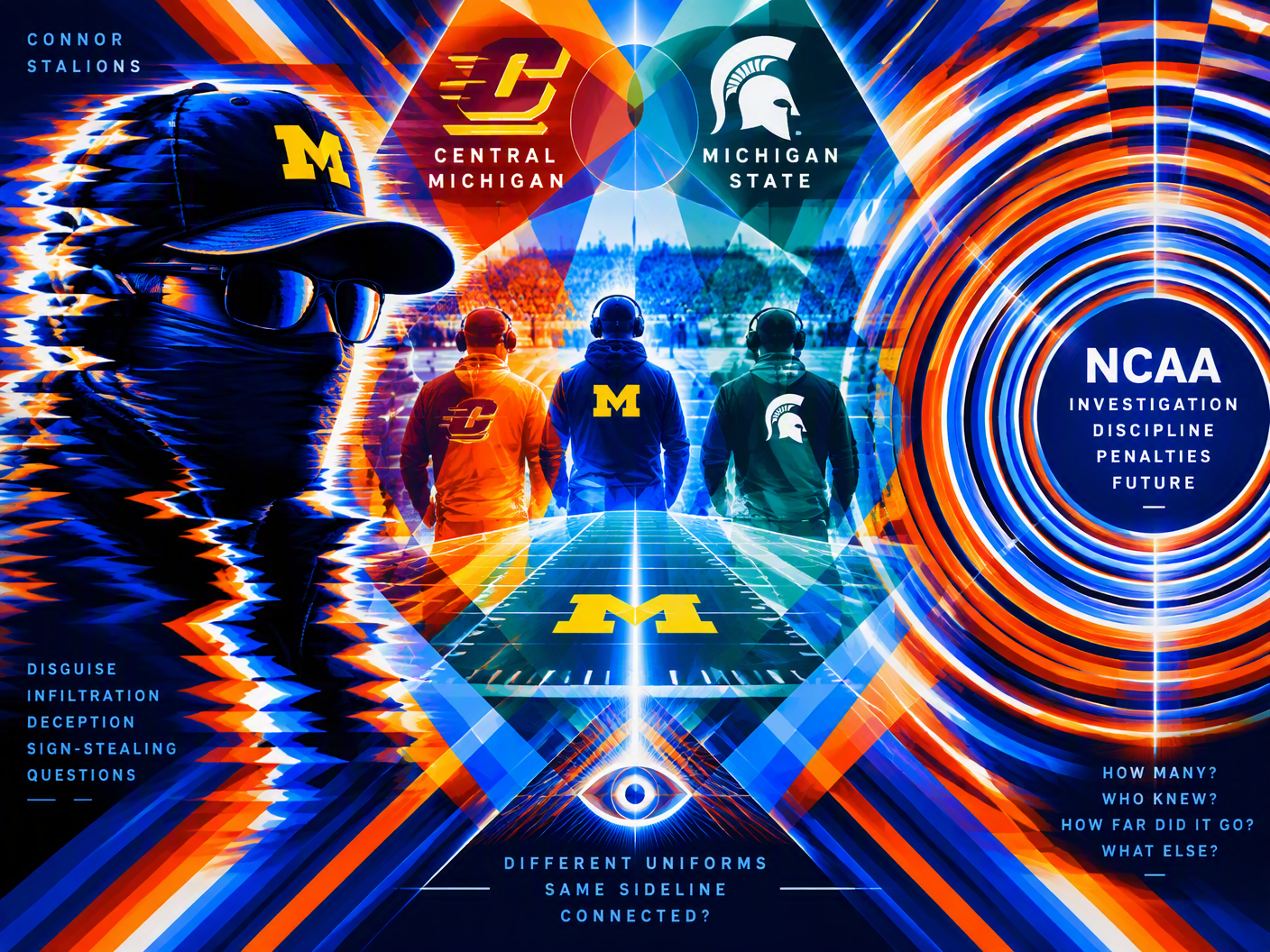
On November 3, 2023, Connor Stalions resigned from Michigan Athletics. The decision came thirteen days after he had been suspended with pay and after the NCAA opened an investigation into accusations that Michigan football staff members had obtained opponents’ signals through prohibited scouting practices. Stalions had become the investigation’s central figure: a former recruiting staffer accused of buying tickets, attending games, and recording video of opposing teams. His departure did not close the case. It gave the inquiry a fixed personnel consequence while the larger questions remained in motion.
The NCAA inquiry began in 2023, when sign stealing moved from a familiar competitive suspicion into an institutional matter. Football teams exchanged signals from crowded sidelines, and the line between observation and organized advance scouting depended on rules, access, and method. Stalions was drawn into that line of scrutiny because his work placed him near the practical business of gathering information. The allegations centered not on a single gesture or play, but on whether a staff operation had turned opponents’ sideline communications into material prepared for future games.
One earlier date became important as investigators and reporters traced the episode backward. On September 1, 2023, Central Michigan played Michigan State, and a photograph emerged showing a man identified as Stalions in disguise on Central Michigan’s sideline. The image placed him inside a question that extended beyond Michigan’s own staff: whether he had entered another program’s working area while posing as someone else, and what purpose that presence served. Central Michigan began examining the matter and later cooperated with the NCAA inquiry.
The Central Michigan photograph acquired force because it connected an individual already under scrutiny to a separate game involving Michigan State. It did not arrive as a formal ruling; it arrived as an object to be examined—an image, a date, a sideline, and a question about identity. That distinction shaped the public controversy. The appearance became part of the larger investigation, while the underlying claim about misconduct remained a matter for institutional review rather than a completed adjudication.
The paper trail added another complication. The University of Michigan had no records of Stalions filing expense reports while he was employed by the football team. That absence did not explain how tickets, travel, or video might have been obtained, but it narrowed what the university could produce when the inquiry turned toward routine administrative records. The controversy therefore developed along two tracks: one involving the conduct attributed to a staffer, the other involving the records an institution could locate when asked to account for his activities.
On October 20, before the resignation, Michigan suspended Stalions with pay. The measure placed him outside the team’s ordinary operations while the NCAA investigation advanced. Fourteen days later, he resigned. Michigan stated that he had resigned from his position with Michigan Athletics, and the institutional relationship ended before the larger case reached its final stage. The sequence—investigation, paid suspension, resignation—showed how a university could act against an employee while the governing authorities continued to determine what rules had been violated and by whom.
The conference then created a second line of consequence. The Big Ten suspended Jim Harbaugh for Michigan’s final three games of the 2023 regular season. The sanction addressed the head coach’s position within conference competition even as the NCAA process continued to examine the alleged sign-stealing operation. The Big Ten had not received evidence establishing that Harbaugh knew about the scheme. That fact shaped the public dispute without removing Harbaugh from the conference’s reach: discipline arrived through the league’s authority, not through a criminal proceeding.
Michigan sought a temporary restraining order against the suspension, but the request was not ruled on before the Penn State game on November 11. The legal calendar therefore became part of the sporting calendar. Harbaugh could not coach Michigan in State College, Pennsylvania, and the team proceeded under an acting coach. The order of events mattered: the conference penalty took effect before a court could decide whether to interrupt it, leaving Michigan to manage the game under the sanction already imposed.
Sherrone Moore, Michigan’s offensive coordinator, stepped in as acting coach for the Penn State game. His temporary authority reflected the practical structure of college football, where a suspension of the head coach could be imposed on a weekend schedule that allowed little time for institutional adjustment. Later, ESPN reported that Moore was expected to receive a two-game ban as the matter continued into its next phase. The personnel consequences had begun to spread beyond Stalions, even though the central factual questions remained unsettled.
By then, the investigation had acquired several different kinds of evidence: staff employment records, ticket and expense questions, a sideline photograph, institutional inquiries, and conference action. Each answered a different question. Stalions’s resignation established his departure, not the full scope of the alleged operation. The photograph established a reported subject of inquiry, not a final finding of misconduct. The suspension established the Big Ten’s response, not the competitive effect of every alleged act. The case continued because those categories could not simply be substituted for one another.
The public dispute also resisted a simple conclusion about Michigan’s advantage. The NCAA investigation established that the governing body treated the allegations as serious enough to pursue, while the conference imposed an immediate penalty on Harbaugh. Neither action by itself resolved how much any alleged sign gathering changed a game, whether every reported act belonged to one coordinated program, or what Harbaugh knew. Those questions remained active as later discipline and litigation extended the controversy beyond the 2023 season.
What endured was not a single final image but an altered arrangement of responsibility. Stalions was gone from Michigan by November 3. Harbaugh’s suspension removed him from the sideline for three regular-season games, and Moore assumed the team’s immediate authority before facing a reported two-game ban of his own. Central Michigan’s sideline became part of the inquiry because one photograph widened the geography of the case. The NCAA investigation carried the matter forward into 2025, preserving the distinction between an allegation that changed institutions and a finding that could finally settle it.
Investigative Dossier & Evidence
Read the companion investigation notes, verified source claims, and primary documents.
Read the Companion Notes & Evidence Record →