
Scandals & Feuds · 1990s
The Simpson Trial and the LAPD Credibility Dispute
The murders of Nicole Brown Simpson and Ronald Goldman produced a televised criminal trial in which DNA evidence, police credibility, and racial bias became inseparable from the question of guilt. On October 3, 1995, the jury acquitted O. J. Simpson after less than four hours of deliberation, leaving Los Angeles divided over what the verdict had decided.
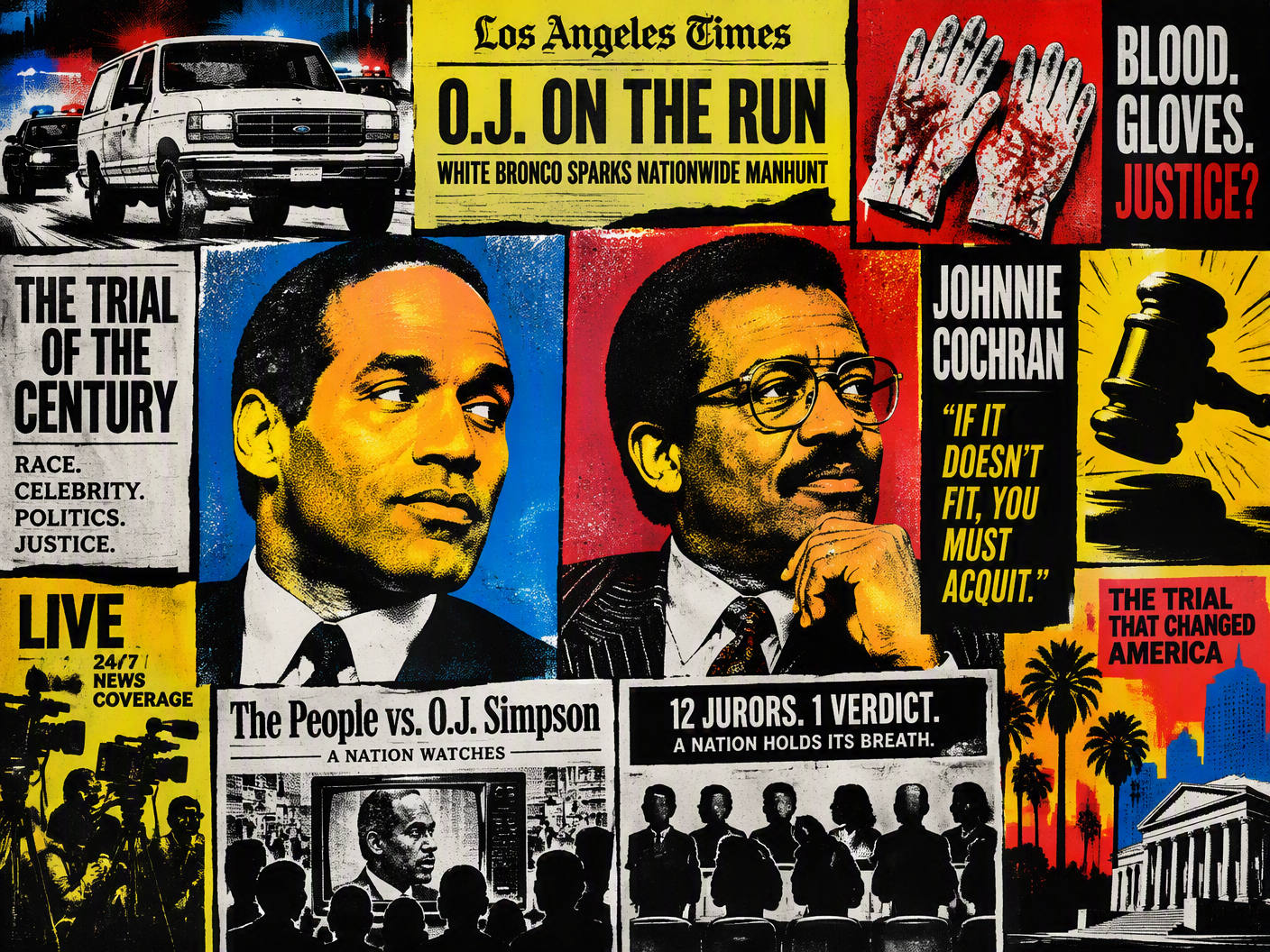
Nicole Brown Simpson and Ronald Goldman were stabbed to death outside Brown’s home at 875 South Bundy Drive in Los Angeles on June 12, 1994. Four days later, authorities charged O. J. Simpson, the former NFL player whose public identity had been built through football, television, and advertising. The case moved quickly from a double homicide in Brentwood to a national legal spectacle. What happened to Brown and Goldman remained the human center of the prosecution, but the trial would also test whether a Los Angeles police investigation could command confidence across a city divided by race, policing, and history.
On June 17, Simpson became the subject of a low-speed police chase in a white Ford Bronco. Al Cowlings drove while Simpson remained inside, and officers followed the vehicle through the Los Angeles area before he surrendered. The pursuit transformed the criminal case into a public event before a courtroom had heard its first argument. It also placed Simpson’s celebrity beside the ordinary procedures of charging, pursuit, and custody, showing how fame could alter the scale at which a local homicide was watched and discussed.
The trial began on January 24, 1995, at the C. S. Foltz Criminal Courts Building. Judge Lance Ito presided over 134 days of testimony, argument, and evidentiary conflict. Lead prosecutor Marcia Clark told jurors that blood evidence would connect Simpson to the killings. The defense, led by Johnnie Cochran, built its case around a different vulnerability: if jurors could not trust the Los Angeles Police Department or the authenticity and handling of the prosecution’s evidence, then the physical case could no longer carry its intended force.
That dispute made the police department part of the defendant’s story. The prosecution presented physical evidence as a path from Simpson to the crime scene. The defense treated the investigators who collected and presented that evidence as an independent question the jury had to answer first. The argument was not simply about laboratory results. It concerned whether police conduct, institutional culture, and the history of racial bias in Los Angeles had contaminated the public authority behind those results. For jurors, scientific evidence arrived attached to the credibility of the people who carried it into court.
Former LAPD detective Mark Fuhrman became central to that credibility dispute when his racial comments entered the trial’s public meaning. The defense used those comments to challenge the department’s integrity and to argue that institutional racism could not be separated from the investigation. Cochran told the jury that their verdict could redress that racism. The defense therefore offered acquittal as both a legal decision and a judgment on police power, asking jurors to weigh not only what the prosecution’s evidence showed but also what the department represented to Black Los Angeles.
The courtroom’s social pressure became visible on April 21, 1995. Thirteen jurors and alternates refused to proceed until Ito met with them. The protest interrupted the trial’s formal sequence and forced the judge to address the people expected to sit silently through its proceedings. Their action did not decide the case, but it revealed that the jury itself was an institution with internal tensions, demands, and limits. In a trial already burdened by race and police credibility, the jurors were not invisible recipients of evidence; they were participants in a strained public process.
The length of the proceeding gave every major argument time to travel beyond the courthouse. Prosecutors maintained that the blood evidence pointed toward Simpson’s responsibility for the murders. Defense lawyers returned to police integrity, evidence handling, and the possibility that prosecution materials could not be trusted. Those positions reached viewers through daily televised coverage, where legal procedure became a household conversation and the meaning of reasonable doubt was filtered through existing experiences with the LAPD. The trial placed forensic science and public institutions on the same witness stand.
On October 3, 1995, the jury returned not-guilty verdicts on both murder charges, and Simpson was released from custody. The jury had taken less than four hours to reach its unanimous decision. The speed mattered because it became part of the interpretation that followed. To some observers, it suggested that the defense had reduced the case to a decisive question about police credibility. To others, it appeared to show that the jury had rejected the prosecution’s account with unusual finality. The legal endpoint was clear even as its meaning remained contested.
Los Angeles did not receive the verdict as a single civic judgment. A Los Angeles Times poll found that 51 percent of county residents disagreed with the not-guilty decision, while 41 percent agreed with it. The same poll found broad agreement that Fuhrman should face charges stemming from his racial comments. Those figures measured public reaction rather than criminal responsibility, but they showed how the case had divided the city’s understanding of justice. The verdict could release Simpson from custody while leaving the police department, the prosecution, and the meaning of evidence under public examination.
For Brown’s family and Goldman’s family, the case had begun with two people killed outside a home and ended with a defendant walking free after a national trial. For Los Angeles, the case carried another burden: the legal system had asked jurors to decide a homicide prosecution through evidence presented by a police department whose credibility had become inseparable from racial history. The acquittal established the jury’s decision, not a universal account of what happened. Brown and Goldman remained dead; Simpson remained acquitted; and the city continued carrying the unresolved conflict between forensic proof and institutional trust.
Investigative Dossier & Evidence
Read the companion investigation notes, verified source claims, and primary documents.
Read the Companion Notes & Evidence Record →