
Bizarre & Myths · 1970s
The Pitch Invasion That Moved the 1972 European Cup Winners' Cup Final Indoors
Rangers defeated Dynamo Moscow 3-2 at Camp Nou on 24 May 1972, but supporters entered the field before the final whistle and forced the last minute to be played after the pitch was cleared. The trophy was presented to captain John Greig inside the stadium, and UEFA later imposed a two-year ban on Rangers before reducing it to one.
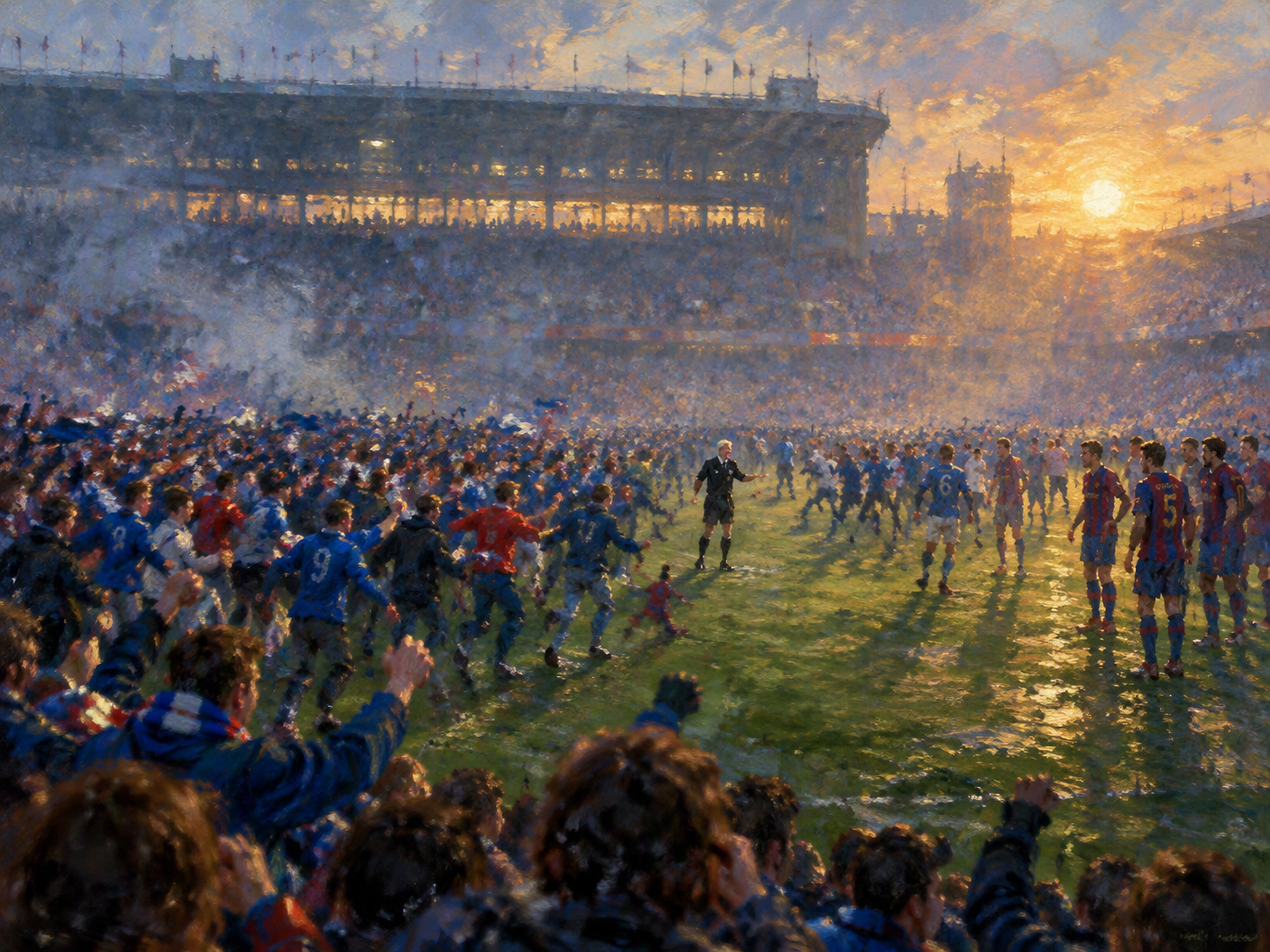
On 24 May 1972, at Camp Nou in Barcelona, the European Cup Winners' Cup final changed shape before it ended. Rangers led Dynamo Moscow 3-0, then conceded twice late in the match. Before José María Ortiz de Mendíbil could bring the game to its formal conclusion, Rangers supporters entered the pitch. Spanish police and officials cleared the playing area, and the final minute was played. The score remained 3-2. The result belonged to Rangers; the closing scene belonged to the crowd, and it altered the ceremony that followed.
The match had been built around a widening Rangers lead and then narrowed by Dynamo's late response. Colin Stein scored for Rangers, while Willie Johnston scored twice, giving the Scottish club its three goals. Dynamo Moscow's two goals transformed the margin without overturning it. By the time supporters crossed onto the field, Rangers were still ahead, but the arithmetic no longer carried the ease of a settled victory. The final minute had to be restored before the referee could close the competition in the ordinary way.
Willie Waddell, Rangers' manager, had brought his team through the competition to the Barcelona final. On the field, Ortiz de Mendíbil officiated the match while the two clubs contested the cup under the rules and authority of European football's governing body. The surviving public account fixes the essential order: Rangers established a three-goal advantage, Dynamo Moscow reduced it by two, and the supporters' entry came before the whistle. That sequence matters because the invasion interrupted the conclusion of a match Rangers were already winning; it did not create the scoreline.
The entry onto the pitch made the final minute an administrative problem as well as a sporting one. Players could not complete the contest while the playing area was occupied, and the field had to be cleared before the match resumed. The intervention by Spanish police returned the surface to the teams, allowing the officials to complete the remaining minute. The public ending was therefore divided: the result was settled in footballing terms, but the final whistle arrived only after order had been re-established around the game.
When the match finally ended, the usual presentation could not take place on the pitch. John Greig, Rangers' captain, received the trophy inside the stadium buildings rather than before the spectators gathered around the field. Rangers officials joined him there. A cup normally handed across an open playing surface was instead carried into the protected interior of Camp Nou, where the ceremony could proceed away from the supporters who had entered the pitch. The location of the presentation became part of the final's permanent account.
That indoor ceremony also separated the achievement from its public display. Rangers had won 3-2, but Greig did not lift the cup in the conventional space where a European final was meant to conclude. Dynamo Moscow, having scored twice after falling three goals behind, sought a replay after the invasion. The request belonged to the immediate dispute over what the crowd's conduct had done to the match. It did not change the official result: Rangers remained the winners, while the circumstances of the ending became the subject of the next argument.
The aftermath moved from Camp Nou to UEFA's disciplinary jurisdiction. The governing body treated the supporters' behavior as conduct for which Rangers could be punished and imposed a two-year ban on the club. The sanction was not a second scoreline or a replayed final. It was an institutional consequence attached to the invasion and to the club whose supporters had entered the field. Rangers' European future was placed under restriction because the match had not remained within the boundaries expected of a final.
The ban did not remain at its original length. UEFA later reduced the punishment from two years to one, preserving a sanction while changing its duration. That revision created a second official decision in the aftermath: first, the governing body imposed the larger exclusion; later, it moderated the term. The record consequently holds two versions of Rangers' penalty, not one. The reduction softened the practical effect on the club, but it did not erase the disciplinary finding that followed the pitch invasion.
Over time, the Barcelona final acquired explanations that reached beyond its documented sequence. The public record firmly preserves the score, the late goals, the invasion, the cleared pitch, Greig's indoor presentation, and UEFA's reduced ban. It does not turn the crowd's entry into a proven deliberate anti-Soviet act, nor does it establish that Ortiz de Mendíbil intentionally manipulated the contest. Those interpretations belong to the afterlife of the match, while the settled events remain narrower: Rangers won, the ceremony moved inside, and the club was disciplined.
The final endured in that divided form. Rangers' 3-2 victory gave John Greig the cup and Willie Waddell's team the title, with Stein and Johnston supplying the goals that produced it. Yet the trophy's journey inside Camp Nou and UEFA's later one-year ban attached a second structure to the occasion. The match entered the record not simply as a contest completed on a field, but as a final whose last minute had to be recovered, whose ceremony required shelter, and whose club carried the consequence into the seasons that followed.
Investigative Dossier & Evidence
Read the companion investigation notes, verified source claims, and primary documents.
Read the Companion Notes & Evidence Record →