
Tragedy · 2000s
The Banked Oval That CART Could Not Make Safe
At Texas Motor Speedway, sustained speeds above 230 mph produced forces and symptoms that drivers could not manage through a full race distance. CART postponed the Firestone Firehawk 600 on April 29, 2001, then canceled it after officials and manufacturers failed to find a timely way to slow the cars.
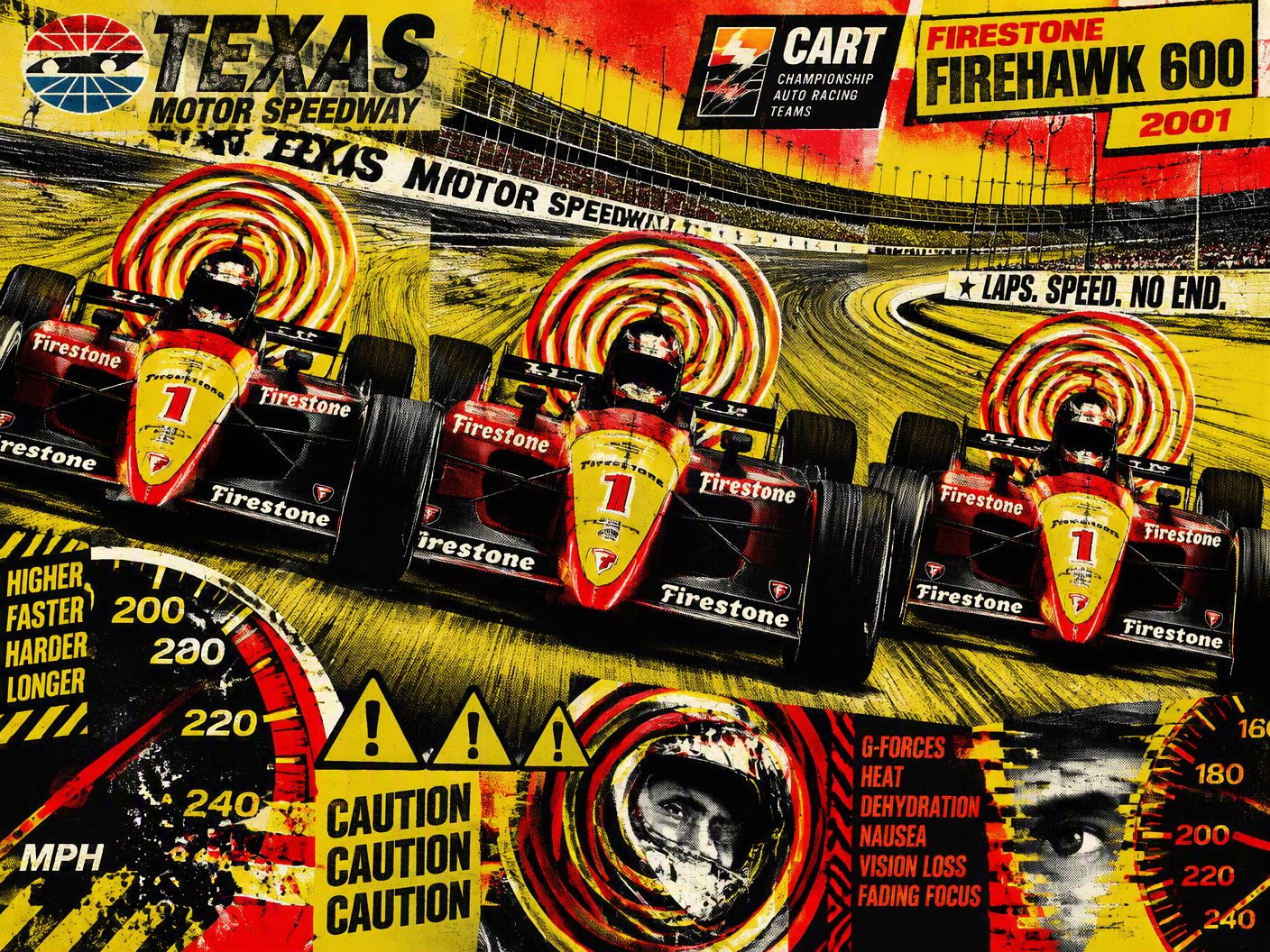
Mauricio Gugelmin lasted 25 laps before the banked oval began to move beneath him. The Champ Car driver reported dizziness after the run, one of several drivers who found that the problem emerged not in a single corner but through repetition: lap after lap, at speeds the body had to absorb as continuously as the car. On April 29, 2001, CART postponed the scheduled Firestone Firehawk 600 at Texas Motor Speedway. The race had become a workplace in which the workers could no longer reliably control the equipment.
The Texas track demanded a particular kind of speed. Practice and qualifying runs exceeded 230 miles per hour, while the steeply banked oval pushed the cars and their drivers vertically and sideways at the same time. Honda measured vertical loads of up to four gs and lateral loads above five. Those figures were not brief impacts from a collision. They were forces encountered while the cars circled the track, asking drivers to maintain precision while their vision, balance, and orientation began to deteriorate.
The symptoms spread across the field. In a private meeting, 21 of the 25 Champ Car drivers told officials that long runs produced dizziness, nausea, or visual distortion. The majority had experienced periods of dizziness and disorientation when they tried to run more than a handful of laps in succession. A racing weekend normally sorts competitors by lap time, fuel strategy, and mechanical reliability. At Texas, the relevant division was becoming physical: who could remain oriented long enough to keep the car on the banking.
Dr. Steve Olvey, CART’s director of Medical Affairs, described drivers pulling off the track after extended stints above 230 miles per hour because they no longer felt able to control the cars safely. The distinction mattered. A driver who pits with a damaged tire has encountered a mechanical failure; a driver who cannot trust his own balance or vision has lost the human capacity on which every steering correction depends. The issue had moved beyond discomfort and into the basic question of whether a full-speed race could be operated responsibly.
Michael Andretti, who had spent two decades racing, said he had never experienced forces like those at Texas. He publicly praised CART’s safety decision. Gil de Ferran, the defending CART champion, described the speeds as uncharted territory and identified the problem as physical or physiological. Their statements placed the conflict inside the racing profession itself. The drivers were not asking for easier work; they were describing a condition in which the ordinary skills that made them valuable could be compromised by the conditions of employment.
That condition had been produced by an arrangement shared across the event: a high-speed oval, purpose-built racing cars, powerful engines, aerodynamic design, and a schedule that expected drivers to sustain performance rather than demonstrate it for a single lap. Speed was the product being sold to spectators and sponsors, but the cost of producing it was carried inside the cockpit. The same conditions that made the race attractive also narrowed the margin between professional control and physical disorientation.
CART officials did not treat the drivers’ reports as an isolated complaint. Representatives of every engine and chassis manufacturer joined the effort to investigate ways to slow the cars down. The search was practical and immediate: find a change that could reduce the forces without turning the race into a different event. But the weekend had already reached its decision point. The teams had prepared to compete, the manufacturers had supplied the equipment, and the officials now had to determine whether any adjustment could be made before the cars returned to the track.
Joe Heitzler, CART’s chief executive, announced the postponement on April 29. He said the decision had the support of Firestone and the engine manufacturers, placing the cancellation inside the same commercial network that had built the event. The authority to stop the race belonged to CART, but the consequences touched everyone connected to the weekend: drivers whose bodies had absorbed the loads, teams that had brought cars to Fort Worth, manufacturers responsible for performance, and a speedway whose scheduled competition would not take place.
The postponement did not become a short delay while officials searched for a minor adjustment. On April 30, Honda stated that CART officials had concluded that a successful solution to slow the cars could not be achieved at that time. The race’s status hardened from postponed to canceled. Later listings for the Firestone Firehawk 600 Presented by Pioneer identify April 29, 2001, as the date of a race canceled for safety concerns, preserving the distinction between an event interrupted by weather and one abandoned because its operating conditions could not be made acceptable.
The decision also exposed a limit in the way speed had been treated. Engineers could calculate loads, manufacturers could alter components, and officials could set rules, but none of those systems could make dizziness irrelevant once it appeared in the cockpit. The drivers supplied the most immediate measurement: their ability to complete long runs without losing orientation. At Texas, that measurement turned against the event. The race could be organized on paper, but the people required to perform it could not safely sustain the conditions written into the schedule.
Gugelmin’s 25-lap run remained a small, human-scale measure of the larger failure. He had not simply found the limit of a machine; he had reported finding the limit of his body while operating one. Andretti’s experience, de Ferran’s description, and the private testimony of most of the field gave that limit a wider shape. By the time Heitzler announced the postponement, CART was no longer choosing between competing strategies. It was choosing whether the workers inside the cars could be asked to continue.
Investigative Dossier & Evidence
Read the companion investigation notes, verified source claims, and primary documents.
Read the Companion Notes & Evidence Record →