
Tragedy · 1960s
Puerta 12: The Exit Crush That Left River Plate and Boca Juniors Without an Answer
After the 0–0 River Plate–Boca Juniors match on June 23, 1968, spectators leaving through Gate 12 were caught in a fatal crowd crush. Seventy-one people died, hundreds were injured, and later prosecutions, appeals, and club memorials never fixed a single cause or responsible institution.
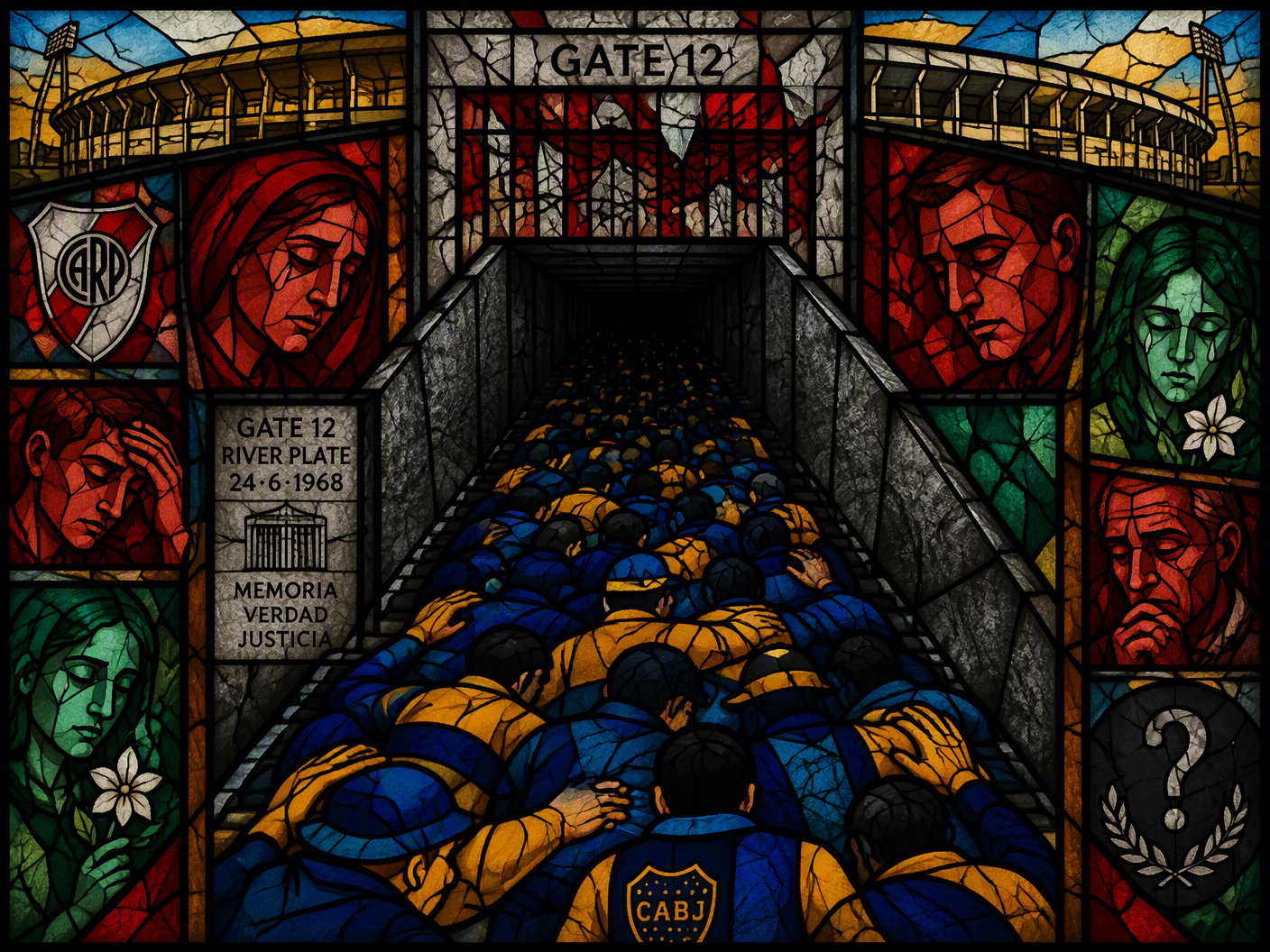
The River Plate–Boca Juniors match ended 0–0 on June 23, 1968. Then the spectators began to leave Estadio Monumental. At Gate 12, the exit assigned to visiting supporters, bodies compressed into a moving mass. People fell in the passage and others were forced against them. The crush became fatal before the crowd could clear the stadium. By the time the emergency response had ended, 71 people were dead. Injury totals varied, from more than 200 in some accounts to 113 in another summary. The match had produced no winner. The exit produced a disaster.
Gate 12 was not an incidental opening in the stadium perimeter. It was the designated route for fans of Boca Juniors, River Plate’s visiting rival. That arrangement concentrated an entire departing section of the crowd at one point after the final whistle. The victims were identified as Boca supporters, bound together by the club they had come to watch and by the exit they were expected to use. The danger emerged after play had stopped, when the ordinary act of leaving became a contest over space, movement, and control.
The physical description of the passage explains why the exit became so difficult to navigate. The tunnel was dark and poorly lit. Eighty steep steps descended without handrails. In a crowd moving downhill, each obstruction narrowed the margin for recovery: a stumble could interrupt the people behind, while those at the front had little room to retreat. These conditions establish a hazardous route. They do not, by themselves, identify the event that transformed congestion into lethal compression. That question remained open after the dead had been counted.
The central dispute formed immediately around that missing moment. Some accounts placed police action at the center, alleging that officers blocked or pushed back spectators. Other versions focused on the gate, with claims that it had been locked. Neither proposition acquired a settled legal status. The gate’s condition was not established consistently, and police responsibility was never fixed as the sole explanation. What remained certain was narrower and more severe: a crowd entering or passing through Gate 12 had compressed until dozens of people could not survive it.
Police inspected the site on June 24, the day after the match. The inspection confronted investigators with an exit whose darkness, steep descent, and lack of handrails had become part of the public explanation. But identifying dangerous conditions was different from proving which decision caused the deaths. The immediate sequence inside the passage—who moved first, what stopped the flow, and whether an obstruction or intervention triggered the collapse—did not produce a single account capable of closing the question.
River Plate’s institutional responsibility entered the courts through two of its directors, Américo Di Vietrio and Marcelino Cabrera. Prosecutors charged them with negligence after the disaster. The case converted a public catastrophe into a specific legal question: whether club officials had breached duties connected to the stadium and its exit arrangements. The prosecution named individuals with authority inside the host club. It did not, however, yield a final finding that assigned the entire event to River Plate.
The Court of Appeals later declared Di Vietrio and Cabrera innocent. A separate civil proceeding involving the families of victims reached judgments in 1971 that identified no cause or culpable party. The legal system had therefore addressed the disaster through both criminal negligence charges and civil claims, but neither track supplied the definitive explanation families and institutions would have needed. The prosecutions ended without convictions. The civil cases ended without a responsible actor.
The numbers also resisted complete closure. Seventy-one deaths became the official figure repeated across the later accounts. The injury count did not settle with the same precision: some accounts placed it above 200, while another summary listed 113. The difference did not alter the scale of the event, but it exposed the unevenness of the surviving public account. The death toll was treated as fixed for official purposes; the number of injured and the mechanics of the crush remained less stable.
River Plate eventually marked the location itself. In 2008, the club installed a commemorative plaque at the site, now identified as Gate M. The plaque converted an exit into a place of institutional memory. It did not resolve whether the police, the club, the design of the passage, or a combination of conditions had produced the compression. It preserved the location where the deaths occurred while leaving the legal question of responsibility intact.
Boca Juniors gave the date a formal place in its own calendar. On June 23, 2021, the club declared a day of mourning and observed a minute of silence. The gesture connected the victims to the community that had occupied the visiting section in 1968. River Plate’s plaque and Boca’s mourning served different institutional purposes, but both acknowledged the same fixed point: the match ended at zero goals, and the exit at Gate 12 ended 71 lives. Neither memorial supplied the missing cause.
Investigative Dossier & Evidence
Read the companion investigation notes, verified source claims, and primary documents.
Read the Companion Notes & Evidence Record →