
Tragedy · 1st century AD
The Stones and Swords at Pompeii’s Amphitheatre
Built with private money and civic ambition, Pompeii’s amphitheatre became the scene of a 59 CE fight that brought a ten-year Roman ban on public gatherings. Earthquake, eruption, and modern performance later gave the site other lives without erasing the violence that first fixed its place in history.
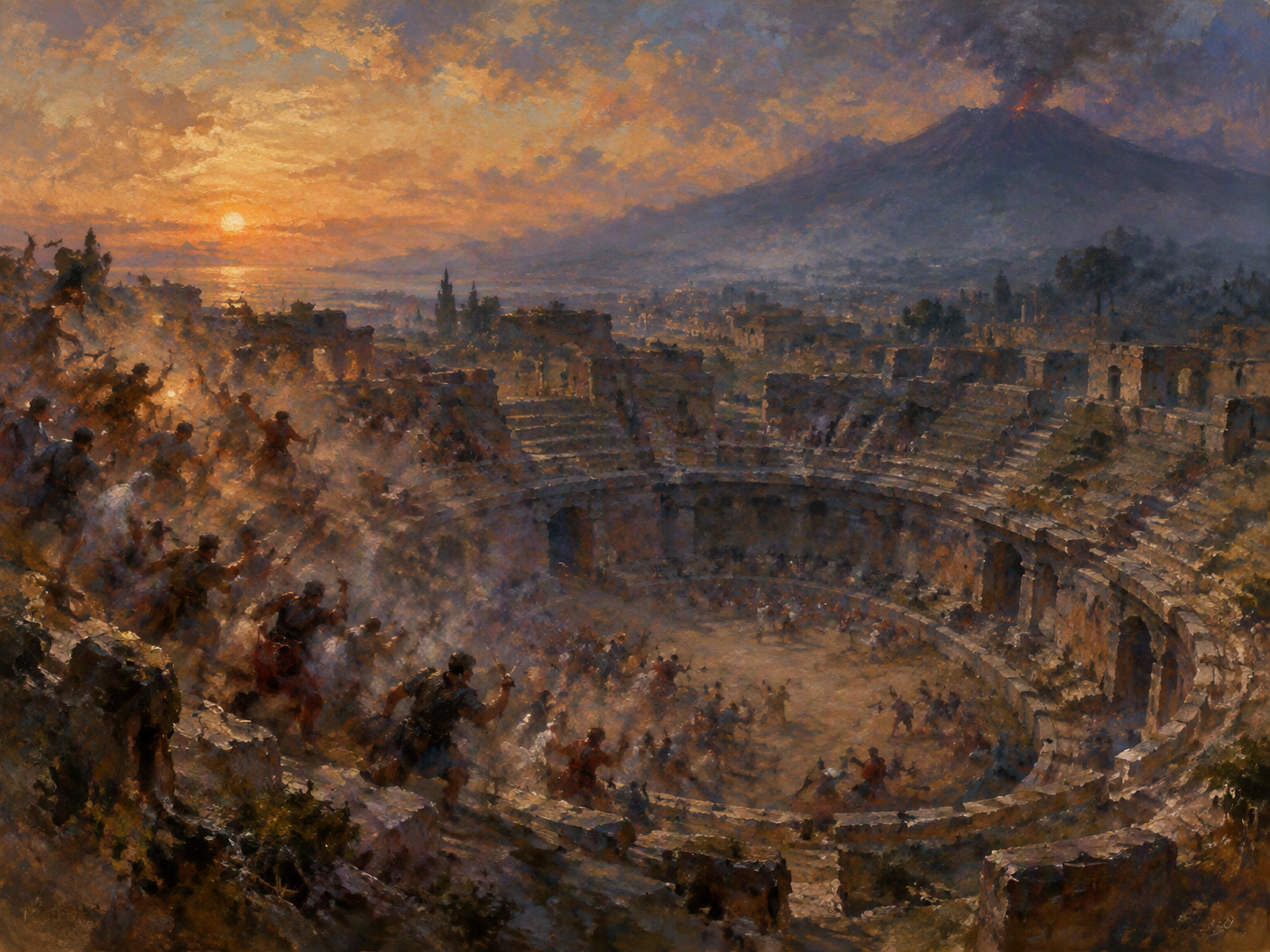
The stones came first. Then the swords. During games at Pompeii’s amphitheatre around 59 CE, residents of Pompeii fought visitors from Nuceria until the disturbance moved beyond the ordinary abuse of spectators. Stones were thrown. Swords were drawn. Men were wounded, and the contest on the sand gave way to a public fight in the stands and around them. The building had been made for crowds, money, and civic display. For one afternoon, it became the place where a local grievance met an armed audience.
The amphitheatre stood at the edge of Pompeii by about 70 BCE, built through the private funds of Gaius Quinctius Valgus and Marcus Porcius. Their money bought more than seats and spectacle. It gave the city a permanent place for games, a structure large enough to gather Pompeians and outsiders under the same public roof. The donors’ names belonged to construction and patronage. The residents who later fought there supplied the building with a different kind of memory.
Pompeii and Nuceria were not separated by a locked door when the trouble began. Their people had come to the same games, and the gathering turned against itself. The violence was not simply a theatrical accident produced by the sport. The games provided the occasion; the people supplied the choices. A thrown stone made a second stone possible. Then weapons entered the dispute. By the time the fighting was over, the amphitheatre had become a civic liability rather than a monument to the generosity of its builders.
Rome answered with a punishment aimed at the city, not merely at the men who had thrown stones or drawn blades. The Roman senate barred Pompeii from holding similar gatherings for ten years. The prohibition removed the city’s right to use its own public stage for the kind of event that had filled it. Under Nero, the penalty traveled from the arena to the civic calendar. The empty interval was part of the sentence. Pompeii could keep its walls, but not the gatherings those walls had been built to contain.
The ban did not destroy the amphitheatre. It left the structure in Pompeii, tied to a punishment that outlasted the shouting. Games had once converted private funds into public prestige. Now the same venue carried the cost of disorder. No stone inscription could make that contradiction disappear. A city had accepted the benefits of spectacle and then lost control of the crowd it had invited. The senate’s response was plain: the privilege of gathering could be withdrawn when the gathering became a threat.
Three years after the fight, the earth damaged the building. An earthquake struck Pompeii in 62 CE, and the amphitheatre required restoration. Cuspius Pansa, a Pompeian magistrate, undertook the work with his son. The repair placed another set of hands on the structure: not the donors who had financed its construction, but local officials trying to make a damaged public building usable again. The amphitheatre survived the senate’s restriction and then had to survive the ground beneath it.
Pansa’s restoration could not settle the building’s future. In 79 CE, Mount Vesuvius erupted and buried the amphitheatre along with Pompeii. The event ended its ancient public life in a single geological act, after the earlier political punishment and earthquake had already altered its meaning. The walls did not vanish. They were covered, held in place beneath the material of the eruption, while the city above them ceased to function.
Later retellings often compress the story into a sequence of theatrical phrases: an arena built for blood, a riot born from the games, a city buried alive. The secure sequence is harder and cleaner. The building existed by about 70 BCE. A fight between Pompeii and Nuceria occurred during games in 59 CE. Stones and swords entered it. Rome imposed a ten-year ban. An earthquake damaged the structure in 62 CE. Vesuvius buried it in 79. The facts need no extra executioner.
The site’s later life changed the terms without changing the past. Once excavated and preserved, the amphitheatre became a place people visited to look backward. Its public use did not end with archaeology. In July 2016, David Gilmour performed concerts there, bringing music into a structure whose earlier crowds had watched games and whose long silence had followed burial. The same tiers that had held Pompeiians and Nucerians could again hold an audience, this time beneath the rules of preservation and performance.
Gilmour’s concerts did not redeem the amphitheatre, and the eruption did not explain the riot. The building carried both histories without choosing between them. Valgus and Porcius had paid for its construction. Pompeii’s residents and Nuceria’s visitors turned one gathering into a fight. The senate closed the city’s public games. Pansa worked on the damaged stone. Vesuvius covered it. In July 2016, a modern performer stood where the ancient crowd had once gathered, and the old arena remained what it had always been: a public place shaped by whoever was allowed to use it.
Investigative Dossier & Evidence
Read the companion investigation notes, verified source claims, and primary documents.
Read the Companion Notes & Evidence Record →