
Bizarre & Myths · 2015
The Fourth-and-25 Lateral That Decided Arkansas–Ole Miss
Arkansas defeated Ole Miss 53–52 in overtime on November 7, 2015, after a fourth-and-25 completion became a 31-yard first down and Brandon Allen finished the game with a two-point conversion. The result also carried the memory of Houston Nutt’s departure from Arkansas and his later return to the rivalry as Ole Miss’s coach.
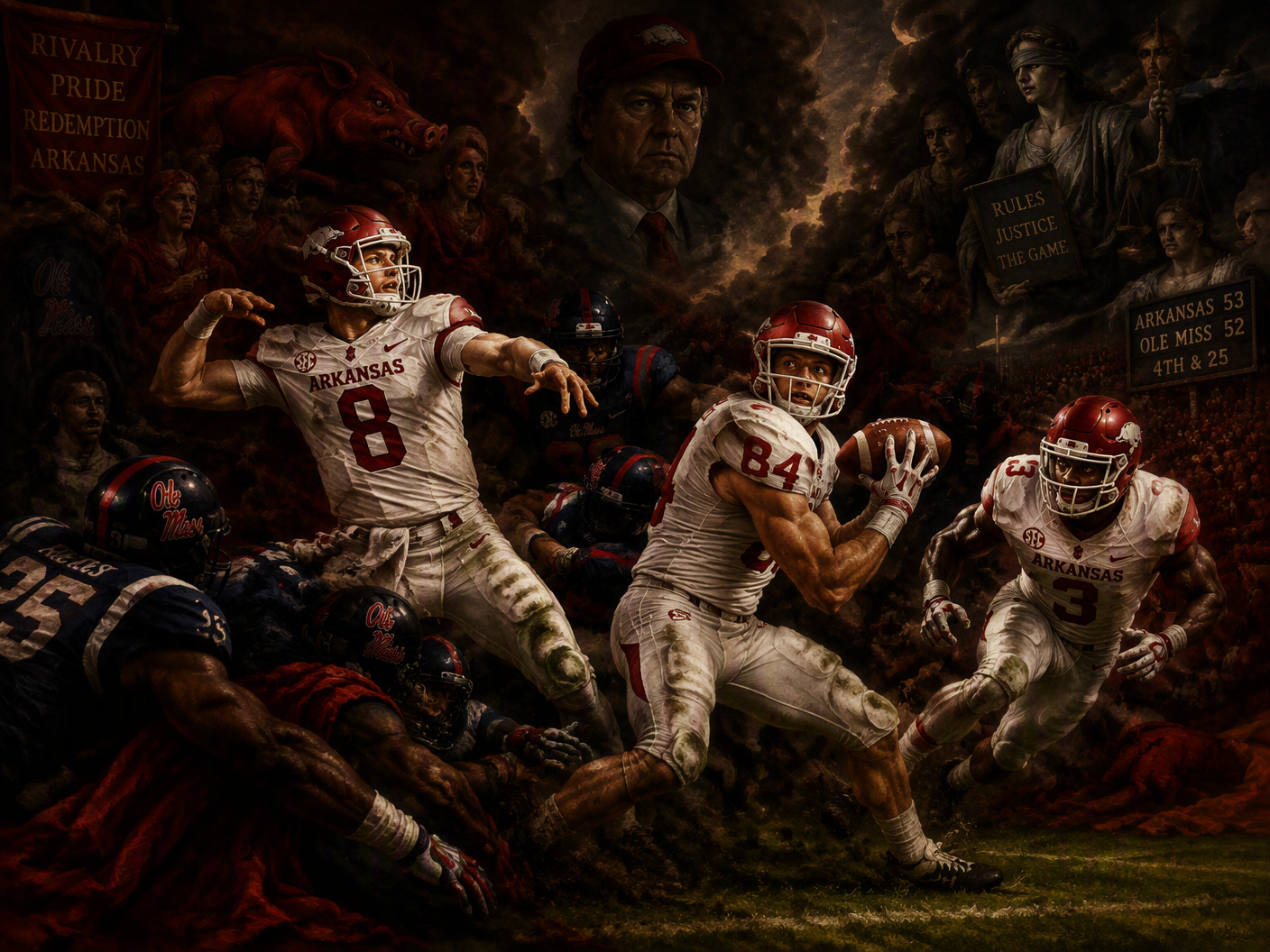
On fourth-and-25 in overtime, Arkansas quarterback Brandon Allen threw to tight end Hunter Henry. Henry caught the pass, then sent the ball backward toward running back Alex Collins. Collins gathered it and ran 31 yards for a first down. The conversion kept Arkansas alive in Oxford and created the possession that produced a 53–52 victory over Ole Miss on November 7, 2015. The decisive sequence was not a single act. It was a chain: a long fourth-down completion, a backward lateral, a running gain, and a final conversion that turned survival into a win.
The play began with a down that normally ends a possession. Arkansas needed 25 yards, and Allen’s pass reached Henry at the point where the completion could still be stopped short of the line to gain. Henry did not go down with the ball. He lateraled it backward toward Collins, preserving the play and transferring responsibility to the running back. Collins picked up the ball and gained 31 yards. That was enough for a first down, and it moved Arkansas from an apparent turnover on downs to another scoring opportunity.
Allen had already produced the kind of statistical workload that made the finish possible. He threw for 442 yards and six touchdowns during the game. Those numbers defined Arkansas’s offense before the overtime sequence arrived, but they did not decide the final margin by themselves. The last possession required Allen to extend a failing down, Henry to redirect the ball, and Collins to cover the remaining distance. The quarterback’s passing total established the scale of his performance. The fourth-and-25 play established how little of that performance could be separated from the decisions made after the catch.
The first two-point attempt after the extended possession did not end the game. Arkansas was penalized for a facemask on Ole Miss defender Marquis Haynes. The penalty forced another attempt and placed the final conversion after an additional official intervention. Arkansas then ran the next play, and Allen scored the successful two-point conversion. The sequence therefore had two separate hazards: the fourth-down play had to reach the line to gain, and the first attempt at the decisive conversion had to be discarded before the second could settle the score.
Allen’s run made the final arithmetic 53–52. Arkansas left Oxford with the overtime victory; Ole Miss remained on the wrong side of a one-point result that had been kept alive by a possession already beyond its apparent limit. The score did not require a supernatural explanation. It followed from the legal actions preserved in the sequence: Allen completed the pass, Henry lateraled backward, Collins advanced 31 yards, Haynes drew the facemask penalty, and Allen scored on the next conversion attempt.
The rivalry had acquired institutional memory years before the overtime finish. Houston Nutt left Arkansas after the 2007 season and moved to Ole Miss. On October 25, 2008, he coached the Rebels against Arkansas in Fayetteville, where Ole Miss won 23–21. Nutt therefore occupied both sides of the Arkansas–Ole Miss coaching relationship: he had led Arkansas, then returned as the opposing head coach. That history gave the matchup a personnel connection that reached beyond the players on the 2015 field.
Nutt’s change of employer did not control the 2015 play. By then, the coaches and players involved in the overtime sequence were operating within a different game and a different set of decisions. But the earlier crossover remained part of the rivalry’s context. Arkansas had once been Nutt’s program; Ole Miss became his next stop; and his 2008 team had already defeated Arkansas from the opposite sideline. The connection explained why the matchup carried a longer institutional memory than the final score alone could show.
The 2015 contest was decided by football actions rather than by the older coaching history. Allen’s six touchdown passes and 442 passing yards supplied Arkansas’s offensive production. Henry made the fourth-down reception, then moved the ball backward instead of ending the play with his own gain. Collins recovered the lateral and advanced it 31 yards. Haynes was penalized for the facemask on the initial two-point attempt. Allen finished the next play himself. Each action had a defined role in the result.
The fourth-and-25 conversion also changed the meaning of the possession. Before the catch, Arkansas faced a down that required an unusually long gain simply to continue. After Collins crossed the necessary distance, the possession became a scoring chance. The lateral was backward, not a second forward pass, and Collins’s 31-yard advance supplied the first down that the original completion could not provide on its own. The rule-governed sequence mattered because every later event depended on that initial extension.
Then the penalty introduced a second break in the finish. Arkansas’s first two-point attempt was nullified by the facemask call on Haynes. The successful play came afterward, when Allen ran the conversion that produced the one-point victory. The game’s ending was therefore not simply fourth down followed by celebration. It was fourth down, lateral, first down, an unsuccessful conversion attempt altered by penalty, and a second conversion that held. The order matters because changing any one of those steps changes the result.
Arkansas’s 53–52 overtime win became memorable because the decisive evidence was compact and exact. Allen threw for 442 yards and six touchdowns. Henry caught the fourth-and-25 pass and lateraled backward. Collins picked up the ball and ran 31 yards for a first down. Haynes was flagged for a facemask. Allen scored the successful two-point conversion on the next play. The older Nutt connection supplied the rivalry’s institutional background, but the final outcome rested on the players who executed those linked decisions in Oxford.
Investigative Dossier & Evidence
Read the companion investigation notes, verified source claims, and primary documents.
Read the Companion Notes & Evidence Record →