
Scandals & Feuds · 2010s
The Razor-Blade Claim and the $2.3 Million Hepatitis C Judgment
Devon Nicholson sued Lawrence Robert Shreve, known as Abdullah the Butcher, over an alleged 2007 in-ring cut and hepatitis C transmission. On June 3, 2014, an Ontario Superior Court judge ruled that Shreve transmitted the infection and awarded Nicholson $2.3 million in damages and fees.
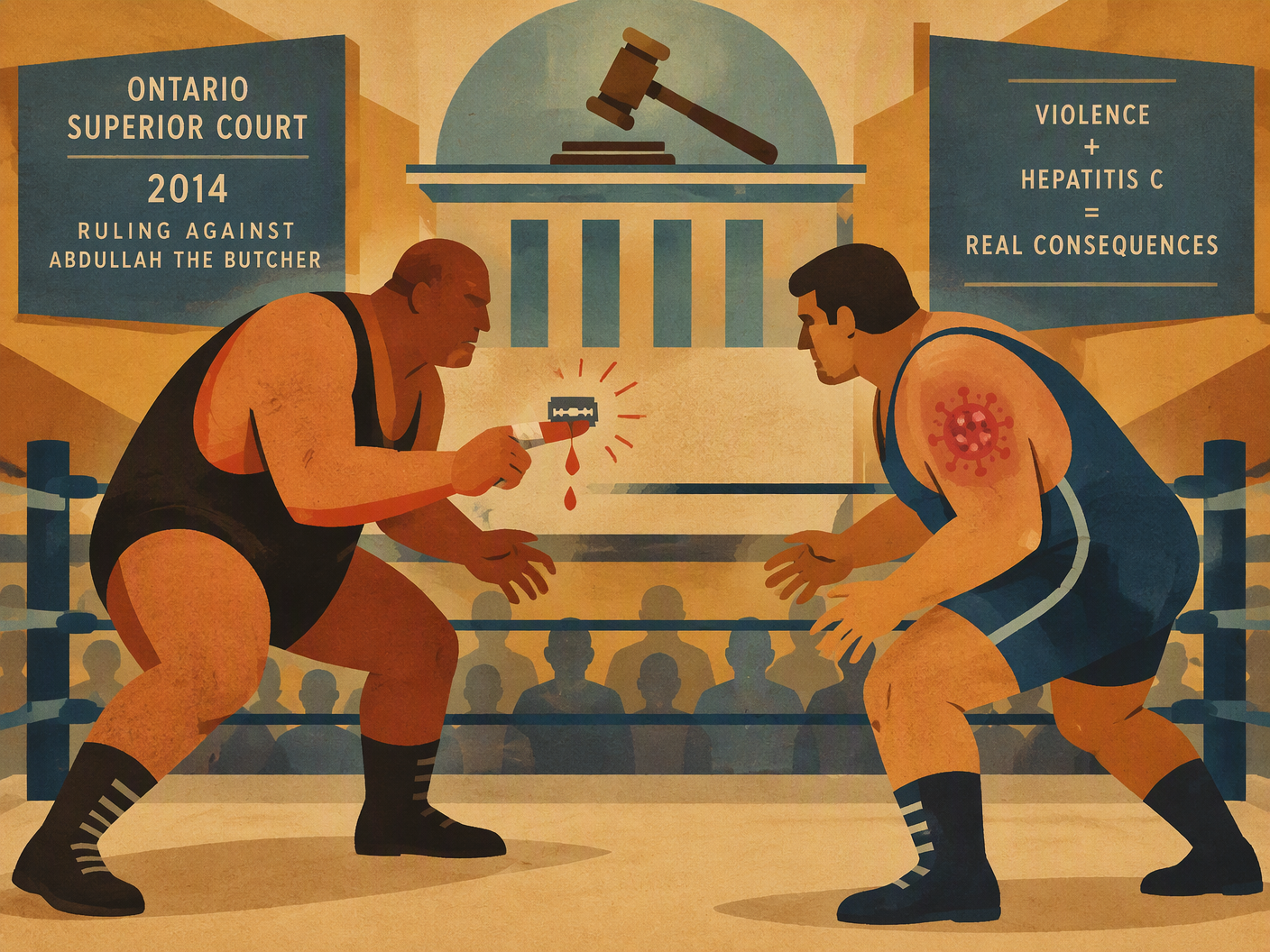
On June 3, 2014, an Ontario Superior Court judge ruled that professional wrestler Devon Nicholson contracted hepatitis C from Lawrence Robert Shreve, the veteran performer known as Abdullah the Butcher. The judge awarded Nicholson $2.3 million in damages and fees. The decision converted a violent allegation from a wrestling ring into a civil finding with a financial consequence measured in millions. It also fixed the central distinction in the case: the court imposed civil liability. No criminal conviction against Shreve formed part of that judgment.
Seven years earlier, Nicholson had placed the alleged transmission at a match in Cochrane, Alberta, on May 26, 2007. He said Shreve cut him during the performance and that the cut exposed him to hepatitis C. The claim depended on a particular act, not on the generalized risks of professional wrestling: Nicholson identified Shreve, the venue’s occasion, and the object he said caused the wound. He later filed suit against Shreve, carrying the accusation from the ring into Ontario’s civil courts.
Nicholson said the object was a piece of razor blade taped to Shreve’s finger. In wrestling, performers have long used controlled cuts to produce visible blood, but Nicholson’s lawsuit treated the practice as an act with medical and legal consequences. His allegation was that the blade cut him during the Cochrane match and that Shreve’s infection passed through that contact. The physical detail gave the lawsuit its mechanism: a concealed sharp edge, a break in the skin, and a disease whose effects could continue long after the audience had left.
Shreve denied the essential facts. CBC reported that he said he did not cut Nicholson and did not have hepatitis C. That position placed the two men on opposite sides of every decisive question: whether the blade was present, whether a cut occurred, whether Shreve carried the virus, and whether the infection reached Nicholson through that match. The denial did not end the case. Nicholson pursued a civil claim, where the judge evaluated the competing accounts and entered a ruling against Shreve.
The ruling came after the alleged match, not immediately after it. The interval mattered because the lawsuit joined a single event to a later medical condition and asked the court to assign causation between them. On June 3, 2014, the judge found that Nicholson had contracted hepatitis C from Shreve. The award of $2.3 million in damages and fees gave the finding an enforceable economic dimension. It was not an announcement by a wrestling promotion or a private settlement disclosed without a trial result; it was a judgment of the Ontario Superior Court.
The judgment also defined what kind of accountability the case produced. Nicholson won a civil award, and Shreve was held responsible for the infection under the court’s ruling. The accessible proceedings did not produce a criminal indictment or conviction against Shreve for the hepatitis C claim. That boundary does not reduce the amount awarded or erase the judge’s finding. It identifies the authority that acted and the remedy it supplied: a civil court determined liability and ordered damages and fees, rather than a criminal court imposing imprisonment or a criminal sentence.
Years later, Nicholson became the subject of a separate incident in Texas. On December 11, 2021, USA Today reported that he repeatedly stabbed referee Lando Deltoro on the head with a sharp object during World Class Pro Wrestling’s Christmas Star Wars event in Irving. Deltoro was hospitalized afterward. World Class Pro Wrestling banned Nicholson and announced that it would no longer be associated with him. The promotion’s response was immediate and institutional: remove the performer from the organization after an assault on an official.
The Texas incident did not reopen the hepatitis C judgment, and it did not supply evidence about what happened in Cochrane fourteen years earlier. It involved a different victim, a different location, and a different organization exercising its own authority. Deltoro was the referee at the 2021 event; Nicholson was the performer accused of attacking him. The reported hospitalization established the immediate human consequence, while the promotion’s ban established the professional consequence. Neither changed the Ontario court’s 2014 finding.
Nicholson faced another legal problem in Kingston, Ontario. In September 2022, PWInsider reported that he had been arrested on assault charges and was awaiting trial the following month. The arrest was separate from both the civil hepatitis C case and the Irving incident as presented in the available reporting. An arrest is a procedural event, not a conviction. Its significance here is narrower: the man who had secured a major civil judgment against a former opponent later appeared in reporting as the accused party in unrelated assault proceedings.
The sequence left three different forms of consequence attached to Nicholson’s name. In Ontario, a judge found that Shreve transmitted hepatitis C to him and awarded $2.3 million. In Texas, a wrestling promotion banned Nicholson after the reported attack on Deltoro, who was hospitalized. In Kingston, an assault arrest led toward a later trial. These events cannot be collapsed into one moral narrative without losing the legal structure that separates them. The civil judgment remains a judgment against Shreve; the Texas and Kingston matters concern Nicholson’s later conduct.
What endured from the original dispute was a specific judicial conclusion: Nicholson contracted hepatitis C from Shreve after the 2007 match in Cochrane, and the court valued the resulting damages and fees at $2.3 million. Shreve’s denial remained part of the public account, but it did not displace the ruling. The later incidents supplied no reversal and no criminal judgment against Shreve. They instead became separate entries in Nicholson’s legal and professional history, leaving the 2014 award as the final documented consequence of the razor-blade claim.
Investigative Dossier & Evidence
Read the companion investigation notes, verified source claims, and primary documents.
Read the Companion Notes & Evidence Record →