
Doping & Drugs · 2016
The Concealed Motor Found in a Bicycle Associated with Femke Van den Driessche
At the 2016 cyclo-cross world championships in Zolder, race officials detained and examined a bicycle associated with Femke Van den Driessche; the UCI said it contained a concealed electric motor and battery. Despite her reported denial of intentional use, the UCI found her responsible for technological fraud and imposed a six-year ban, a CHF 20,000 fine, and retrospective disqualification.
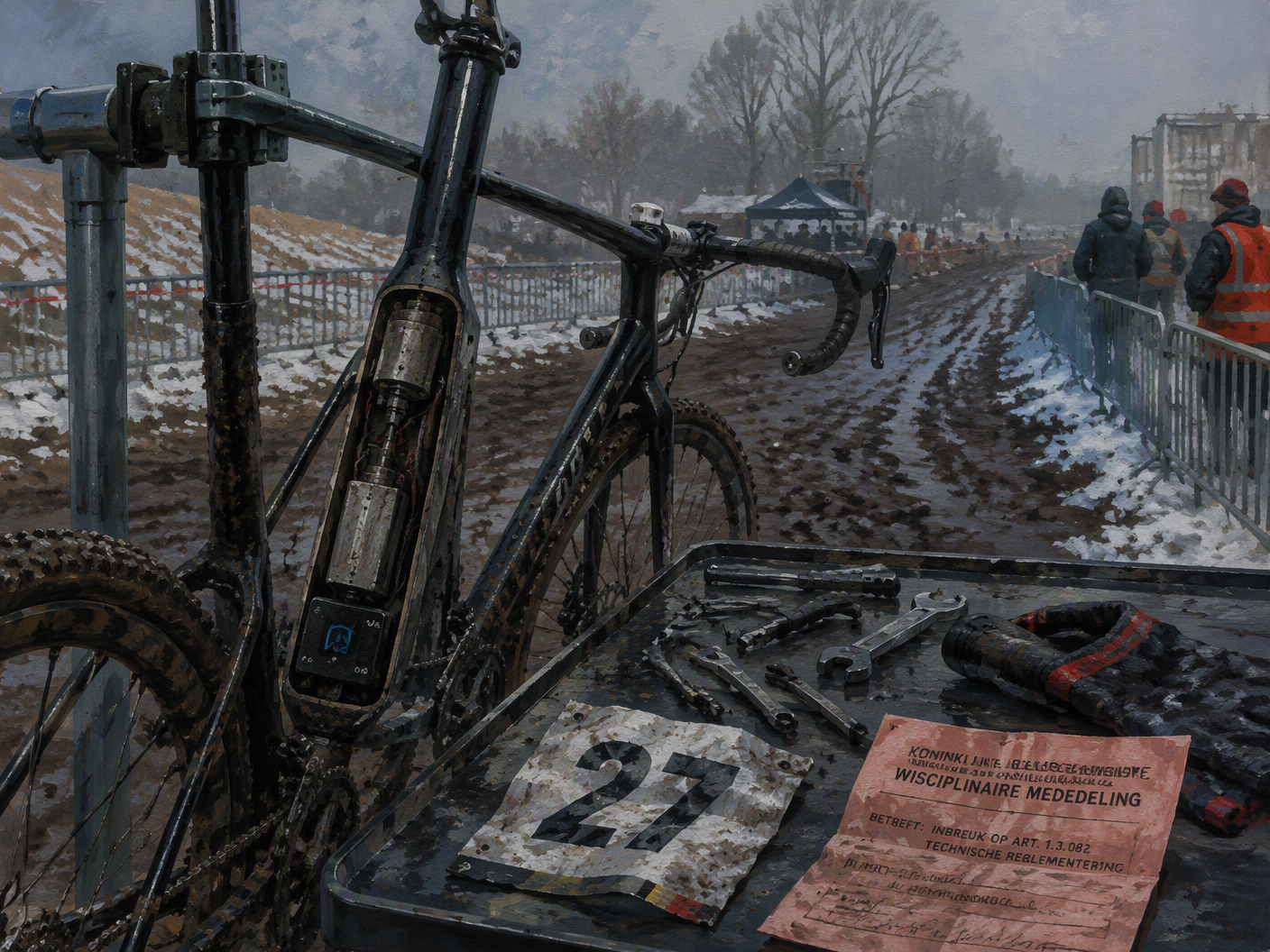
The bicycle was not supposed to be the story. In Zolder, Belgium, the women’s under-23 cyclo-cross championship moved through its familiar winter machinery: mud, barriers, pit lanes, mechanics, and the constant exchange of bicycles as riders fought to keep momentum on a course designed to punish hesitation. Then race officials detained and examined a bicycle associated with Femke Van den Driessche. The UCI later described what that examination had found inside it: a concealed electric motor, a battery, and a means of activating them—components that did not belong to the ordinary grammar of human-powered racing.
The discovery converted an obscure mechanical inspection into a test of what cycling believed it was protecting. Cyclo-cross is built around visible exertion. Riders carry their bicycles through mud, remount under pressure, and spend the race negotiating terrain that exposes every weakness in balance and strength. A hidden motor offered no dramatic plume of smoke and no obvious change in the machine’s appearance. It occupied the space beneath the surface, where a frame could still look like a frame and an advantage could remain invisible until someone opened the right tube.
Officials found the bicycle in or near Van den Driessche’s pit area during the championships. Reports described the machine as containing a Vivax electric motor concealed in the seat tube, with an associated battery and a Bluetooth control switch. The equipment was compact enough to hide inside the architecture of a racing bicycle, turning the machine itself into an accomplice. The discovery did not depend on a suspicious acceleration caught by television cameras. It came through inspection of an object that had been placed within the race’s operational zone.
Van den Driessche withdrew from the race. In the hours that followed, the explanation attached to the bicycle became as important as the device found inside it. She denied intentionally using a motor and said the bicycle belonged to a friend. A mechanic, she said, had mistakenly cleaned and prepared that bicycle for her. Her account placed the machine inside a chain of confusion: the wrong bicycle, the wrong preparation, the wrong place at the wrong time.
The governing body did not treat that explanation as the end of the matter. UCI president Brian Cookson said the discovery established technological fraud because a concealed motor had been found. His statement supplied the institution’s public characterization of the case: the presence of a hidden propulsion system in a competition bicycle was enough for the governing body to describe the incident as technological fraud. The statement did not depend on a public account of an athlete pressing a button or visibly crossing a finish line under electric power; it centered on the concealed equipment identified in the bicycle.
That position carried the case beyond a single bicycle. Cycling had spent years absorbing rumors about mechanical assistance, with public allegations and speculation involving other riders, teams, and suspicious-looking machines. Names including Fabian Cancellara and Ryder Hesjedal entered that wider conversation. But those earlier episodes did not produce the same official result: riders denied allegations, no penalty was imposed on Cancellara, and no motor was found in the Hesjedal inspection described in the surviving accounts.
Zolder therefore became the first official high-level case in which cycling’s governing body identified a concealed motor and pursued a disciplinary finding for mechanical or technological doping. The distinction mattered. Suspicion could travel through television images, internet analysis, and the visual language of professional cycling. A confirmed device changed the institutional problem. It gave officials an object to seize, a mechanism to describe, and a rule violation that could be processed through the sport’s disciplinary system.
On April 26, 2016, the UCI disciplinary process found Van den Driessche responsible for technological fraud. The sanction was a six-year ban, a CHF 20,000 fine, and disqualification of her results from October 11, 2015, onward. The punishment reached backward through the calendar, stripping earlier results from the record while carrying forward the consequences of the bicycle discovered at the world championships.
For Van den Driessche, the case remained different from the institution’s public conclusion. She had denied knowingly cheating and described a preparation error involving a friend’s bicycle and a mechanic. The disciplinary finding nevertheless assigned responsibility to her. The public record thus held two accounts beside each other: her denial of intentional use, and the UCI’s determination that the concealed motor constituted technological fraud for which she was responsible.
The case also exposed the limits of detection. In 2024, UCI president David Lappartient said the tablet-screening process used to search for motors had not been consistent enough. The organization planned broader inspections at the start of stages and after races, while also seeking information from whistleblowers and supporting payments for useful tips. Those later measures placed the Zolder case within a continuing institutional response: the UCI was revising how it searched for concealed motors and how it gathered information about them, without changing the disciplinary finding reached in 2016.
The bicycle in Zolder remains the fixed point in that argument. It was not a rumor, a television freeze-frame, or a theory about suspicious legs. Officials examined a machine associated with a young rider, and the UCI described the machine as containing a motor, battery, and control system hidden within it. Van den Driessche’s explanation contested what she knew and intended; the UCI’s sanction answered with responsibility. Between those positions stood the object itself—a racing bicycle altered so that the line between athletic effort and mechanical assistance could be crossed without announcing it.
Companion notes
What the Zolder Bicycle Established
The surviving record supports the UCI’s account that officials found a concealed motor, battery, and control system in a bicycle associated with Van den Driessche. It also preserves important limits: the captured material does not independently establish that she personally operated that specific bicycle during competition or who installed the equipment.
The seizure and the machine
Cyclingnews, Business Insider, the New York Daily News, and the reference record on Van den Driessche describe officials detaining or examining a bicycle during the women’s under-23 event at the 2016 championships in Zolder. Their accounts place the bicycle in or near Van den Driessche’s pit area, with some reporting that organizers seized and examined it after she withdrew. Together, those sources establish association with her race operation, not personal operation of that exact bicycle during competition. [S4], [S5], [S7], [S1]
Cyclingnews reproduces the UCI’s description of a concealed Vivax electric motor, a battery hidden in the seat tube, and a Bluetooth control switch. That is the governing body’s reported technical account. The captured packet contains no independent forensic laboratory report, chain-of-custody file, or technical examination by an outside authority. The mechanism is therefore established as a UCI-described finding rather than independently documented through a separate forensic record. [S4], [S5], [S6]
The disciplinary ruling
Cyclingnews reported that the UCI disciplinary process found Van den Driessche responsible for technological fraud and imposed a six-year ban, a CHF 20,000 fine, and disqualification of results from October 11, 2015, onward. The Van den Driessche reference entry and the mechanical-doping reference entry summarize the same sanction. This was an athletic disciplinary ruling, not a criminal conviction, and the supplied record does not describe criminal charges or a criminal trial. [S4], [S1], [S3]
Business Insider and the New York Daily News reported Van den Driessche’s denial that she intentionally used a motor. She said the bicycle belonged to a friend and had been mistakenly cleaned and prepared for her by a mechanic. Those reports preserve her account but do not establish that she lacked knowledge or intent. The UCI’s finding establishes institutional responsibility under its disciplinary process; it does not, by itself, identify who installed the motor. [S5], [S7], [S1], [S4]
The first confirmed high-level case
Cyclingnews called the sanction the first such case, while Business Insider described it as the first official mechanical-doping case at cycling’s highest level. The technology-doping and mechanical-doping reference entries preserve that distinction between a confirmed disciplinary case and the earlier atmosphere of suspicion. The record supports calling Zolder the first official high-level concealed-motor case described by the UCI and contemporary reporting, not proof that earlier allegations were violations. [S4], [S5], [S2], [S3]
Earlier allegations involving riders such as Fabian Cancellara and Ryder Hesjedal appear in Business Insider’s account of the public debate. The same material notes denials and the absence of penalties for Cancellara; the mechanical-doping reference entry states that no motor was found in the Hesjedal inspection it describes. Those episodes belong in the context of suspicion, not in the category of established motor-doping cases. [S5], [S7], [S3]
The institution’s stated conclusion
Business Insider and the New York Daily News attributed to UCI president Brian Cookson the statement that technological fraud had occurred because a concealed motor had been found. That verifies the governing body’s public characterization of the discovery. It does not independently prove Van den Driessche’s intent, personal use of the bicycle, or the identity of the person who installed the system. [S5], [S7], [S1]
The 2024 enforcement context
The Guardian reported in 2024 that UCI president David Lappartient considered tablet screening for motors insufficiently consistent. He described expanded inspections at the beginning of stages and after races, along with efforts to obtain whistleblower information and support payments for useful tips. That later admission provides institutional context for the enforcement problem, but it does not revise the 2016 finding or establish that concealed motors were widespread in professional cycling. [S6], [S3]
Source key
The associated evidence packet contains visible source URLs, source roles and the complete claim ledger.