
Violence & Brawls · 2000s
The Highway 9 Bus Clash Between Los Borrachos del Tablón and Newell’s Supporters
In 2003, Los Borrachos del Tablón, River Plate’s barra brava, confronted a Newell’s supporters bus on the road to Rosario; two Newell’s fans were killed. The episode belongs to a wider history of rival accusations, departing leaders, and violence inside River’s supporter culture.
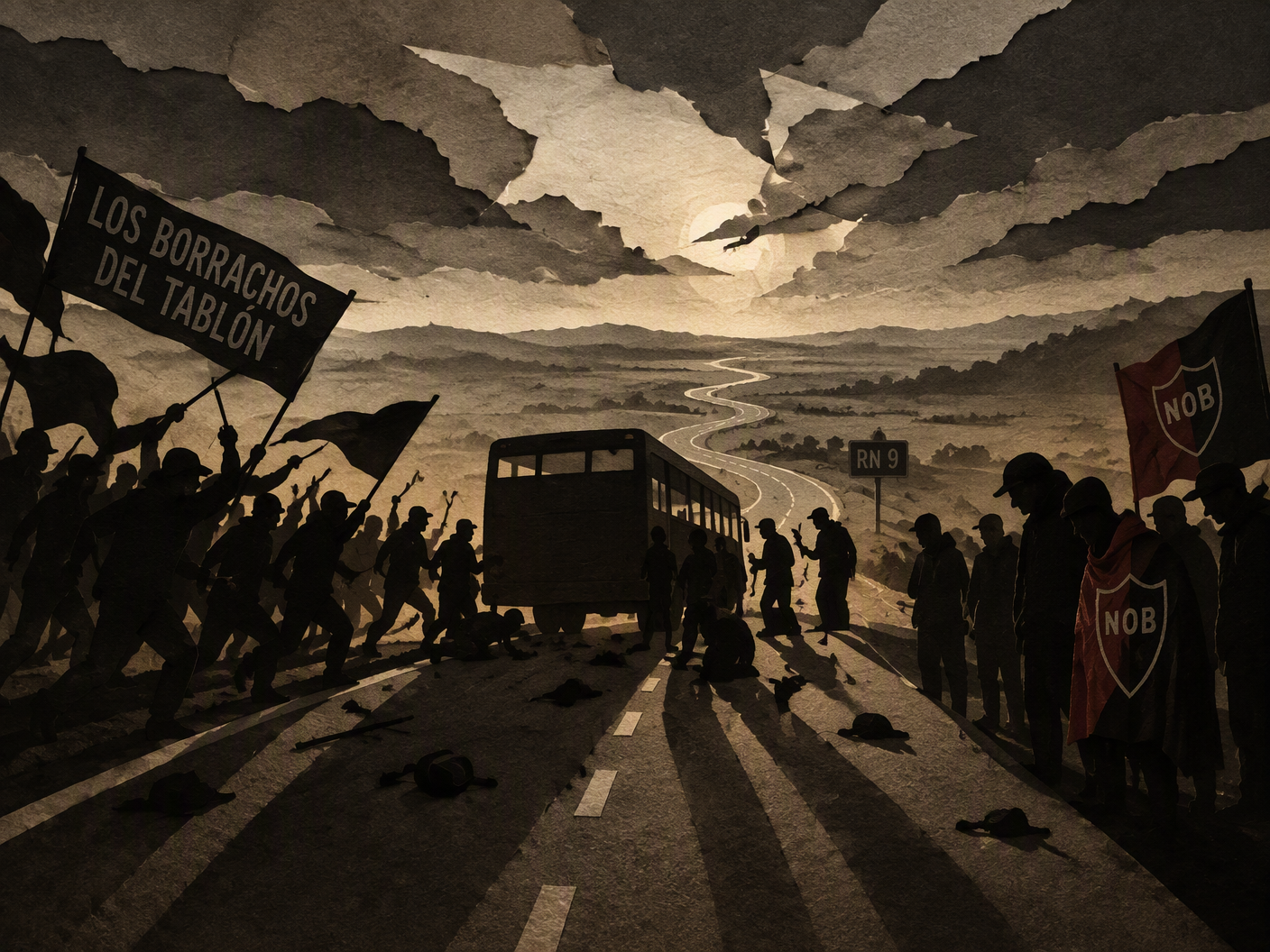
On Highway 9, a River Plate supporters group confronted a bus carrying Newell’s fans toward Rosario. The group was Los Borrachos del Tablón, River Plate’s barra brava. Two Newell’s supporters were killed in the clash. It happened away from the stadium, on a road between Buenos Aires and Rosario, where the rivalry traveled inside vehicles instead of through turnstiles. The episode left behind a blunt sequence: one bus, two opposing supporter groups, two dead Newell’s fans. The road became part of River’s supporter history.
Los Borrachos del Tablón was not a nickname attached to a single night. It was River Plate’s barra brava, the club’s hard-core supporters’ organization. In Argentina, the barra stood apart from the ordinary crowd with its own leadership, loyalties, and reputation. By 2000, Los Borrachos had acquired a reputation for violence. The name traveled with River Plate to matches and through the streets around them. Three years before the Highway 9 confrontation, that identity was already fixed in the public life of the club.
In 2000, the group’s reputation carried more than the threat of a fight outside a ground. Rival hinchadas accused River supporters of having political contacts and help from an employee of SIDE, Argentina’s intelligence service, as well as assistance from police. Those accusations placed Los Borrachos inside a wider contest over access and protection. Supporters’ groups were not only trading insults across terraces. Their rivals were describing connections that could reach beyond football and into the offices and uniforms surrounding it.
The names around the group mattered. Alan Schlenker and a figure known as the Mono were identified among its leaders. Edgar Butassi and Luis Pereyra had left after investigations linked the River Plate barra to the killing of Christian Rousoulis. The departures gave the group a history of changing faces without changing its name. One set of leaders moved out; another remained visible. By the time the buses met on Highway 9, Los Borrachos was already carrying the weight of its earlier violence and the people associated with it.
The Newell’s rivalry had its own prelude. In 2002, before a River Plate–Newell’s Old Boys match, Los Patovicas confronted the Newell’s barra outside the stadium. The encounter came before the teams played and away from the field itself. The two supporter groups did not need a referee to define the boundary between them. Their conflict had already taken shape at the edge of the ground. A year later, the setting would change from the stadium perimeter to the highway leading toward Rosario.
Then, in 2003, Newell’s supporters boarded a bus for Rosario. Los Borrachos del Tablón confronted them on Highway 9. The clash ended with two Newell’s fans dead. The names of the groups were clear: River’s barra on one side, Newell’s supporters on the other. So was the location. Highway 9 was the route between the confrontation and the destination, a stretch of travel turned into the scene of a deadly meeting. The deaths made the bus more than transport in the history that followed.
At the stadium, the 2002 confrontation had taken place before a River–Newell’s match and outside its walls. In 2003, the meeting occurred while Newell’s supporters were traveling to Rosario. The geography changed, but the opposing names remained. Los Borrachos represented River Plate’s barra brava; the passengers represented Newell’s. The violence no longer depended on a shared entrance, a terrace, or a fixture beginning on schedule. The route itself became the point of contact, and two people paid for that contact with their lives.
The group’s wider history continued to split along personal lines. Butassi and Pereyra had already departed after the investigations involving Christian Rousoulis. Schlenker and the Mono stood among the leaders identified around Los Borrachos. The structure had names, exits, and replacements. It also carried the old accusations of political contacts and police help made by rival hinchadas. Those claims formed part of how the group was described in the years surrounding Highway 9, alongside the violence that could be seen when supporters met away from the field.
Four years after the Highway 9 clash, another River Plate barra figure entered the story through gunfire. On August 7, 2007, Gonzalo Acro was shot three times while coming home from the gym in Buenos Aires. He died the following day. Acro’s shooting belonged to the later violence surrounding the River supporter group, after the bus confrontation and after the earlier departures of Butassi and Pereyra. The sequence did not produce a clean line of succession. It produced names, fractures, and another body carried out of the group’s orbit.
Highway 9 remains the hard center of the story. A River Plate barra brava confronted a Newell’s supporters bus on the way to Rosario in 2003. Two Newell’s fans were killed. Around that event sit the group’s reputation, rival accusations, its changing leadership, the earlier clash outside a stadium, and Acro’s death four years later. The road carried the bus toward Rosario. For two Newell’s supporters, the journey ended there.
Investigative Dossier & Evidence
Read the companion investigation notes, verified source claims, and primary documents.
Read the Companion Notes & Evidence Record →