
Doping & Drugs · 2010s
Michele Ferrari’s Italian Malpractice Penalty, Drug-Distribution Acquittal and Lifetime Sporting Ban
An Italian court sentenced Ferrari for malpractice and barred him from practicing medicine while acquitting him on a charge of distributing drugs to leading riders. USADA later imposed a lifetime ban from professional sport in a separate anti-doping proceeding.
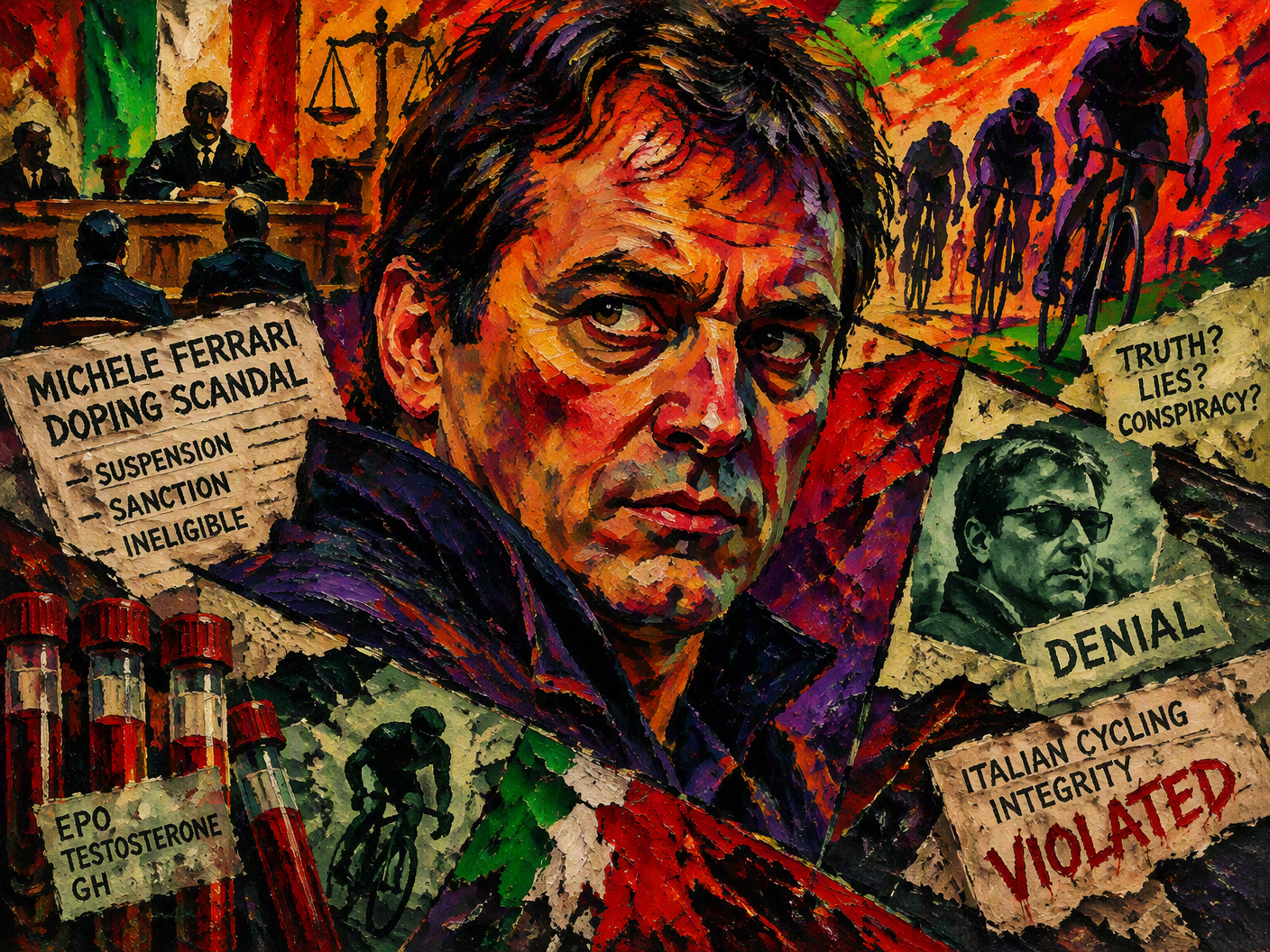
On 13 February 2002, Filippo Simeoni testified in Bologna that Michele Ferrari had prescribed him EPO and human growth hormone during the 1996–97 period. Simeoni also described conversations about testosterone and methods for managing hematocrit, the blood measurement that can reveal or conceal changes produced by endurance-enhancing drugs. Ferrari was not appearing before a sporting tribunal. He was facing an Italian criminal case in which a cyclist’s account placed a physician’s instructions at the center of the prosecution. The testimony gave the case a human witness and a precise medical vocabulary.
The Bologna proceedings also produced physical evidence tied to Ferrari’s practice. Magistrates presented written instructions allegedly written by Ferrari during the case against him. The documents mattered because they shifted the dispute from the recollection of a former client toward the question of what a physician had put on paper. They did not resolve every allegation. They did, however, give prosecutors an object to examine: instructions bearing the apparent connection between medical expertise and the methods athletes used to alter performance.
Ferrari occupied an unusual position in professional cycling. He was an Italian physician, but his influence extended beyond ordinary clinical care. Riders sought his advice because endurance sport rewarded marginal gains and because the substances at issue required technical management: dosage, timing, blood values, recovery, and concealment. That expertise created a professional relationship with consequences beyond the consultation room. A doctor could describe a prohibited substance as treatment, while an athlete could treat the same instruction as a competitive resource.
The Italian court reached its first definitive outcome on 2 October 2004. Ferrari received a 12-month suspended jail sentence and a 900-euro fine for malpractice. The sentence imposed criminal punishment without sending him to prison immediately, while the fine attached a financial penalty to the professional conduct at issue. The court also barred him from acting as a doctor for 11 months and 21 days. That restriction targeted the authority that had enabled his work: his medical license and his ability to advise patients and athletes.
The same judgment drew a boundary around the criminal case. Ferrari was acquitted of distributing drugs to leading riders. The court therefore punished malpractice but did not sustain the broader drug-distribution charge. Both results belonged to the same proceeding. The suspended sentence, fine, and temporary medical prohibition established legal consequences; the acquittal prevented those consequences from being recast as a conviction for distributing drugs to the riders associated with him.
Lance Armstrong publicly defended Ferrari in 2004, when the Italian proceedings had already made the physician a central figure in cycling’s doping debate. Years later, in written testimony connected to a settlement-related lawsuit, Armstrong named Ferrari as one of four people who supplied him with performance-enhancing drugs. The two statements placed the relationship on opposite sides of a widening legal divide: public loyalty in one period, sworn testimony in another. Ferrari’s professional reputation became inseparable from the accounts of the athletes who had relied on his expertise.
The next formal intervention came from the United States. On 13 June 2012, the United States Anti-Doping Agency charged Ferrari with the administration and trafficking of prohibited substances. This was not a new Italian criminal sentence. It was an anti-doping proceeding, operating under sporting rules and directed at Ferrari’s role in professional competition. The charge treated medical advice, supply, and athlete access as part of the same prohibited conduct. A decade after the Bologna testimony, the question had moved from one national courtroom to the authority governing eligibility in professional sport.
In July 2012, USADA issued Ferrari a lifetime ban from professional sport. The sanction removed him permanently from the sport’s recognized professional environment and separated the American disciplinary outcome from the Italian court’s mixed judgment. Italy had imposed a suspended criminal sentence and a temporary bar on medical practice while acquitting him of drug distribution. USADA imposed the most severe sporting exclusion available. The two decisions did not cancel one another; they measured Ferrari’s conduct under different systems with different powers.
Ferrari continued to deny a central allegation involving Armstrong. In a 14 December 2012 interview, he said he had never seen or heard of doping practice from Armstrong and denied that Armstrong had asked him for doping information. The denial addressed Ferrari’s knowledge and conduct directly. It did not alter the lifetime ban already imposed four months earlier. By then, the legal and disciplinary history contained competing narratives: athletes describing Ferrari’s role, institutions imposing sanctions, and Ferrari rejecting the account of his relationship with Armstrong.
The consequences also reached athletes who consulted Ferrari. Michele Scarponi and Giovanni Visconti each received three-month bans for consulting with him. Their suspensions showed how anti-doping authorities treated the relationship itself as a disciplinary fact, even when the sanction fell on riders rather than the physician. The punishment traveled outward from Ferrari’s professional role to the athletes who entered his orbit. In that system, the consultant was not merely a background adviser; his presence could become the basis for exclusion.
Ferrari’s history therefore cannot be reduced to a single verdict or a single ban. Simeoni’s 2002 testimony put alleged prescriptions and blood-management advice before a Bologna court. Written instructions allegedly linked to Ferrari gave the case a documentary component. The 2004 judgment convicted him of malpractice, fined him, suspended his jail sentence, and temporarily barred him from practicing medicine, while acquitting him of distributing drugs to leading riders. In 2012, USADA charged him with administering and trafficking prohibited substances and imposed a lifetime sporting ban.
The final public position came from Ferrari himself. In December 2012, while the lifetime exclusion stood and the Armstrong relationship remained contested, he denied seeing or hearing doping practice from Armstrong. Scarponi and Visconti had already served the consequences of consulting him. The Italian court had already separated malpractice from drug distribution. USADA had supplied the later and harsher endpoint: Ferrari could no longer participate in professional sport. His denials remained part of the dispute, but the ban remained the last formal decision governing his place in cycling.
Investigative Dossier & Evidence
Read the companion investigation notes, verified source claims, and primary documents.
Read the Companion Notes & Evidence Record →