
Tragedy ·
The Bridge That Collapsed on the Way to the Games
Four Australian delegates died after the 1997 Maccabiah bridge collapse. An inquiry found failures in planning and construction; five defendants were later convicted of causing death by negligence.
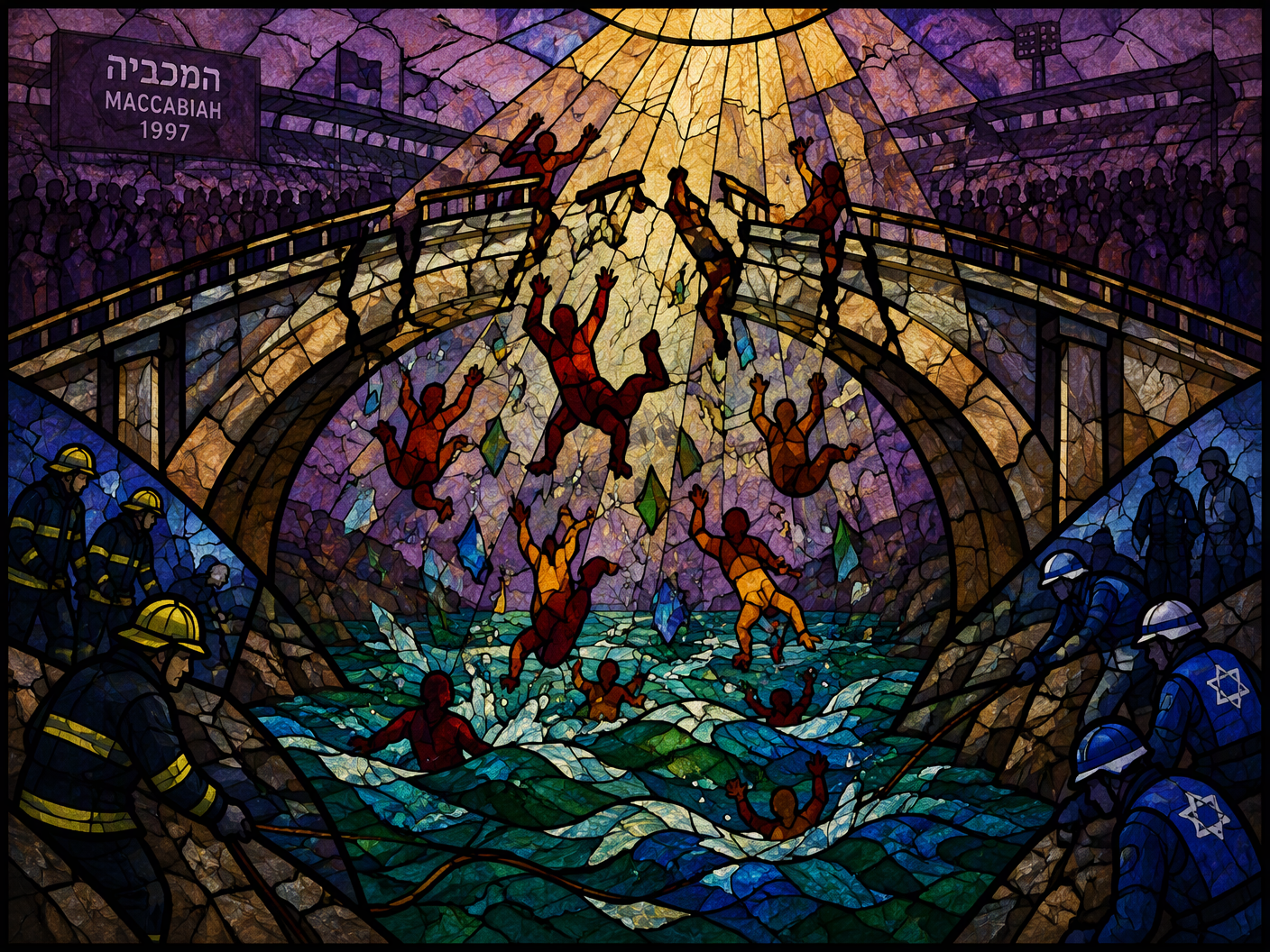
The Australian athletes were on their way into Ramat Gan’s National Stadium for the opening of the Maccabiah Games when the temporary bridge beneath them collapsed. On July 14, 1997, a procession became a rescue operation in the Yarkon River. Four members of the Australian delegation eventually died, and more than 60 athletes and other delegates were injured.
Witnesses said about 100 Australians were on the bridge when it gave way. Evelyn Cohen, an injured survivor, recalled people falling on top of her as she tumbled into the river. “I had people on top of me, but my head was above the water,” she said. “Other people were under the water and couldn’t move to get others out.”
Firefighters and police jumped into the water. Rescuers used ropes to negotiate the steep, muddy banks, while ambulances arrived and divers searched for victims. Inside the stadium, the opening ceremony went ahead, though the remaining parade of national teams was canceled. Ramat Gan Mayor Zvi Bar said the decision was intended to prevent panic among spectators who were still unaware of the collapse.
Responsibility for continuing the ceremony was disputed. President Ezer Weizman opened it roughly 40 minutes after the bridge fell. His spokeswoman, Batya Keinan, later denied that he had made the decision to proceed: “The decision to continue was taken by the organizing committee, the police, and the other organizers,” she said. “Not by the president, but in his presence.”
For some of those pulled from the river, the danger was not over. Gregory Small, a bowler from Sydney, was dead on arrival at a hospital, apparently from injuries or drowning. Within hours of admission, a number of other victims began showing signs of asphyxia. Doctors found that an unidentified organism was attacking their respiratory systems and pulmonary blood vessels. By the next morning, seven athletes were critically ill.
Bowler Yetty Bennett died later on the day of the collapse. Elizabeth Sawicki, a member of the delegation’s bridge team, died on July 26 from complications of infection. Bowler Warren Zines died on August 10 from a severe respiratory-tract infection. An autopsy of Zines identified a fungus associated with stagnant or polluted water as the source of the infections.
On July 23, a public commission attributed the collapse to a chain of failures in planning and construction. It found that engineer Micha Bar Ilan had never submitted an engineering plan, had not designed the bridge for its intended use and had failed to supervise the work properly. The contractors had used substandard materials and were not authorized to build such a structure. The commission also faulted the Maccabiah organizing committee for poor coordination.
The commission referred its findings to the attorney general rather than recommending legal action itself. Five defendants subsequently pleaded not guilty to causing death by negligence. At trial, the defense argued that police should share responsibility because they had approved the building permit and were charged with controlling the number of people on the bridge. On April 17, 2000, the court convicted all five. Bar Ilan received a prison sentence of one year and nine months; organizing committee chairman Yoram Eyal was sentenced to six months of community service.