
Scandals & Feuds · 2020s
The 11,000 Mexico City Marathon Disqualifications and the Checkpoint Problem
After the 27 August 2023 Mexico City Marathon, organizers expelled more than 11,000 runners for cutting sections of the course, using checkpoint and tracking data to invalidate their results. The episode extended a longer history in which timing mats, missing chips, and administrative certainty have been asked to determine who actually ran the race.
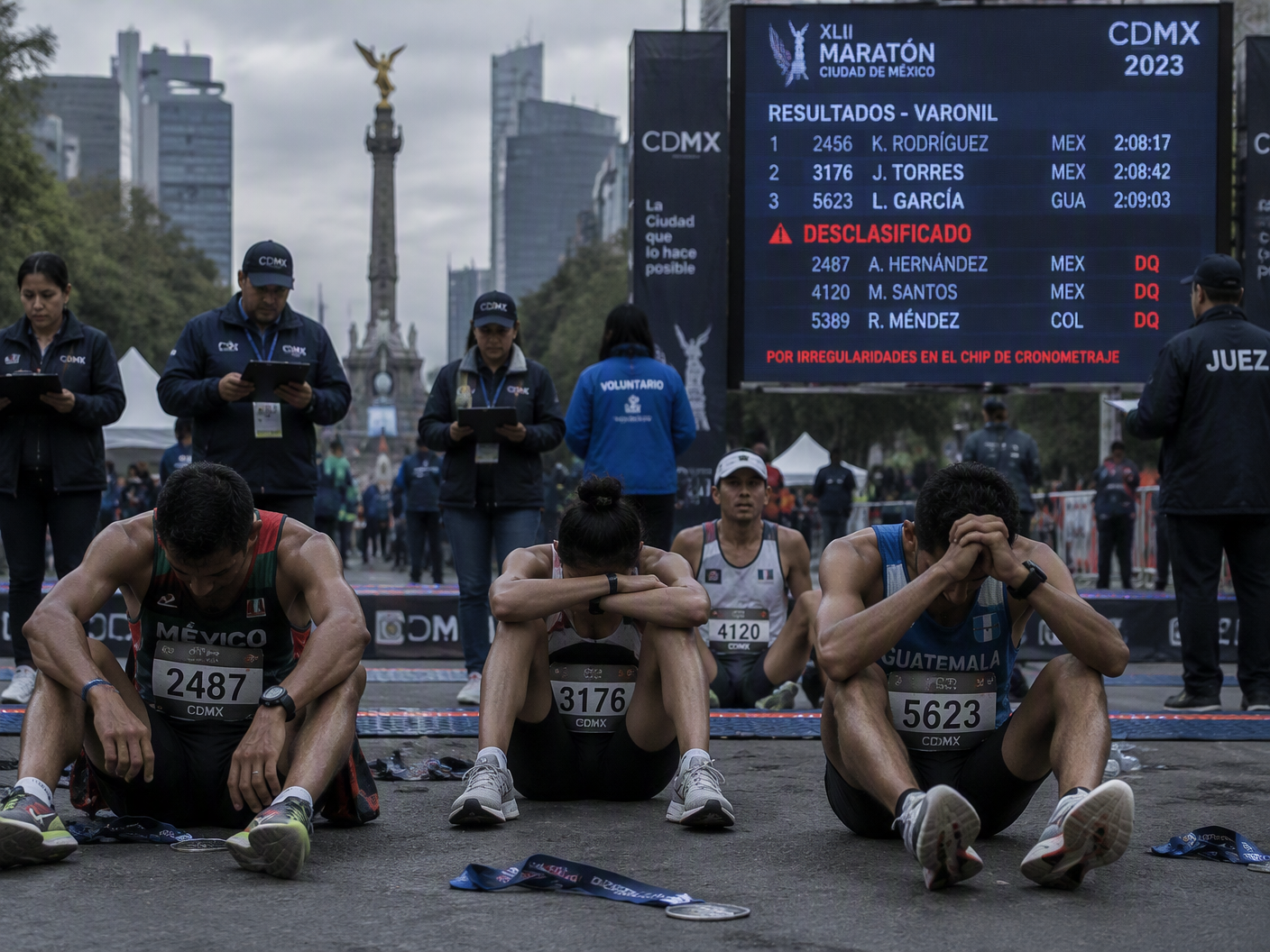
The Mexico City Marathon promised the usual civic grandeur: endurance, discipline, human potential, perhaps a municipal banner large enough to conceal the plumbing. Then the spreadsheets arrived. On 27 August 2023, more than 11,000 runners crossed the finish line and entered the gentler world of post-race administration, where a medal can be awarded in the morning and repossessed by committee in the afternoon. Organizers later expelled them for cutting sections of the course, turning a mass celebration into a clerical purge conducted through timing records and the stern vocabulary of sportsmanship.
The course had been fitted with checkpoints every five kilometers, a technological breadcrumb trail intended to confirm that runners had completed the full distance rather than merely appearing at the end with the expression of people who had suffered nobly. Each passage was supposed to leave a digital trace. The marathon therefore had two versions of reality: the visible one, populated by exhausted finishers and cheap commemorative medals, and the electronic one, stored in chips and timing systems. When those versions disagreed, the machine received the better chair at the conference table.
After the race, organizers reviewed tracking data and complaints. The data showed that thousands of participants had not passed some checkpoints. The Mexico City Sports Institute said it would identify cases of unsportsmanlike conduct and invalidate registration times, an institutional phrase with the soft, padded sound of a cushion being placed beneath a guillotine. The decision did not arrive at the finish line, where volunteers handed out water. It emerged later, after the course had been dismantled and the public triumph reduced to missing digital entries.
More than 11,000 runners were consequently expelled. The number was large enough to make individual embarrassment look almost industrial, like a factory producing disgraced finishers by the pallet. The organizers’ position was direct: sections of the course had been cut, and the affected results would not stand. For runners seeking qualifying times, rankings, or the ordinary emotional satisfaction of having completed 26.2 miles, the sanction converted a day of physical effort into an administrative nullity. The body had run—or claimed to run. The database had other plans.
Some participants rejected the accusation. They insisted they had not cheated and said the trackers were faulty, failing to register them at checkpoints. That explanation placed the marathon’s grand moral drama beside a rather less majestic possibility: thousands of people may have been judged by equipment that could not reliably announce their passage. The dispute had no courtroom, no witness box, and no lawyer dramatically waving a shoe. It had runners, devices, absent timing marks, and officials deciding which story the data was permitted to tell.
Mexico City had already rehearsed this performance. In the 2017 edition, organizers expelled 6,000 runners for failing to complete the full distance. The earlier purge established that course completion was not merely an honor-system proposition dressed in athletic clothing. It was an operational condition monitored through checkpoints and enforced after the crowds had gone home. By 2023, the apparatus was familiar: record the passage, inspect the gaps, remove the names. The only novelty was scale, which is how bureaucracy measures progress when nobody has improved the underlying problem.
The technology’s authority had also been demonstrated in Berlin. Roberto Madrazo, a Mexican political figure, finished the 2007 Berlin Marathon in the men’s age-55 category. His result was later deleted after chip timing indicated that he had skipped two checkpoints. The episode supplied a neat lesson in the modern marathon: a finishing time may be printed in the language of achievement, but its survival depends on the invisible itinerary beneath it. The chip does not care about status, speeches, or the flattering geometry of a podium photograph.
Chicago produced a smaller but equally tidy accounting in 2009, when officials disqualified the times of 252 runners. Most had missed two or more timing mats in succession. The mat, that squat electronic sentinel lying beside the road, had become a kind of race official without a whistle, a salary, or the capacity to explain itself under questioning. Its silence could erase hours of exertion. Its data could preserve a result—or make the runner’s achievement vanish into the municipal waste stream of invalidated entries.
Carey Pinkowski, the Chicago Marathon race director, publicly discussed course-cutting enforcement and Chicago’s timing system, reflecting the sport’s growing reliance on electronic checkpoints to police a distance too large for human supervision alone. A marathon route is a sprawling temporary city: streets closed, crowds shifting, volunteers stationed at intervals, and competitors moving through blind spots where the honor system encounters shortcuts. Timing technology was installed to close those gaps. Instead, it created a new one between what runners experienced and what the official record could recognize.
The Mexico City expulsions were administrative sanctions, not criminal prosecutions. No police cordon surrounded the finish line; no prosecutor summoned a runner beneath the fluorescent lights of a courthouse. Organizers reviewed the race’s electronic traces and invalidated results. That limited machinery nevertheless carried substantial consequences. A runner could lose a time, a ranking, a qualification opportunity, or the public identity of having completed the course. The marathon’s ideals remained printed on banners and medals. Enforcement lived elsewhere—in checkpoint gaps, malfunction claims, spreadsheets, and the impersonal verdict of a system that never had to run anywhere.
By 6 September, the marathon had become a spectacle of subtraction. The field was no longer defined by who finished, but by whose record remained intact after inspection. Mexico City’s officials had inherited a familiar problem from Berlin, Chicago, and their own 2017 race: a mass event built on trust, then retrofitted with enough electronic surveillance to distrust everyone efficiently. The result was neither a detective story nor a courtroom drama. It was something more modern and more petty—a race decided after the running, by the evidence left behind when the runners had disappeared.
Investigative Dossier & Evidence
Read the companion investigation notes, verified source claims, and primary documents.
Read the Companion Notes & Evidence Record →