
Scandals & Feuds · 1970s
The Free Kick Before the Bounce That Dandenong Kept
A free kick awarded before the opening bounce of the 1971 VFA Division 1 Grand Final became the basis of Preston’s formal protest. The VFA rejected the challenge three days later, leaving Dandenong’s six-point victory and premiership intact.
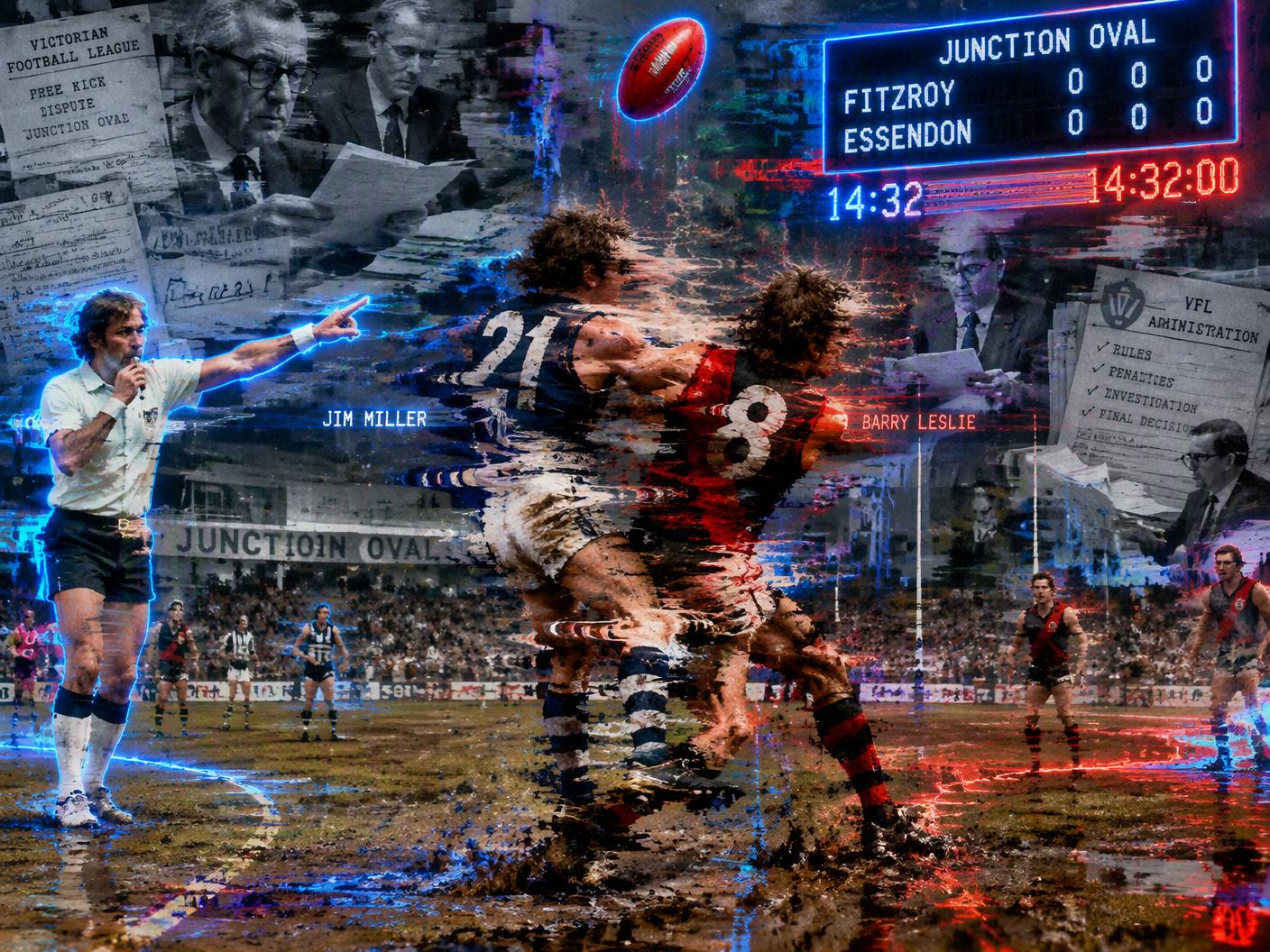
The Victorian Football Association preferred its grand finals to conclude with a champion, a cup, and the reassuring fiction that rules governed everything. At Junction Oval on 26 September 1971, that fiction acquired a small but durable crack before the match had even begun. Field umpire Jim McMaster saw jostling between Preston full-back Barry Leslie and Dandenong full-forward Jim Miller, blew his whistle, and awarded Miller a free kick. The players had not yet contested the opening bounce. Miller kicked the goal. A premiership had acquired its first point before the contest was, in the most literal sense, underway.
Junction Oval, in St Kilda, was not a cathedral of procedural serenity. It was a football ground, which meant mud, elbows, shouted instructions, and men in woollen jumpers attempting to persuade one another that violence became lawful when performed near a boundary line. McMaster’s decision gave Dandenong the opening score and gave Preston something more useful than possession: a grievance with paperwork potential. Leslie had been penalized for a push in the back. Preston did not deny that the whistle had blown or that Miller had taken the kick. Its objection was that the whistle had blown too soon.
Miller converted the free kick and became the first scorer of the grand final, a distinction usually preserved for statistical ledgers and mildly tedious club dinners. Here it became the first exhibit in a dispute over when a match legally began. The ball had not bounced, yet the scoreboard had moved. One could almost hear the future committee meeting assembling itself around a polished table: men in bad suits, collars tightening, a plate of stale biscuits losing its will to live. The VFA’s grand constitutional question was whether a game could begin before its opening ritual had occurred.
The football that followed did little to restore the atmosphere of a controlled civic exercise. Dandenong and Preston produced multiple brawls, and the third quarter generated three striking reports, involving Miller, Lyall Henriksen, and Robert Ireland. The final was not a delicate dispute among etiquette enthusiasts. Bodies collided, tempers rose, and the officials accumulated the kind of administrative debris that makes institutions suddenly discover the majesty of due process. Yet the protest did not challenge every shove, punch, or erupting argument. It targeted the first free kick, a single decision with the irritating durability of a paperclip lodged in a machine.
Preston nevertheless remained in the match. Late in the final quarter, the club briefly took the lead, and for a moment the opening goal looked less like a constitutional crisis than an unpleasant memory buried beneath the arithmetic. Dandenong recovered the advantage before the finish. The premiership contest narrowed into six points, the sort of margin that allows every supporter to become an amateur forensic accountant. A dropped mark, a missed shot, a misplaced hand: all can be promoted after the siren into evidence of destiny, incompetence, or an umpire’s supposedly revolutionary interpretation of time.
Dandenong’s David Sheehan added another flourish to the closing minutes. He marked within scoring range just before the final siren, close enough to make the crowd and opposing defenders calculate possibilities in real time. Sheehan did not take an after-the-siren kick. The moment remained a suspended possibility rather than another score, and Dandenong held on to defeat Preston by six points. The match ended on the field with Dandenong ahead. It did not end, however, in the minds of Preston’s officials, who had already found a route from the oval to the association office.
On 27 September, Preston club secretary Alf Rowe notified the VFA that the club would protest, then lodged the formal challenge. The complaint rested on the timing of McMaster’s free kick to Miller: the opening bounce had not occurred, so the kick, Preston argued, was invalid. This was not a demand for the sport to reconsider every act of the preceding afternoon. It was a surgical objection to the opening sequence, which is how bureaucratic quarrels describe themselves before growing teeth. The club had lost by six points; now it asked the administrators to decide whether the first point counted.
The VFA Board of Management met on 29 September, three days after the grand final and two days after Rowe’s filing. The board rejected Preston’s protest and confirmed Dandenong as the 1971 Division 1 premiers. The decision had the clean efficiency of a stamp descending on an already battered document. No replay was ordered. No alternative premiership arrangement was produced. The original result remained standing, with Miller’s pre-bounce goal embedded in the score and Dandenong’s six-point margin preserved as the official conclusion to the match.
That ruling gave the VFA what governing bodies generally crave: finality without the inconvenience of admitting that finality had been difficult. Preston’s protest had been real, formal, and sufficiently serious to reach the board. It simply failed. The association did not erase the goal, replay the contest, or invent a ceremonial rematch in which the opening bounce could be performed under laboratory conditions. Dandenong retained the win because the board dismissed the challenge, not because the dispute evaporated. Paper had carried the argument upward; paper carried the premiership back down.
The central absurdity was therefore modest in size and immense in consequence. A push in the back, a whistle, and a kick before the bounce became the hinge on which Preston tried to reopen a grand final. Around it sat the rougher realities of the afternoon: brawls, striking reports, a brief Preston lead, Dandenong’s recovery, and Sheehan’s unused after-the-siren opportunity. None of those events produced a replay. The board’s ruling did. It converted a disputed opening moment into an official premiership, leaving Dandenong’s players with the flag and Preston with the minutes of a meeting.
Dandenong’s 1971 premiership thus survived not through romantic certainty but through a Wednesday decision in an office far removed from the shouting at Junction Oval. McMaster’s whistle began the trouble; Miller’s kick put it on the scoreboard; Rowe’s protest moved it into the machinery of the VFA; and the board’s rejection closed the file. The match had started before the bounce, ended by six points, and remained finished because administrators said so. In football, as in government, the grand principle occasionally arrives wearing a very small hat.
Investigative Dossier & Evidence
Read the companion investigation notes, verified source claims, and primary documents.
Read the Companion Notes & Evidence Record →