
Violence & Brawls · 2000s
Ángel Matos, the Injury Timeout, and the Referee Assault in Beijing
At the 2008 Beijing Olympics, Cuban taekwondo athlete Ángel Matos lost a bronze-medal bout after exceeding the injury-time allowance, then struck referee Chakir Chelbat during the confrontation that followed. The World Taekwondo Federation answered with lifetime bans for Matos and his coach, Leudis González.
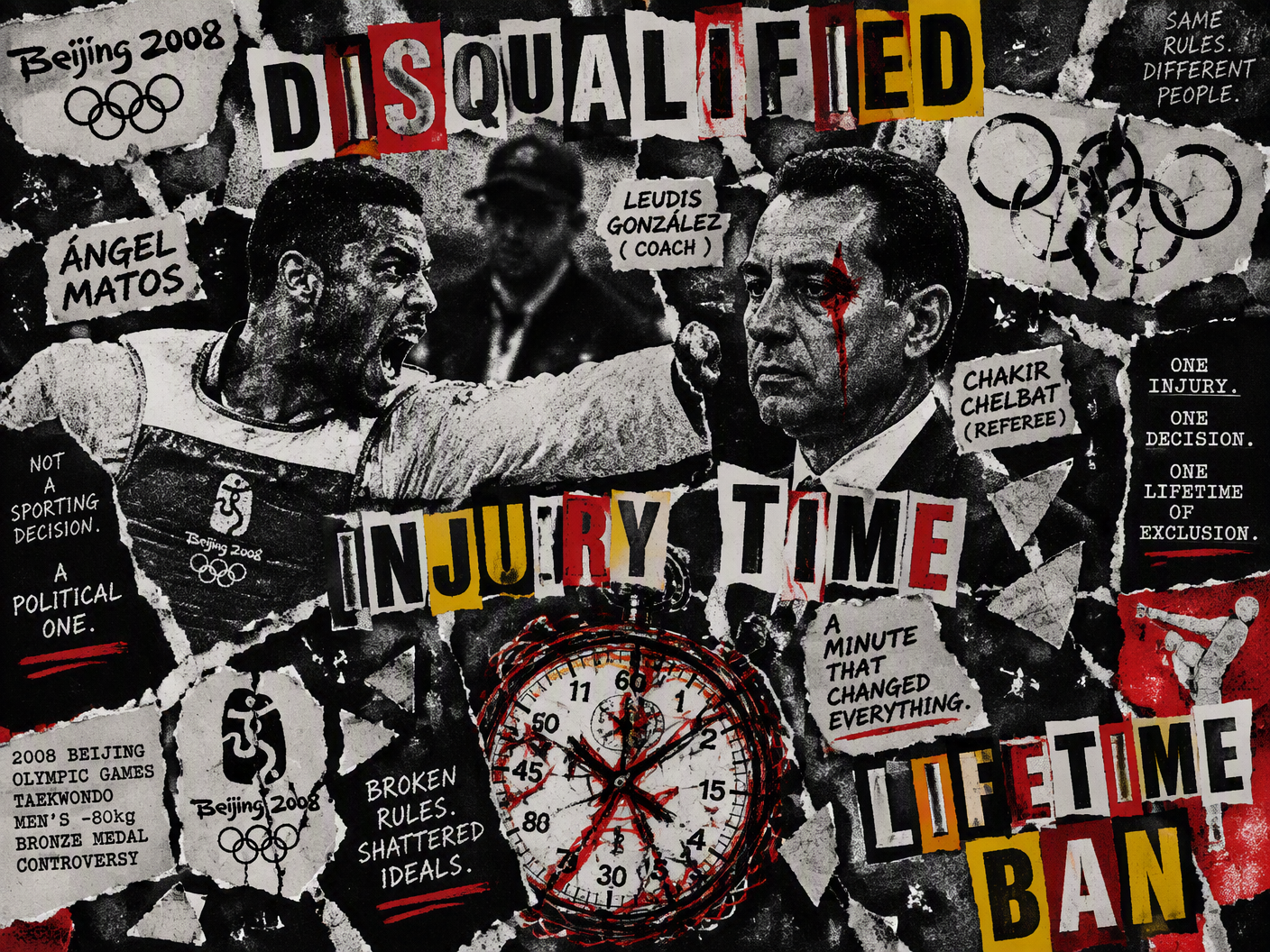
On August 23, 2008, beneath the white lights of Beijing’s Olympic taekwondo venue, Ángel Matos was fighting for a bronze medal in the men’s over-80-kilogram division. The bout had narrowed to its final procedural margins: a clock, an injury timeout, an official’s decision. Matos had already occupied the highest place in the sport, winning Olympic gold in 2000. Now, with the mat marked by the movements of two exhausted fighters and the crowd waiting for the next exchange, the Cuban athlete’s medal depended on returning before the allotted time expired.
The timeout became the hinge of the match. Matos remained out too long, beyond the injury-time allowance permitted under the competition rules. Referee Chakir Chelbat, a Swedish official working the bout, made the disqualification call. There was no further contest to settle and no final sequence of kicks through which Matos could recover the medal. The ruling ended the bout in an instant and transferred the bronze-medal result to Arman Chilmanov of Kazakhstan, who was declared the winner.
The geometry of the arena changed after the call. A contest built around distance, balance, and controlled impact became an encounter between an athlete and the official who had ended his Olympic campaign. Chelbat stood near the competition area as Matos moved toward him. The decision was no longer being argued through points on a scoreboard. It was being carried across the mat, past the boundary between sanctioned contact and personal violence.
Matos struck Chelbat in the face. The blow landed after the disqualification, when the bout itself had finished. In the seconds that followed, Matos also pushed a judge and spat on the floor. Officials and security moved to contain him and remove him from the arena. The sequence was brief, but its order mattered: first came the expired injury timeout, then the disqualification, then the physical assault, and only afterward the removal from the Olympic venue.
Chelbat was left with a cut to his lip that required stitches. The injury was not the residue of an exchange between competitors or an accident within the rules of taekwondo. It came from the referee’s face being struck after he had performed his official duty. In the treatment room, the tournament continued elsewhere under the same lights, while the wound imposed a slower, more intimate aftermath: medical attention, sutures, and the physical mark of a decision made at ringside.
For Matos, the medal disappeared with the call. For Chilmanov, the bronze was awarded without a concluding victory over his opponent in the ordinary sense. The distinction was created by the rule governing injury time, then hardened by what followed. A narrow interval on the clock had determined the match’s official outcome. Matos’s response transformed a sporting penalty into a disciplinary crisis for the entire federation, bringing the referee, the coach, the judges, and the security staff into the same compressed chain of events.
Leudis González, Matos’s coach, was present during the incident. His role placed him close to the athlete at the moment when the bout moved from competition into confrontation. The arena’s work was procedural: officials made the call, judges stood at their stations, and security escorted the athlete away. By the time the doors closed behind Matos, the immediate physical scene had ended. What remained was the governing body’s question of how far the consequences should travel beyond the mat.
Within the next reporting cycle, the World Taekwondo Federation announced lifetime bans for Matos and González from events sanctioned by the federation. The punishment removed Matos from the organized international sport that had made him an Olympic champion and placed his coach under the same permanent exclusion. The federation treated the assault as an offense requiring more than a reprimand or a temporary suspension. The official response reached beyond Beijing and beyond the single bout, closing the federation’s competitions to both men for life.
The sanction did not restore the bronze medal to the moment before the call. It did not erase Chelbat’s injury or return the match to the point at which Matos was still waiting to resume. It established a second result, separate from Chilmanov’s victory: the athlete and coach would no longer participate in World Taekwondo Federation events. The first decision had been made by a referee with a clock running. The second came from administrators after the arena had emptied and the incident had become a matter of institutional judgment.
In the years that followed, the Beijing incident acquired the compact shape of an Olympic scandal: an accomplished athlete, a disputed moment of timing, a referee struck in the face, and a lifetime ban. Claims that the bout was fixed or that bribes were offered expanded the story beyond its established center. The documented sequence is narrower and more severe in its simplicity. Matos exceeded the injury-time allowance, was disqualified, attacked Chelbat after the call, and was permanently barred alongside González by the sport’s governing federation.
The episode ended without another round. There was no athletic answer waiting on the mat, only the lip injury that required stitches, the medal awarded to Chilmanov, and the security detail leading Matos away. In the quiet after the crowd and the officials dispersed, the Olympic machinery resumed its schedule. The names on the brackets remained fixed. So did the sequence that had carried a former champion from an injury timeout to disqualification, from disqualification to violence, and from the arena to a lifetime outside the federation’s events.
Investigative Dossier & Evidence
Read the companion investigation notes, verified source claims, and primary documents.
Read the Companion Notes & Evidence Record →