
Bizarre & Myths · 1980s
The Return That Had to Be Allowed
Five backward passes carried Cal's Kevin Moen through Stanford's band and into the end zone. Then the officials gathered, and the touchdown stood.
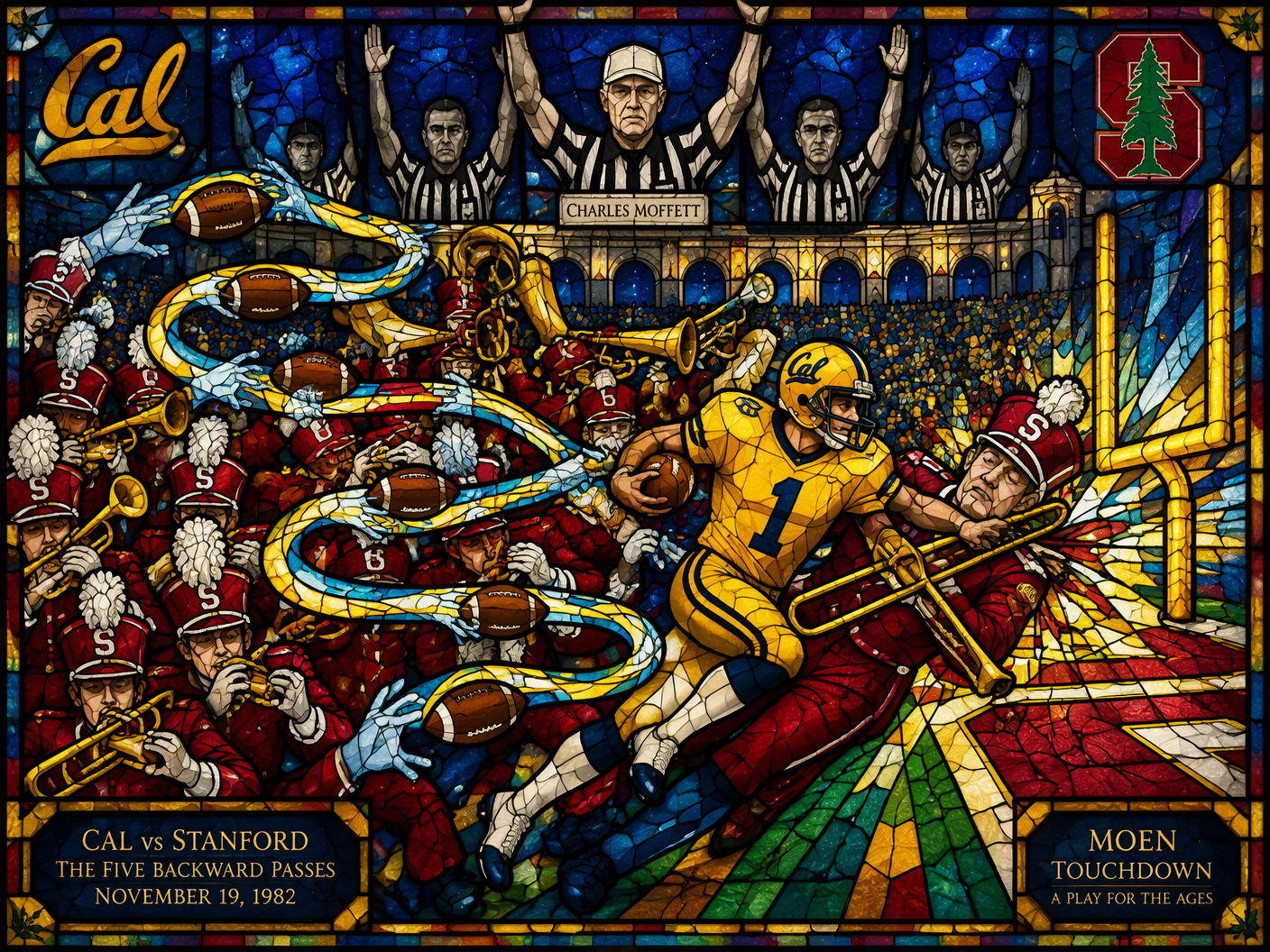
On November 20, 1982, Kevin Moen reached the end zone and collided with Stanford trombone player Gary Tyrrell. The collision was the return's final physical consequence, but it also marked the point at which a chaotic football sequence passed into the officials' judgment.
The return chain ran from Moen to Richard Rodgers, then to Dwight Garner, back to Rodgers, on to Mariet Ford, and finally to Moen again. The sequence included five backward passes. While it developed, the Stanford band was already on the field, and Moen advanced through the musicians before reaching the end zone and striking Tyrrell at the finish.
Referee Charles Moffett and the other officials then gathered to determine whether the touchdown would count. Their decision followed a play composed of separate actions: the backward passes, Moen's run through the occupied field, and the collision at the goal line. The officials ruled that the touchdown stood.
That ruling gave the return its official consequence. The final score was Cal 25, Stanford 20, a result fixed not merely by Moen's arrival in the end zone but by the crew's acceptance of the sequence that had carried him there. The band remained part of the play's setting, and Tyrrell's collision remained part of its documented finish.
Moffett later said he thought he had started World War III when he raised his arms to signal the touchdown. The remark preserved the scale of the moment as he remembered it; the record preserved the decision itself. Cal's return counted, and the 1982 Big Game ended 25-20.
Investigative Dossier & Evidence
Read the companion investigation notes, verified source claims, and primary documents.
Read the Companion Notes & Evidence Record →