
Scandals & Feuds · 1980s
The South African Breweries England XI and the Three-Year International Bans
In March 1982, England cricketers crossed an international moratorium to play a privately financed series in South Africa. The tour produced a full competitive schedule, commercial backing, and three-year exclusions from international cricket when the players returned.
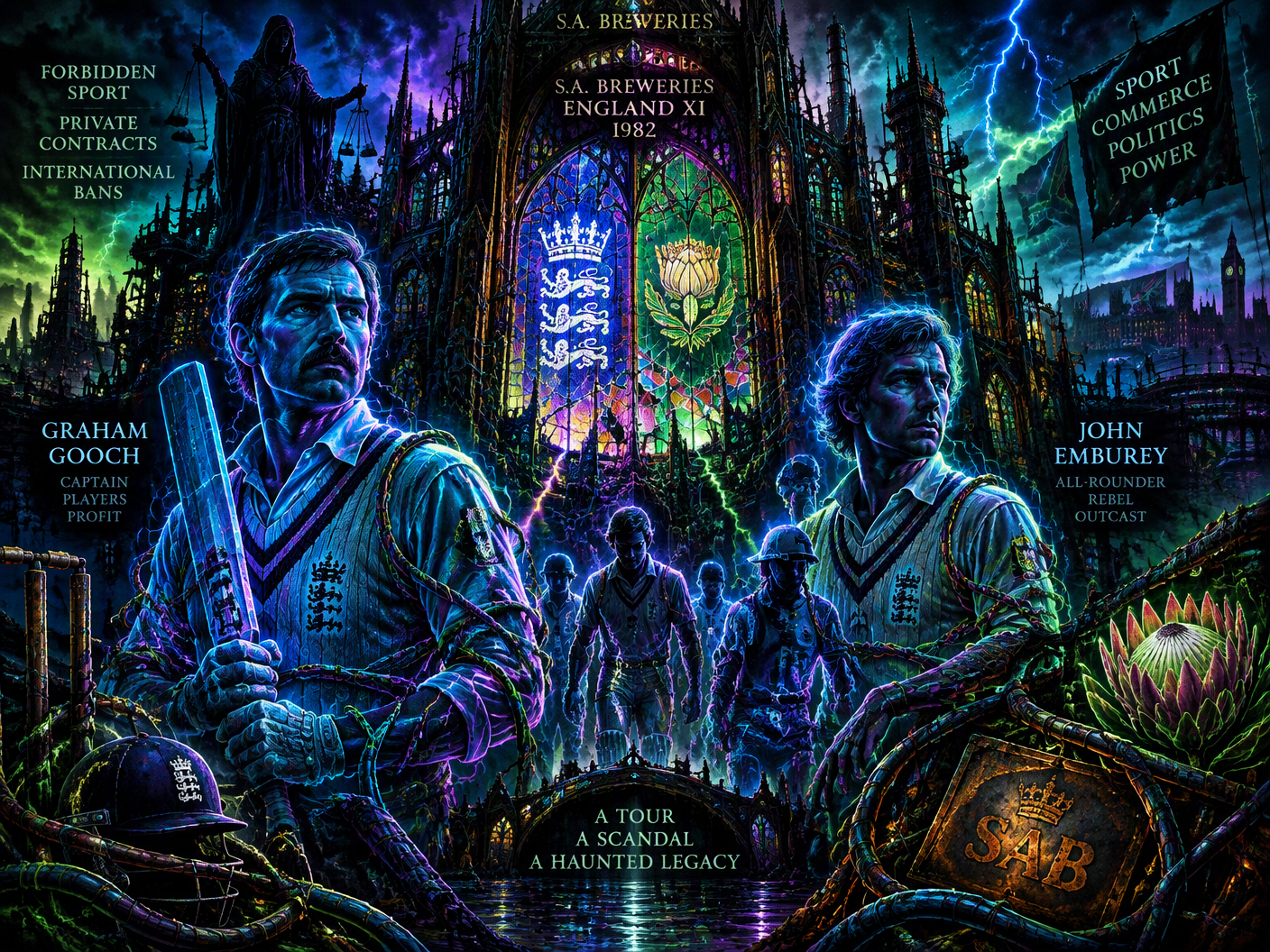
On 1 March 1982, seven English cricketers flew to Johannesburg, and a tour that had been assembled in private became public fact. They were not traveling as an officially sanctioned England side. They arrived under the commercial name South African Breweries England XI, entering a country where the International Cricket Council maintained a moratorium on international teams touring South Africa. The flight changed the matter from a set of contracts and promises into a sporting event with players, fixtures, sponsors, and consequences that would follow them home.
The arrangement had been completed quickly. England had returned from its tour of India on 24 February. During the three days that followed, the selected players signed contracts for South Africa. The timing left little interval between the end of one England assignment and the creation of another, this one outside the authority that governed official international cricket. Graham Gooch, an England batsman, became the touring captain. John Emburey, the off-spinner, was among the players who accepted the invitation.
The money changed hands before the team crossed the equator. Holiday Inns had been prepared to support the venture, but its backing carried a condition: Ian Botham had to be part of the touring party. Botham, England’s leading all-rounder, pulled out. Holiday Inns’ support consequently shifted away, and South African Breweries underwrote the tour instead. The name placed on the side’s fixtures therefore recorded its financial structure as well as its cricketing identity. It was an England-linked team supported by a South African company, not an England team operating through the normal international channel.
The public revelation did not end the tour; it began its visible phase. From 3 through 29 March, the South African Breweries England XI moved through a schedule that included Pretoria, Cape Town, Port Elizabeth, Johannesburg, and Durban. The program contained a match against South African Colts and another against Western Province, then three Tests and three one-day internationals. This was not a short exhibition arranged around a single appearance. It was a substantial competitive itinerary, built to resemble the international cricket that official bodies had declined to authorize.
The distinction between appearance and authority remained central. On the field, the players performed the familiar work of an international cricket tour: batting, bowling, fielding, and completing scheduled matches. Outside the boundary, the tour occupied a different legal and administrative position. The ICC moratorium had denied South Africa the regular exchange of international teams, while the privately organized England XI supplied opponents and fixtures without receiving the standing of a sanctioned England national side. The players could produce scorecards; they could not convert those scorecards into official approval.
Gooch gave the series a statistical center. Across the three-match Test series, he scored 338 runs and captained the touring side. Those figures belonged to the matches that were played, regardless of the dispute surrounding the tour’s status. They also showed why the episode could not be reduced to a symbolic political gesture or a hurried commercial appearance. The players had entered a serious cricketing program, and Gooch’s runs provided a measurable record of its sporting substance.
The tour’s sponsors and organizers had created an enterprise that could function on the ground: contracts had been signed, a replacement underwriter had been found, players had traveled, and opponents had taken the field. Ali Bacher, the South African cricket administrator, helped organize the rebel-tour structure in South Africa. The venture thus joined private contracts to a commercial sponsor and a local administrative network. Each part was practical. Together, they allowed the matches to proceed during a period when official international cricket remained closed to South Africa.
When the players returned to England after March, the governing question was no longer whether they had played. They had. The Test and County Cricket Board, the authority responsible for English cricket, addressed instead the breach created by participation in an unauthorized overseas tour. Its response was a three-year ban from international cricket for the returning tourists. The sanction separated the players from England’s international side while leaving the disciplinary measure defined by the level of cricket it controlled.
That boundary mattered. The players were not simply erased from every form of English professional cricket, nor were they prosecuted for a criminal offense. The penalty imposed by the TCCB was an international ban. It treated the tour as a violation of cricket’s governing arrangements and restricted the players’ access to England’s representative team. The distinction also prevented later retellings from turning the episode into either an official England campaign or a total professional exile. The documented punishment was serious, specific, and limited to international cricket.
The ban altered the careers of the men who had gone to South Africa, but it did not affect them all in the same way. Gooch and Emburey later returned from the three-year exclusion and played major parts with England. Their return placed the 1982 tour inside a longer professional life rather than at its endpoint. Other tourists did not regain a comparable international standing. The names on the Johannesburg flight therefore divided into different career paths once the sanction expired, shaped by selection, opportunity, and the passage of time.
What endured was a precise institutional record. In late February, players signed contracts almost immediately after returning from India. On 1 March, seven of them flew to Johannesburg. During March, the South African Breweries England XI completed three Tests and three one-day internationals, with Gooch leading the side and scoring 338 Test-series runs. Afterward, the TCCB imposed three-year international bans. The tour remained a completed sporting enterprise, but never an authorized England tour; its name, financing, fixtures, and punishment preserved that distinction.
Investigative Dossier & Evidence
Read the companion investigation notes, verified source claims, and primary documents.
Read the Companion Notes & Evidence Record →