
Tragedy · 2000s
The Rain, the Pileup, and CART’s 40-Lap Finish at Surfers Paradise
Heavy rain turned the 2002 Honda Indy 300 into a stop-start contest before an opening-lap pileup sent Adrián Fernández and Tora Takagi to hospital. CART shortened the race, held most of it under caution, and declared Mario Domínguez the winner after 40 laps—a finish criticized by teams and broadcaster Robin Miller.
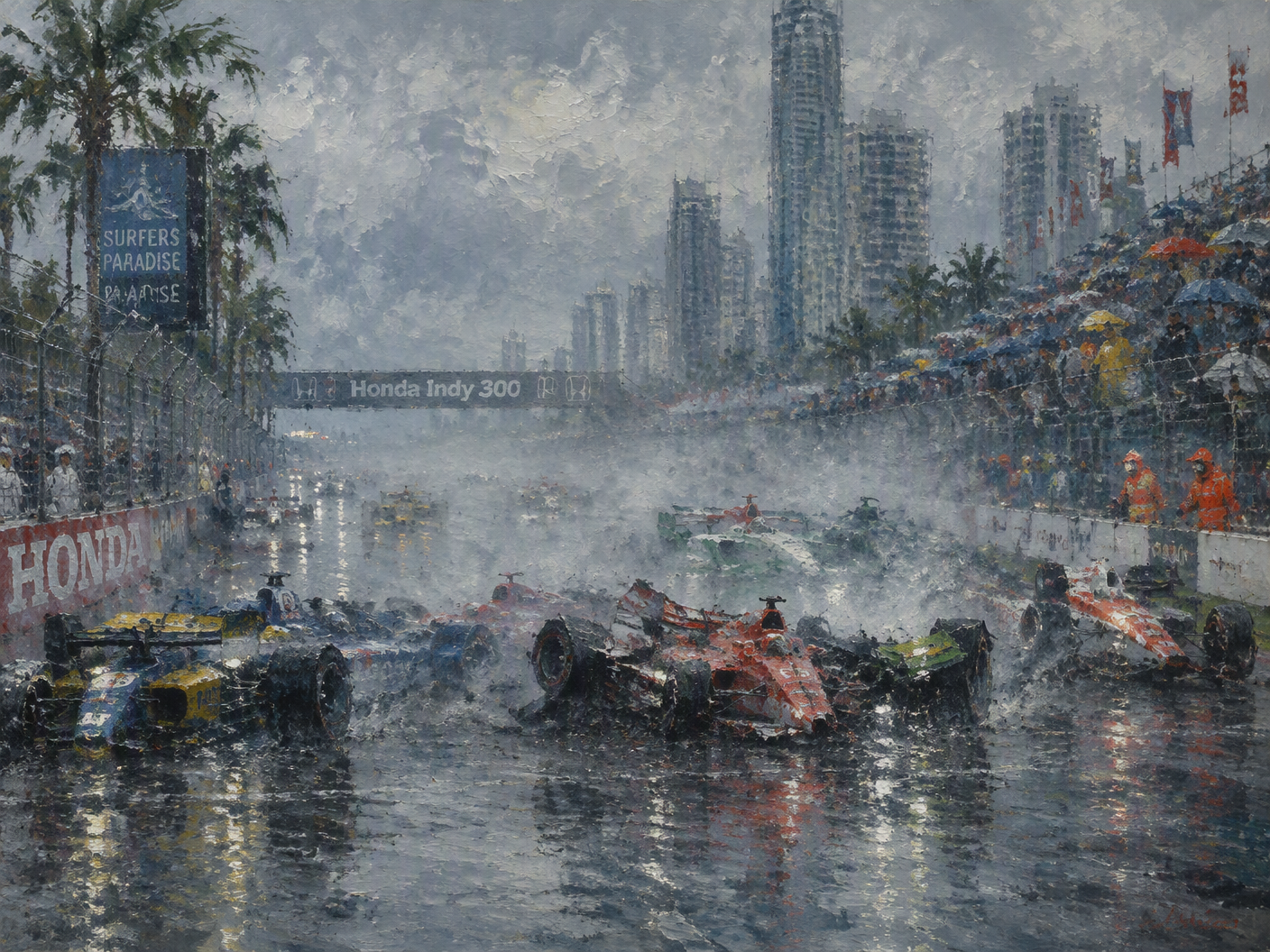
Rain polished the asphalt at Surfers Paradise until the street circuit looked like black glass. On Sunday, October 27, 2002, CART sent its cars into the wet anyway. The Honda Indy 300 was supposed to run 70 laps through Queensland streets lined with temporary grandstands and hard concrete. Instead, the first start lasted only moments. Cars tangled in spray. Carbon fiber broke loose. The field folded into itself before the race had found its rhythm. Adrián Fernández and Tora Takagi came out injured. The afternoon became a negotiation between speed, weather, and the clock.
The crowd had come in force. Pre-race demand had pushed organizers to add grandstand space, and 103,351 people filled the circuit for the weekend’s main event. They brought raincoats, plastic ponchos, and the patience of people waiting for a machine to outrun the weather. The cars carried the sharper smell: hot metal, wet rubber, fuel, and brake dust. Somewhere beneath the grandstand roofs, ticket stubs softened in damp hands. The show had been sold as a high-speed festival. By the time the engines climbed toward the opening start, the course had become a trap of standing water and blind spray.
The rolling start came in heavy rain. Jimmy Vasser, Michel Jourdain Jr., Patrick Carpentier, Alex Tagliani, Michael Andretti, Dario Franchitti, Mario Domínguez, Fernández, and Takagi were caught in the first-lap wreck. The cars struck, slid, and blocked the narrow racing surface. Visibility collapsed behind the spray. A street circuit leaves little room for a driver’s mistake and less for the driver behind him. Fernández and Takagi absorbed the human cost of the pileup. The rest of the field waited for officials to decide whether the race could be put back together.
Race control stopped the opening start. The red flag came out, and the crews went to work with the blunt tools of a damaged afternoon: jacks, wheel guns, replacement bodywork, and backup cars. Surviving teams were allowed to repair their machines or change cars before the restart. Mechanics crawled through the wreckage of their own plans, scraping rain from visors and checking suspension pieces bent by the collision. The delay stretched. Engines cooled. Drivers sat in wet suits beneath awnings while the officials rebuilt the race from the pieces that remained.
Fernández and Takagi were taken to Gold Coast Hospital for treatment. Takagi received precautionary X-rays for pelvic pain. The medical response moved away from the bright fencing and sponsor banners into corridors where the noise of the circuit arrived as a muffled vibration. The race did not pause for a full accounting of what the impact might mean later. It had a schedule, a television window, and a crowd pressed against the barriers. Hospital doors closed behind two drivers while the paddock returned its attention to the cars.
When the field restarted, the rain had not made a deal with anybody. Water continued to blur the braking points. Spray erased the cars ahead. The contest became a procession interrupted by brief bursts of movement, then swallowed again by caution. Cristiano da Matta had arrived as the pole winner and one of the weekend’s leading figures, but the conditions stripped the race of its ordinary hierarchy. Strategy mattered. So did survival. Every lap under yellow turned the event less into a test of overtaking than a test of whether race control could keep the machinery moving without adding another ambulance to the afternoon.
The caution periods accumulated until the race’s final 31 laps ran under yellow. Cars circulated behind the pace vehicle, their tires throwing fans of dirty water across the painted lines. Patrick Carpentier and Paul Tracy remained among the names near the front, while da Matta’s position and earlier pace lost their authority inside the weather-bound arithmetic. The spectators had paid for velocity and received delay, noise, and the ticking uncertainty of officials counting laps. On the pit wall, every decision carried two prices: the race result and the possibility of another crash.
CART then changed the distance. The original 70-lap race became a 50-lap event. Some teams expected the contest to become official after 36 laps. Officials used 40. That number became the hinge. Four laps can be a small distance on a dry circuit. In a rain-choked race, four laps can separate a provisional story from a stamped result. The rulebook and the weather met under pressure, and race control chose the number that would govern the afternoon. The decision did not require a conspiracy to create anger. It required only a finish nobody had imagined at the start.
At 40 laps, Mario Domínguez was declared the winner. His Herdez Competition car stood at the top of a classification shaped by wreckage, cautions, medical transport, and shortened distance. The victory belonged to him in the official result. Around it gathered the residue of the afternoon: teams questioning the conditions, drivers dealing with damaged cars and interrupted plans, and a crowd that had watched much of the race pass beneath yellow flags. The checkered flag ended the procedure. It did not settle the argument over what kind of race the procedure had produced.
Teams criticized the finish. ESPN commentator Robin Miller called it an embarrassment for CART. The phrase landed because the event had begun as a showcase with a swelling audience and ended as a managed fragment. No driver needed to be accused of fixing anything for the result to feel unnatural. The wet track had already done the damage. Race control had stopped the first start, authorized repairs and backup cars, shortened the distance, and counted the final laps under caution. Each action answered an immediate problem. Together, they produced a finish that left the sanctioning body carrying the weight.
The Surfers Paradise weekend remains a clean example of how sporting authority works when conditions outrun the script. The crash was real. Fernández and Takagi went to hospital. The rain reduced visibility. The officials managed the danger, then defined the boundary at which the race would count. Domínguez won under that boundary. The controversy lived in the machinery between those facts: the red flag, the restart, the cautions, the altered distance, the disputed expectation of 36 laps, and the final count of 40. The asphalt dried eventually. The questions did not.
Investigative Dossier & Evidence
Read the companion investigation notes, verified source claims, and primary documents.
Read the Companion Notes & Evidence Record →