
Scandals & Feuds · 1990s
The Two Seconds That Decided Chávez–Taylor
On March 17, 1990, Julio César Chávez stopped Meldrick Taylor with two seconds remaining in a championship fight at the Las Vegas Hilton. Taylor had been ahead on two judges’ scorecards, and the late intervention by referee Richard Steele became a lasting dispute without producing a definitive finding that the stoppage was improper.
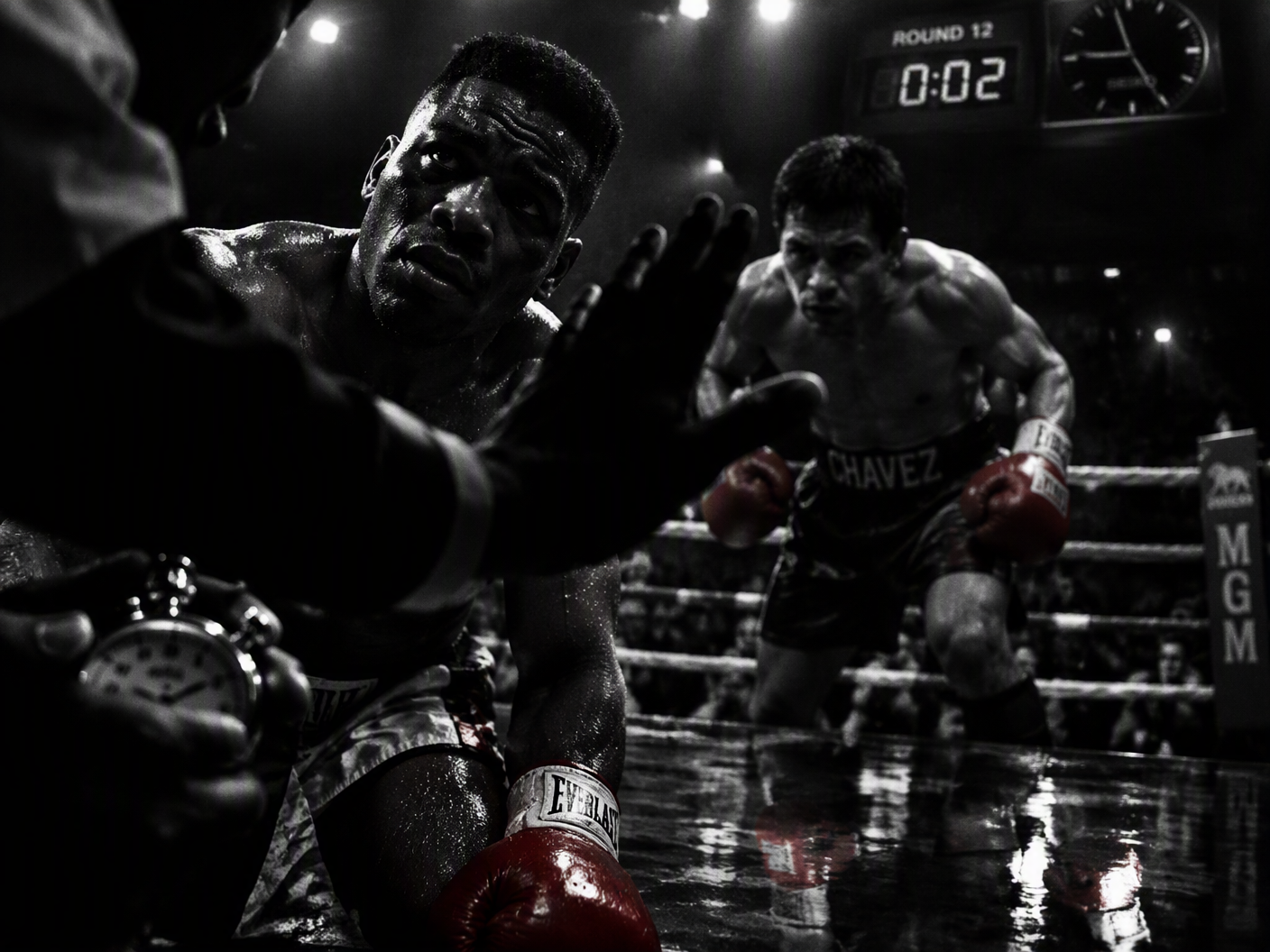
With two seconds left in the 12th round, referee Richard Steele stopped Julio César Chávez’s fight with Meldrick Taylor at the Las Vegas Hilton in Winchester, Nevada. The decision converted the final moments of a championship contest into a late technical knockout for Chávez. Taylor had been ahead on two judges’ scorecards entering the round, but he had also been dropped and given a standing eight count. In the space between those facts lay the dispute that followed: whether the referee had ended the fight at the necessary moment or one moment too soon.
The fight had been arranged for the WBC and IBF light welterweight titles, placing two recognized champions in the same ring under the authority of professional boxing’s separate sanctioning bodies. Chávez carried the WBC championship. Taylor held the IBF title. Their meeting was not an exhibition or a preliminary contest whose meaning could be repaired by another opportunity; the result would determine which boxer left with the official victory and which title claim remained standing.
By the time the final round began, the arithmetic of the judges’ cards had made every exchange consequential. Taylor was ahead on two cards, and his trainer, Lou Duva, told him that he needed to win the round to secure the fight. The instruction placed the scoring system inside the corner’s immediate calculations. Taylor could not simply protect an advantage and assume the result was settled. The last three minutes still belonged to the referee, the judges, and the two men attempting to alter the outcome with their hands.
That arrangement gave the 12th round an unusual double pressure. Taylor was carrying an advantage on the cards, yet Duva’s instruction treated the margin as insufficient. Chávez, meanwhile, needed a decisive change in the fight rather than a narrow reading of the score sheets. The official structure of boxing allowed both conditions to exist at once: a boxer could be ahead and still be required to fight as if he were behind; a challenger could trail and still win the titles through a single late intervention.
Late in the round, Taylor was dropped. Steele administered a standing eight count before the action continued. That count did not close the bout by itself, but it changed the question before the referee. The fight was no longer only about how Taylor had performed across eleven completed rounds or how the judges had scored the exchanges. Steele had to decide whether Taylor could continue through the remaining seconds. Chávez remained in position to press the attack; Taylor remained within a fight that had not yet reached the scheduled bell.
Steele stopped the contest with two seconds still on the clock. Chávez received the victory by 12th-round technical knockout. The timing was precise enough to become inseparable from the result: not a stoppage in the opening minutes, not an intervention after the bell, but a decision made at the edge of the scheduled distance. Taylor’s lead on two scorecards did not become the official outcome. The knockdown, the standing eight count, and Steele’s judgment combined to place the championship in Chávez’s column.
For Taylor’s corner, the ending carried the force of a reversal. Duva had sent him into the round with a clear assignment—win the final three minutes—and the cards had left that assignment within reach. The stoppage arrived before the bell could settle the score through another exchange or through the judges’ totals. For Chávez, the same seconds represented the successful completion of a late attack. The official result did not preserve the fight as a narrow points decision; it recorded a knockout victory achieved before the round was complete.
The immediate post-fight argument centered on Steele’s intervention. Because Taylor had been leading on two cards, because the bout was in its last round, and because only two seconds remained, the referee’s decision became the central fact through which the fight was remembered. The dispute was not separate from the scoring; it depended on it. A stoppage that might have been interpreted differently earlier in the bout acquired another meaning at the precise moment when Taylor’s advantage and his vulnerability occupied the same space.
The official result remained Chávez’s late 12th-round TKO, while the argument over its fairness continued after the fighters left the Las Vegas Hilton. Debate could preserve competing interpretations, but it did not alter the recorded outcome. No later reversal transformed the result into a decision for Taylor, and the dispute did not become a formal finding that Steele’s stoppage had been definitively unjustified. The fight therefore endured in two forms at once: as a settled championship result and as an unsettled question about the final seconds.
That division explains the bout’s afterlife more accurately than the legend attached to it. On March 17, 1990, Chávez and Taylor fought for the WBC and IBF light welterweight titles. Taylor entered the last round ahead on two judges’ cards; Duva told him he needed the round; Taylor was dropped and given a standing eight count; Steele stopped the fight with two seconds remaining. Those events fixed the official result. The debate survived because the same sequence could be read as both a legitimate rescue of a fighter in danger and an interruption of a fight that was nearly over.
Investigative Dossier & Evidence
Read the companion investigation notes, verified source claims, and primary documents.
Read the Companion Notes & Evidence Record →