
Scandals & Feuds · 1940s
The NCAA’s Sanity Code and the Failed Expulsion of Seven Schools
Adopted in 1948, the NCAA’s Sanity Code restricted athletic scholarships to demonstrated financial need and required athletes to meet ordinary academic standards. When the association moved against seven member schools, a 111–93 expulsion vote failed to reach the required two-thirds majority, and the code was repealed the following year.
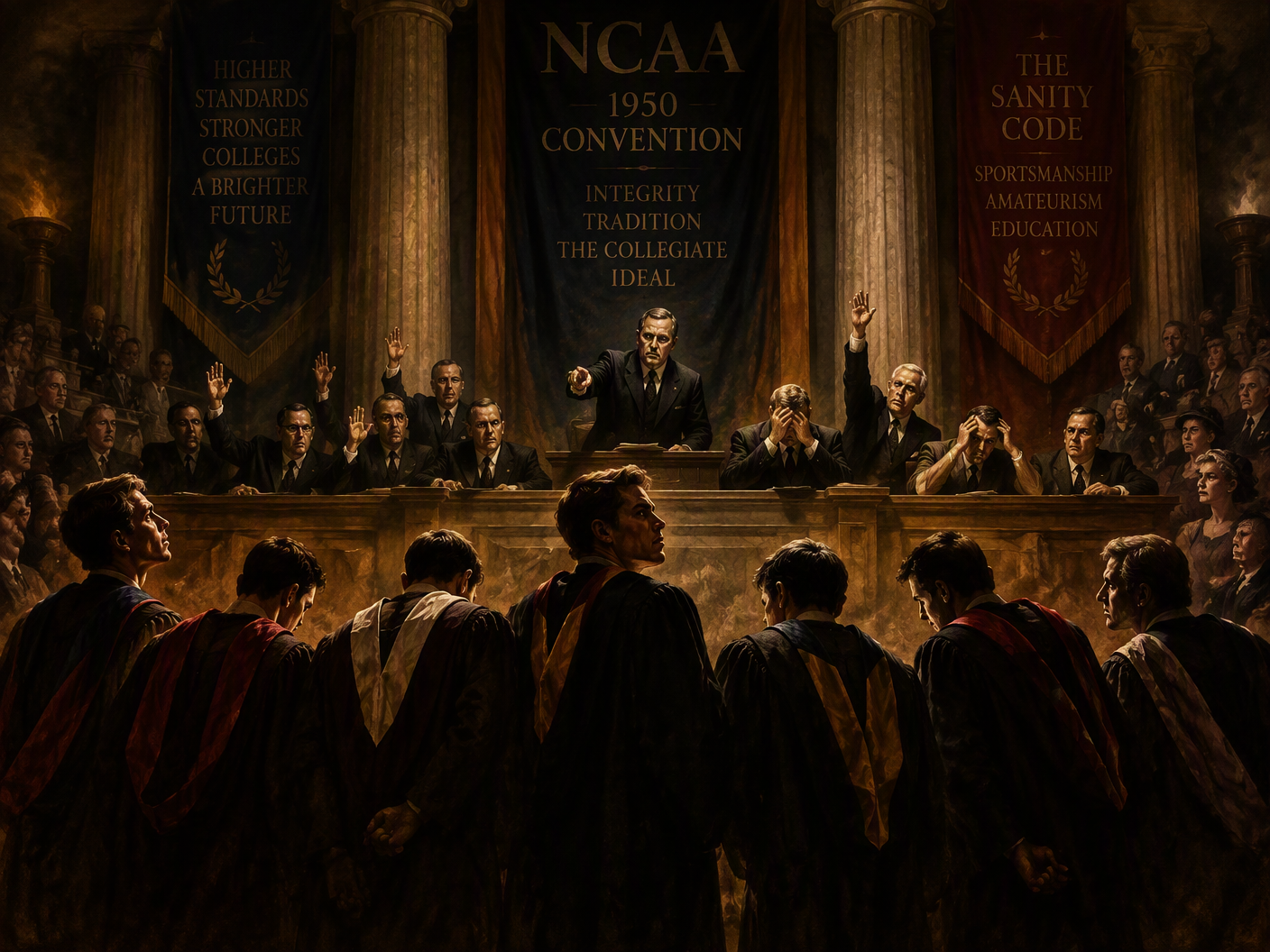
The NCAA adopted the Sanity Code on January 10, 1948, and placed financial aid and academic eligibility inside the association’s enforcement structure. Athletic scholarships could be awarded only on the basis of demonstrated need. Athletes also had to satisfy the same academic standards applied to students who did not compete. The code was an attempt to draw a line between educational assistance and athletic recruitment. It gave the NCAA a written standard, but it also created a disciplinary problem: the association would have to decide whether its member schools had crossed that line, and what punishment membership could impose.
The restriction mattered because financial aid was not a peripheral benefit. It determined which athletes could attend, remain enrolled, and compete. By tying aid to need, the code denied schools the simpler use of scholarships as athletic inducements. By applying ordinary academic standards to athletes, it rejected a separate educational track for players whose value was measured on the field. The NCAA had chosen a demanding principle. It would soon have to defend that principle against institutions whose membership gave them a vote in their own punishment.
The NCAA assigned review to its compliance committee. During 1949, that body examined member institutions under the new rules and identified seven schools for expulsion recommendation. They were Boston College, Villanova, The Citadel, the University of Maryland, the University of Virginia, Virginia Military Institute, and Virginia Polytechnic Institute. The committee’s action converted an argument about athletic aid into a formal question of membership. These schools were not being prosecuted in a criminal court. They were being targeted by the governing association that controlled their access to NCAA competition.
The recommendation carried a consequence beyond the individual schools. Expulsion would have removed them from the association and severed their standing within the competition they had joined. Yet the committee could recommend removal without delivering it. The final authority rested with the NCAA convention, where member representatives would decide whether the seven institutions should lose membership. The same structure that gave the code legitimacy—rules adopted collectively by the member schools—also gave those schools a direct role in limiting its reach.
That conflict reached the convention on January 14, 1950. The expulsion motion received 111 votes in favor and 93 against. A majority supported removal. The number was not enough. The NCAA constitution required a two-thirds majority for expulsion, and the motion failed to reach that threshold. The seven schools therefore remained members. The committee had produced an adverse disciplinary recommendation, and the convention had endorsed expulsion by a clear margin, but the governing rule prevented the sanction from taking effect.
The arithmetic was the decision. One hundred eleven representatives had voted to expel the schools; ninety-three had voted to keep them. Under an ordinary majority system, the result would have removed the seven institutions. Under the NCAA’s rule, it preserved their membership. The supermajority requirement did not erase the committee’s recommendation or the convention’s division. It determined which of those facts carried legal force inside the association. Enforcement depended not only on identifying a violation, but on assembling enough members to authorize the prescribed punishment.
The failed vote also exposed the limits of the Sanity Code as an enforcement instrument. The NCAA had established restrictions, created a compliance review, and identified institutions for expulsion. When the final sanction required broad agreement among the governed, the process stopped short of removal. The seven schools were not expelled in 1950. Their continued membership was the measurable result of the vote, not a later act of clemency or a reversal of the committee’s recommendation.
The code remained in place for another year, but its authority had been weakened by the failed enforcement action. The NCAA had tried to regulate athletic aid through a needs-based standard and to preserve academic eligibility rules through collective discipline. The convention’s vote showed that the association could declare a standard and recommend a penalty while lacking the votes to impose it. The problem was institutional, not rhetorical: a rule that could not reliably produce its stated consequence was difficult to sustain as the central method of control.
On January 13, 1951, the NCAA convention voted to repeal the Sanity Code. The decision ended the regime that had limited scholarships to financial need and required athletes to meet the same academic standards as non-athletes. Repeal did not expel the seven schools. It removed the code itself. The association abandoned the framework after its most consequential disciplinary test had failed to produce the required supermajority, leaving member institutions inside the NCAA and the code outside it.
Between January 1948 and January 1951, the NCAA moved through three distinct acts of governance: it imposed a standard, directed a compliance committee to recommend expulsion for Boston College, Villanova, The Citadel, Maryland, Virginia, Virginia Military Institute, and Virginia Polytechnic Institute, and then failed to secure the votes required to remove them. The final act was repeal. The Sanity Code had been designed to control athletic aid and academic eligibility; its afterlife was defined by the authority the NCAA could write into a rule, the authority it could not convert into expulsion, and the decision to discard that rule when enforcement failed.
Investigative Dossier & Evidence
Read the companion investigation notes, verified source claims, and primary documents.
Read the Companion Notes & Evidence Record →