
Tragedy · Ancient Rome
The Prisoners Who Refused the Beasts
Roman bestiarii occupied two separate worlds: condemned prisoners and slaves sent to die before wild animals, and voluntary young men who entered beast combat for training, courage, or pay. Ancient writers also preserved accounts of prisoners who killed themselves rather than reach the arena.
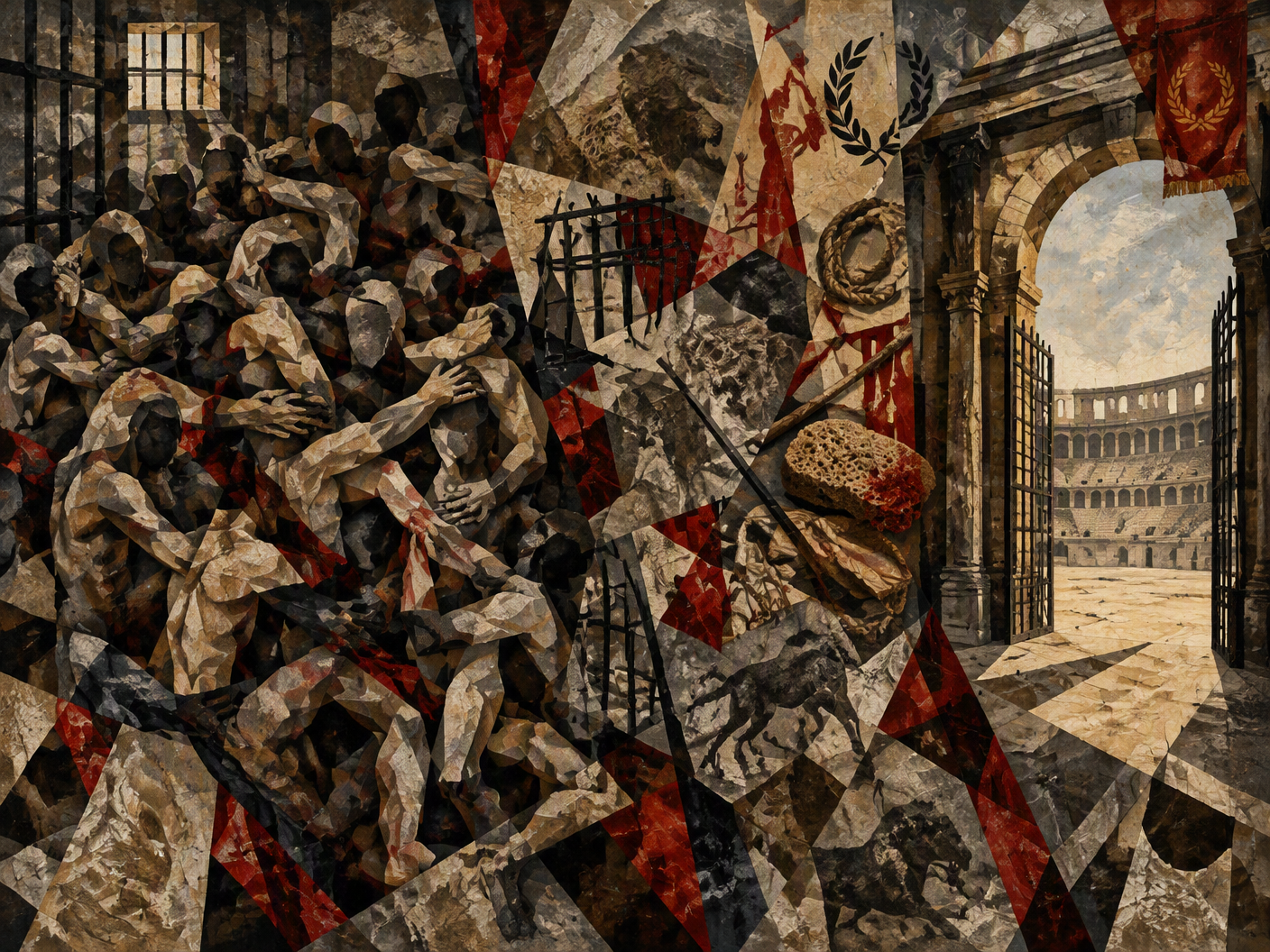
The twenty-nine Saxon prisoners did not reach the arena. On the night before their scheduled appearance, they strangled one another in their cells. Symmachus preserved the account, giving the number and the timing but not the names. By morning, the Roman spectacle had its empty bodies instead of its condemned performers. The cells had done what the arena was meant to do. They had turned prisoners into a public sentence, then lost them before the doors opened.
The men called bestiarii were not one kind of Roman. Some went into combat with beasts. Others were exposed to them. The distinction carried the weight of a life or death judgment. Roman authorities could place prisoners and slaves convicted of serious crimes among those sent toward the animals, while other men entered the same dangerous world by choice. The arena used one name for both. The law, the purse, and the purpose were different.
For the condemned, the encounter was not presented as a contest. They were sent naked and without the means to defend themselves. There was no shield, no weapon, no bargain over terms once the sentence had been delivered. The beast supplied the violence; Rome supplied the enclosure and the audience. A prisoner convicted of a serious crime could be taken from confinement and placed in a space where his death served punishment and spectacle at the same time.
That arrangement made the body part of the sentence. The condemned bestiarius had no training to display and no victory to claim. He was not there to prove courage. He was there because Roman power had decided that death should occur in public, before animals, with the prisoner's helplessness made visible. The sources place prisoners and slaves inside this category, people whose legal status had already stripped away ordinary protection. The arena completed the process with a gate and a cage.
Seneca preserved another refusal. A German prisoner, facing participation in the spectacle, killed himself by forcing a sponge used in the lavatory down his throat. The object belonged to the prison's daily routine, not to combat. In his hand it became a means of escape from the appointed scene. He did not wait for the arena, the animals, or the officials who would have delivered him there. The act was grim, practical, and carried out before the sentence could become theater.
Seneca also wrote of a different prisoner who broke his neck by thrusting his head between the spokes of a cart wheel. The account turns an ordinary piece of equipment into the final barrier between confinement and exposure. There is no arena choreography in it. No beast appears. The prisoner used what was near him and made the decision before others could make it for him. In these stories, refusal did not look heroic. It looked like a body finding one last available exit.
Symmachus's twenty-nine Saxons made that exit together. They were confined in cells, due to appear the next day, and strangled one another during the night. Their deaths occurred before the scheduled public punishment, at the point where custody was supposed to guarantee the spectacle. The report gives no roll call, no account of who began, and no explanation of how the prisoners coordinated. It leaves the number behind: twenty-nine men, gone before the arena could receive them.
The voluntary bestiarii belonged to another economy. They were described as young men who fought beasts, and sometimes one another, for training, courage, or pay. They entered a hazardous profession in pursuit of a chosen reward. A voluntary fighter could seek experience, money, or a reputation for nerve. His presence did not erase the condemned man's coercion. The same animals and enclosures could hold a paid participant one day and a helpless prisoner the next.
That difference mattered to the people who arranged the spectacle. A voluntary fighter had a reason to prepare, a skill to sell, and some interest in surviving the encounter. The condemned prisoner had none of those terms. He could be a slave or a convicted criminal, stripped naked and sent without defense. One man entered for training or pay. The other entered because Roman authorities had converted a criminal sentence into a public performance. Calling both men bestiarii concealed the unequal bargain.
Seneca and Symmachus left the prisoners at the threshold. Their accounts preserve the reported deaths, the timing, and the decision to avoid the arena, but they do not supply an independent inquiry into what happened inside the cells. No modern proceeding follows the German prisoner, the man at the cart wheel, or the twenty-nine Saxons. Their names are mostly absent. What remains is the shape of the choice: condemned people reaching for death before Rome could stage theirs.
The bestiarius, then, was both fighter and sentence. The word could describe a young man seeking pay or courage, and it could describe a prisoner or slave stripped of clothes and defense before wild beasts. Roman authorities supplied the categories, the confinement, and the arena. The ancient writers supplied the stories of those who never crossed into it. When the next day's spectacle began, some places were empty—not because the sentence had been lifted, but because the prisoners had taken the last decision left to them.
Investigative Dossier & Evidence
Read the companion investigation notes, verified source claims, and primary documents.
Read the Companion Notes & Evidence Record →