
Violence & Brawls · 2000s
The 6.57 Crew and the South Coast Riot Sanctions
Portsmouth’s 6.57 Crew was tied to repeated matchday violence, from a 1981 reputation for disorder to the Coventry fighting of 2001 and the Southampton riots of 2004. The final response came through arrests, a juvenile conviction, and 54 lifetime bans imposed by Portsmouth chairman Milan Mandarić.
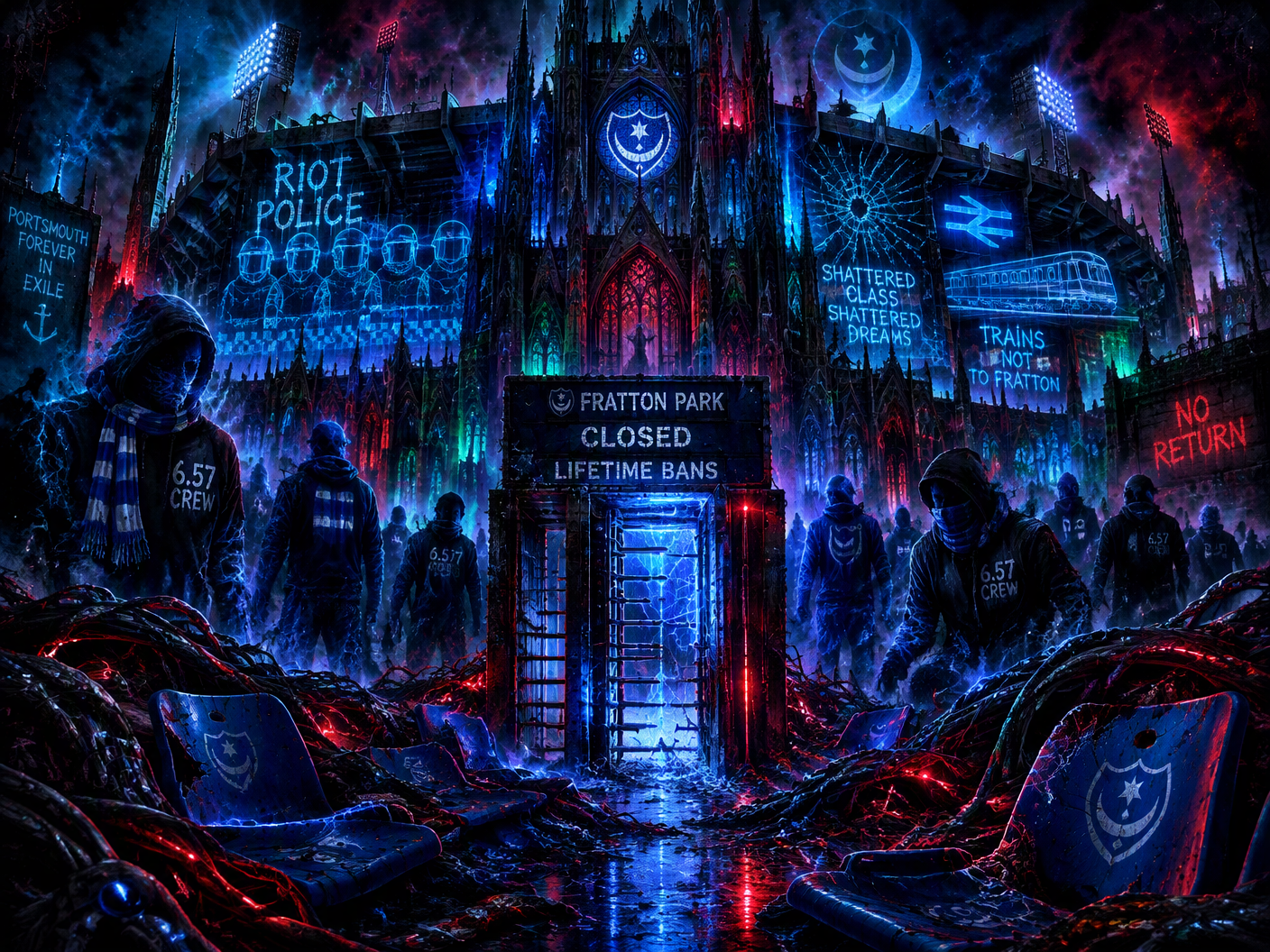
The seats came up first. On 22 September 2001, Portsmouth supporters ripped plastic rows from the Coventry City ground and threw the pieces at Coventry supporters. Riot police moved in during the match. Earlier, 140 Portsmouth hooligans had fought Coventry fans through the city centre before kickoff. The violence crossed the day’s usual boundaries: street to turnstile, pavement to stand, football to police operation. The men attached to Portsmouth’s 6.57 Crew had arrived for a match. By the time the teams played, the match had become the smaller event.
The 6.57 Crew was a Portsmouth-linked football hooligan firm. Its name came from the 6:57 a.m. Train leaving Portsmouth and Southsea station for London Waterloo, a departure time turned into a badge. The name carried the geography with it: the south coast station, the long railway line, the away ground waiting at the other end. It was not a club committee or a supporters’ association. It was a firm identified with football violence, and its public history rested on what happened around matches.
The reputation had hardened long before Coventry. In March 1981, Portsmouth fans were branded “the worst in Britain” after violence in the Plymouth police context. The phrase belonged to the authorities and the moment, not to any neutral league table. It showed how the problem was being named: not as an isolated fight outside a ground, but as a recurring presence attached to Portsmouth away days. The label did not explain every person in the crowd. It did explain the burden the club carried whenever its supporters crossed a county line.
In May 1985, members of the 657 Crew set fire to a stand at Huddersfield Town. Fire changed the scale of the story. A broken barrier could be repaired. A burning stand made the ground itself part of the violence, with timber and plastic becoming evidence of a crowd that had stopped behaving like a crowd. The incident entered the firm’s public identity alongside the railway departure and the Portsmouth shirt. Away fixtures did not merely carry supporters from one town to another. They carried an established expectation of trouble.
By the Coventry match in 2001, the sequence was plain. Portsmouth hooligans fought Coventry supporters in the city centre before the game. Inside the stadium, Portsmouth supporters ripped up plastic seats and used them as missiles. Riot police were called during the match. The police response was not a precaution at the edge of the ground; it was the answer to disorder already unfolding among the stands. The objects had been fixed in place for spectators. Hands tore them loose, and the club’s football ground became a supply of weapons.
The violence did not require a political program or a criminal empire to operate. It required a football fixture, opposing supporters, movement through a city, and people willing to turn rivalry into assault. The public account establishes those ingredients and the disorder they produced. It does not give every member of the firm the same biography, or place every Portsmouth supporter inside the same circle. The distinction sits in the conduct: fights, ripped seats, thrown missiles, police intervention. That was enough to make the firm’s name useful to police, clubs, and newspapers long after the men had left the ground.
The South Coast produced the next major collision on 21 March 2004, around the Southampton match. More than 300 people became involved in riots before and after the game. Police made arrests. The violence spread beyond the ninety minutes and beyond the formal property of the stadium, putting streets, rival supporters, and bystanders inside the same disorder. Portsmouth’s feud with Southampton supplied the setting, but the consequences were administrative as well as physical. Names entered police files. The club had to decide whether loyalty to its paying public stopped at the ticket barrier.
One of those arrested was a ten-year-old boy. He was later found guilty of violent disorder, becoming the youngest-ever convicted football hooligan in the United Kingdom. The conviction gave the episode a human measure that the crowd number could not. Three hundred people was an estimate of scale. A child in court was a consequence with a name removed from the terrace and placed before the law. The case showed how far the riot had reached: not only into the established ranks of football firms, but into the lives of young participants drawn into the disorder.
Milan Mandarić, Portsmouth’s chairman, answered with a club sanction that carried no soft edge. In August 2004, he banned 54 Portsmouth hooligans for life because of their involvement in the Southampton-game riots. A lifetime ban meant the club closed its turnstiles to the men who had treated matchday access as permission to fight. It also made the club’s position concrete. This was not a public-relations statement about family values or a promise to review procedures. Fifty-four people lost the right to enter Portsmouth’s ground for life.
Mandarić had already vowed to investigate action over a book cover connected with Rolling with the 657 Crew, written by Cass Pennant, a former West Ham hooligan leader. The book placed the firm inside a commercial story as well as a football one: violence could be remembered, packaged, and sold. The chairman’s response showed the club trying to control how the name appeared beyond the terraces. But the Southampton riots made the question harder to manage. A cover could be challenged. Seats, arrests, convictions, and bans could not be kept on the shelf.
Portsmouth’s response did not erase the earlier incidents. The March 1981 violence, the stand fire at Huddersfield in May 1985, the Coventry fighting and stadium disorder in September 2001, and the Southampton riots in March 2004 remained separate events with separate consequences. Together they fixed the 6.57 Crew in the public record as a football hooligan firm linked to Portsmouth, not as a proven organization with a wider criminal reach. The sanctions were attached to documented matchday disorder. They did not turn every story told about the firm into fact.
The residue was practical. Riot police had entered the Coventry ground. Arrests followed the South Coast disorder. A ten-year-old carried a conviction for violent disorder. Fifty-four Portsmouth hooligans lost their club for life. The 6.57 name began with a train timetable and endured through the damage left at away grounds. By August 2004, the route back into Fratton Park had been shut for dozens of men. The turnstiles remained. Their names did not pass through them.
Investigative Dossier & Evidence
Read the companion investigation notes, verified source claims, and primary documents.
Read the Companion Notes & Evidence Record →