
Scandals & Feuds · 2010s
The Tutor-Assisted Coursework, the Honor-Court Case, and the NCAA Sanctions at UNC
The NCAA found that tutor Jennifer Wiley provided improper academic assistance and about $4,100 in benefits to football players, while UNC’s honor court separately ruled that Michael McAdoo received help with citations and a works-cited list. The NCAA later imposed a postseason ban, scholarship reductions, and probation; Orange County authorities separately pursued alleged athlete-agent inducement charges.
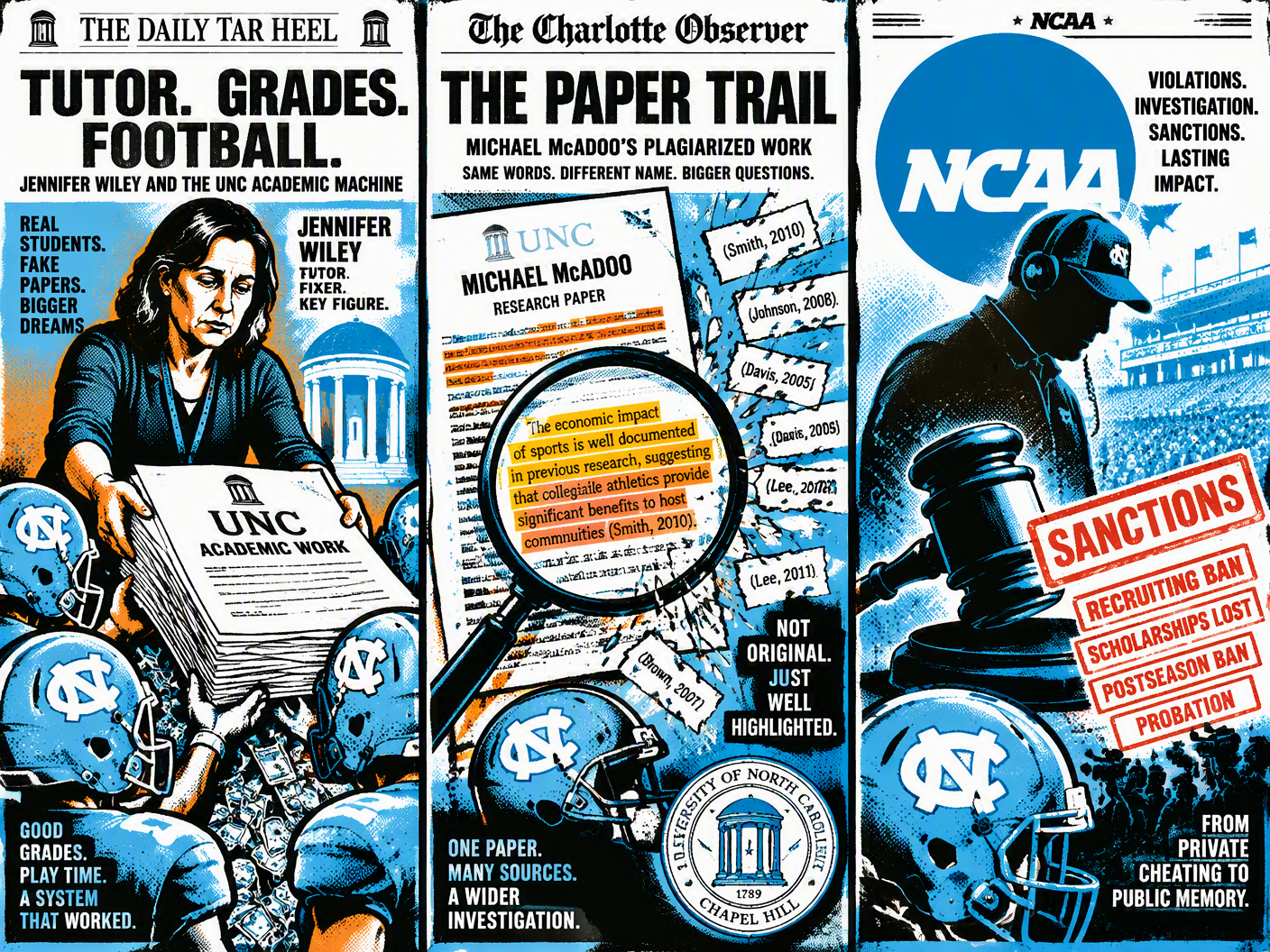
On March 12, 2012, the NCAA imposed a one-year postseason ban on North Carolina football, removed 15 scholarships, and placed the program on probation for three years. The penalties followed an investigation into academic fraud and the university’s failure to monitor its football program. The NCAA had begun examining the case in August 2010, after concerns about a tutor working inside UNC’s academic support system. By the time the ruling arrived, the dispute had moved beyond individual papers. It had become a test of who was responsible when academic assistance crossed into substitution.
The tutor at the center of the NCAA inquiry was Jennifer Wiley. Her role placed her close to players who needed help meeting the academic requirements attached to athletic eligibility. That access became the central operational fact. The NCAA found that Wiley gave several players too much assistance on research papers, moving beyond instruction into work that affected the substance and presentation of their assignments. The distinction was not academic in the abstract. Eligibility depended on completed coursework, and completed coursework depended on the boundary between help and authorship.
The benefits widened that boundary. The NCAA found that Wiley provided approximately $4,100 in improper assistance through travel, parking expenses, and free tutoring. Each item was modest compared with the budgets surrounding major college football. Together, they formed a stream of value attached to athletes whose eligibility carried consequences for coaches, administrators, and the program’s competitive schedule. The violation was therefore not limited to words appearing on a page. It included the exchange of services and expenses that the governing rules treated as improper benefits.
By September 2010, concerns about a tutor’s closeness to football players had entered public view while the NCAA investigation continued. The university faced two questions at once: what individual athletes had received, and whether the support structure created conditions in which improper assistance could continue without effective supervision. Chancellor Holden Thorp announced the university’s response to the probe. The investigation did not begin with a single proven scheme. It developed through separate academic reviews, institutional inquiries, and the NCAA’s effort to determine how assistance had been delivered and monitored.
Michael McAdoo became the most visible academic case. UNC’s honor court ruled that he had received improper help from Wiley with citations and a works-cited list on one of his papers. The proceeding imposed its own institutional consequence before the NCAA issued its final sanctions. After the paper became public, examples of plagiarism were detected in its text. That finding intensified the dispute because it connected the mechanics of academic assistance—citations, sources, and formatting—to the more serious question of whether portions of the paper had been copied.
McAdoo’s case also showed how the scandal acquired layers. The honor court addressed improper assistance with specific parts of an assignment. The later examination of the paper identified passages that had appeared elsewhere. Those were related events, but they were not the same institutional finding. One concerned the help Wiley provided; the other concerned copied language in a paper made public. The distinction mattered to the people facing discipline, but it did not prevent the episode from becoming evidence in the larger inquiry into UNC’s academic support practices.
The NCAA’s March 2012 infractions report converted the separate episodes into a program-level judgment. It found UNC football guilty of multiple infractions, including academic fraud and failure to monitor the program. The university accepted the final resolution. Thorp supported the outcome, while the sanctions reached beyond the tutor and the players whose coursework had been examined. A postseason ban removed the program from championship competition for a year. The scholarship reduction limited future roster construction. Probation extended oversight into the seasons that followed.
The case also changed the position of people who had exercised authority around the players. Head coach Butch Davis was fired by UNC in July 2011, before the NCAA issued its final ruling. Assistant coach John Blake received a three-year show-cause penalty after the NCAA found financial transactions connected to work for an agent and access to NFL-caliber student-athletes. A show-cause order required any NCAA member school seeking to employ him to explain why the restrictions should not follow him. The punishment reached the employment channel that had connected coaching access to professional opportunity.
The scandal later entered the criminal courts through a different route. Between September 30 and December 2, 2013, Orange County authorities pursued athlete-agent inducement charges against people connected to the football program. The defendants included Jennifer Wiley Thompson, Terry Watson, Patrick Jones, Willie Barley, and Michael Johnson; a later grand-jury indictment named Julius Nyang’oro, the former chair of UNC’s African and Afro-American Studies department. Nyang’oro had resigned from the executive chair role in 2011. The criminal case extended the controversy from academic eligibility into alleged benefits offered to athletes.
Those indictments did not erase the separate paths the scandal had taken. The NCAA had imposed administrative sanctions after finding academic fraud and failures of monitoring. UNC had used its honor court to discipline McAdoo for improper assistance. Orange County prosecutors had brought inducement charges against named individuals. Each action carried a different authority and consequence. The final public picture was therefore defined by overlapping proceedings rather than one universal verdict: a football program penalized, individuals sanctioned or charged, and a university forced to account for the people it had placed around its athletes.
Investigative Dossier & Evidence
Read the companion investigation notes, verified source claims, and primary documents.
Read the Companion Notes & Evidence Record →