
Scandals & Feuds · 1990s
The Chelsea Headhunters, the Undercover Camera, and the Violence That Reached Court
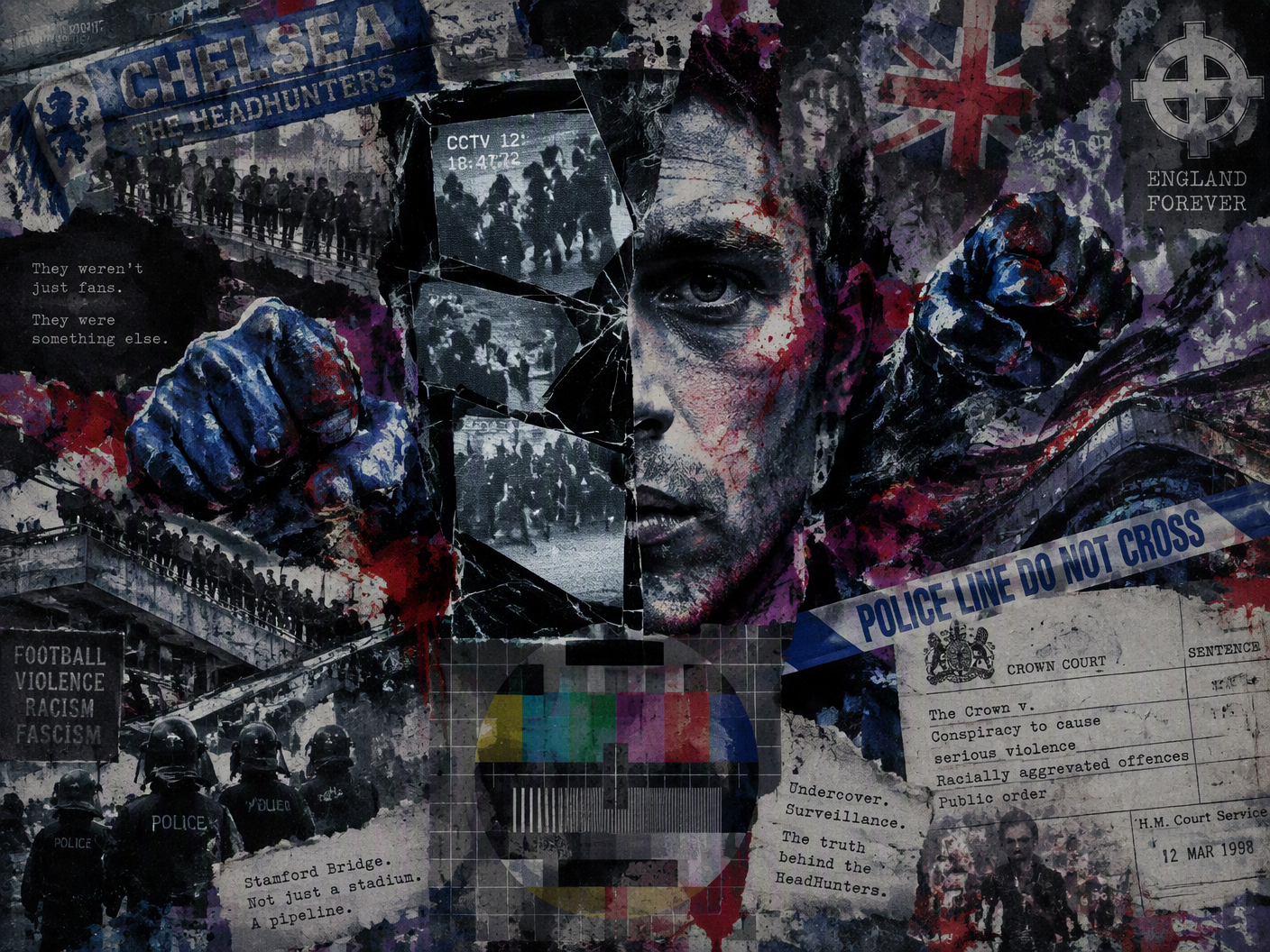
Formed in West London in the late 1960s, the Chelsea Headhunters became a durable football-hooligan firm associated with racist and far-right supporter culture. Donal MacIntyre’s 1999 undercover investigation exposed that world, while later convictions tied named men to violence in London and beyond.
The punch landed outside the Lexington pub in King’s Cross in August 2019. Owen Jones, a journalist and columnist, had been attacked on the pavement by a group that included James Healy, Liam Tracey, and Charlie Ambrose. The men left Jones with the consequences of the assault; Healy carried the case into the following year. In July 2020, a court sentenced Healy to two years and eight months for aggravated assault. The sentence placed a Chelsea supporter with earlier football-hooliganism convictions inside a story that had started decades before, on the other side of London.
The Chelsea Headhunters formed in West London in the late 1960s. They were not a loose collection of men who happened to quarrel near a ground. The name became attached to a Chelsea Football Club-linked hooligan firm, a distinct supporter subculture with its own reputation and following. Football supplied the meeting point. The fights, loyalties, and political attachments belonged to the men who carried them beyond the turnstiles. Over time, the Headhunters became one of the most recognizable names in English football violence.
Racism was part of the public shape that formed around the group. Chelsea attracted racists from across the country, and some supporters followed the club because its stands contained a visible racist and hooligan contingent. That description belonged to the culture surrounding the firm, not to every person who entered Stamford Bridge. But it explained why the Headhunters drew attention beyond football. Their identity was not limited to disorder after a match. It was also tied to the politics men brought with them into the terraces, pubs, and streets.
On 9 November 1999, Donal MacIntyre entered that supporter world under another kind of pressure. He went undercover as a wannabe member of the Chelsea Headhunters for a BBC documentary investigation. The pose gave him access to conversations and conduct that a conventional television crew could not have reached. The camera followed the performance of belonging: the need to prove loyalty, accept the group’s language, and stand close enough to violence for the affiliation to mean something. MacIntyre’s film made the firm’s racist and violent subculture visible to a national audience.
The documentary became an exposure point in the group’s public history. Later summaries credited the investigation with leading to arrests and convictions involving Chelsea Headhunters members and football violence. The legal consequences that followed were carried by named defendants, police work, and courtroom sentences. The broadcast could open the door; it could not serve a prison term. That distinction shaped what came next. The Headhunters were no longer only a name traded among football followers. Their conduct had become material for investigators, prosecutors, and judges.
The next hard endpoint came on 13 February 2010, after Chelsea played Cardiff City in an FA Cup match at Stamford Bridge. Violence followed the game. The Chelsea Head Hunters and Cardiff’s Soul Crew were drawn into the disorder, which brought the Metropolitan Police and South Wales Police into the same investigation. The match was over, but the criminal case was not. Men who had treated the fixture as a contest of allegiance now faced statements, identification work, and the slow movement of charges toward court.
On 25 March 2011, Isleworth Crown Court sentenced 24 men for taking part in the Cardiff-related violence. Jason Marriner received two years in prison and a six-year ban from football grounds. The ban removed him from the places where the group’s identity had been built: the concrete approaches, the turnstiles, the terraces, and the public rituals of match day. The sentence did not assign every act to Marriner, and it did not turn one defendant into the author of the entire disorder. It fixed his own conduct in law.
The trouble was not confined to London. In April 2014, before Chelsea’s Champions League match against Paris Saint-Germain, police dealt with pre-planned violence involving around 300 hooligans. Chelsea-associated hooligans and Paris Saint-Germain supporters were caught in the disturbance. The number mattered because it showed the scale at which football affiliations could travel: across borders, through planned meetings, and into streets where the match itself had not yet begun. Paris became another entry in the long list of places where supporter identity turned physical.
Five years later, the attack on Owen Jones brought the story back to a London pub. Jones was assaulted outside the Lexington in August 2019. Police arrested Healy and two other men after officers recognised them from CCTV footage. Those officers were familiar with Chelsea supporters known to police. The recognition converted faces on a screen into arrests, and arrests into a prosecution. Jones later gave a victim impact statement about the aftermath. The violence lasted minutes. Its administrative and personal residue lasted much longer.
Healy was jailed in July 2020 for two years and eight months. The conviction concerned the aggravated assault on Jones, not every act ever associated with Chelsea’s hooligan culture. Yet the case carried the weight of the older name. A firm formed in the late 1960s had survived investigations, football-ground bans, prison terms, foreign disorder, and changing public language. The people changed. The habits found new streets. Courts continued to deal with individuals whose conduct connected football allegiance to organised violence and, in some cases, far-right politics.
MacIntyre’s undercover work remains the cleanest image of the contradiction: a reporter presenting himself as a recruit in order to show what recruitment meant. But the later court cases supplied the firm’s strongest legal consequences. Twenty-four men were sentenced after the Chelsea-Cardiff violence. Marriner went to prison and lost access to football grounds for six years. Healy went to prison for assaulting Jones. Paris produced another police-described outbreak involving hundreds. The camera revealed a culture. The courts counted individual acts.
The final residue is not a legend about terraces or a slogan about loyalty. It is a prison sentence, a six-year football ban, a CCTV identification, and a journalist describing what an assault did after the attackers had gone. The Chelsea Headhunters began as a West London firm in the late 1960s. By July 2020, their name still traveled with men appearing before courts. The empty space left by a banned supporter, and the damage carried by an assaulted one, outlasted every match attached to the story.
Investigative Dossier & Evidence
Read the companion investigation notes, verified source claims, and primary documents.
Read the Companion Notes & Evidence Record →