
Scandals & Feuds · 2000s
The Red-Painted BYU Y That Became a Felony Case
In April 2004, eight Utah baseball players painted Brigham Young University’s hillside Y red. Photographs developed in Salt Lake City led police to Ryan Breska, a felony mischief charge against all eight players, and a later reduction to misdemeanors with a reported $6,267.20 fine.
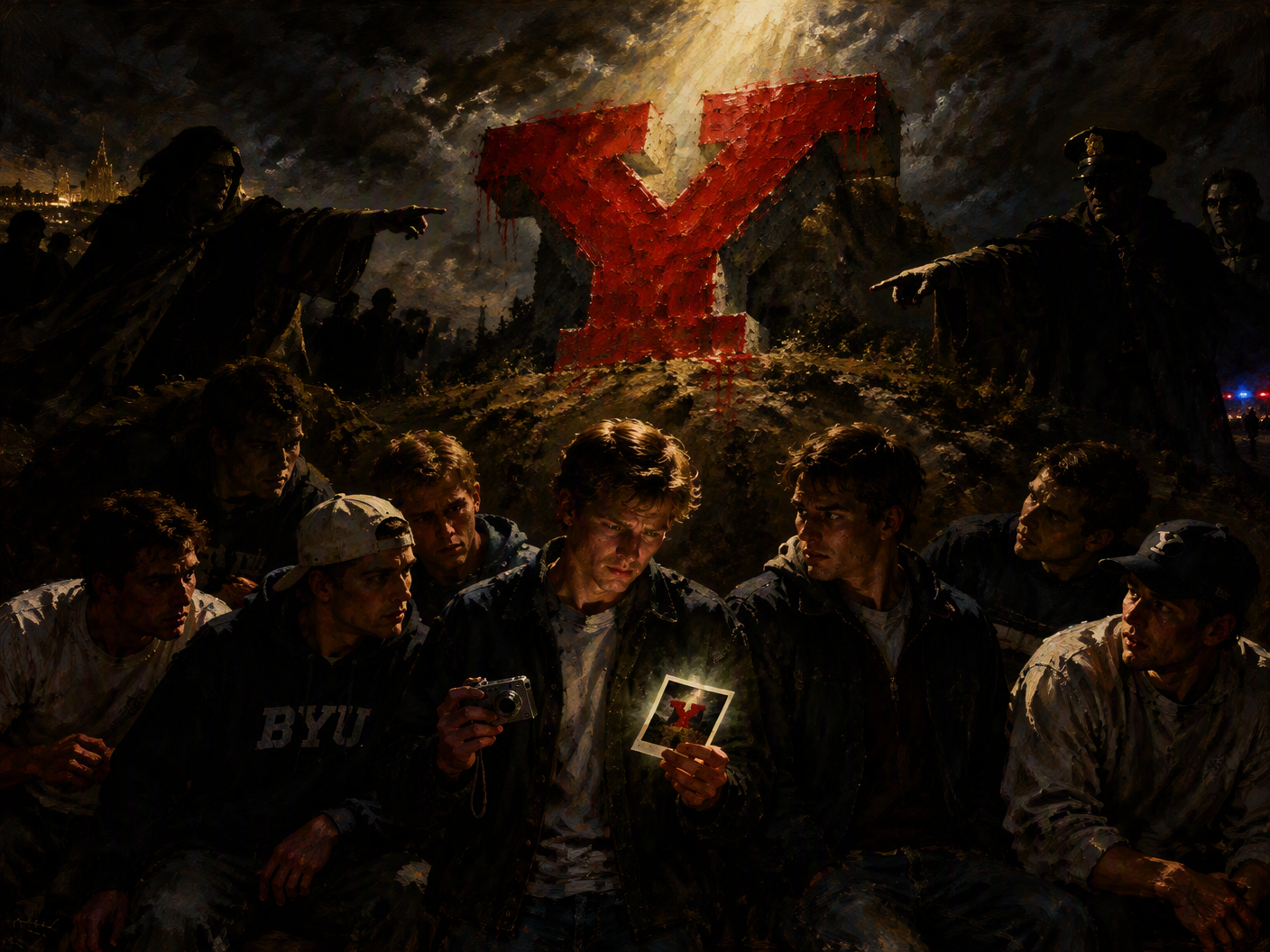
The police encounter began at a discount store in Salt Lake City, not on the Provo hillside where the paint had been applied. Ryan Breska returned to collect developed photographs, and police were waiting for him. The pictures showed Breska and friends standing in front of the BYU hillside Y after it had been painted red. The episode had moved from a rivalry gesture at a fixed landmark to an arrest built around a set of ordinary photographs. (C1, C2, C3)
In April 2004, eight Utah baseball players carried out the act at the large concrete Y associated with Brigham Young University. The landmark overlooks Provo and functions as more than campus signage: it is a visible emblem of the school whose athletic identity has long stood opposite the University of Utah’s. Red paint placed across it converted that emblem into a temporary declaration of allegiance. The players then posed for photographs in front of the altered letter, creating the images that later brought the incident to police attention. (C1)
The photographs supplied the connection that the hillside itself had not. A customer brought developed pictures of himself and friends to a Salt Lake City discount store. The images showed the group at the painted Y, and the store became the point at which the incident entered an official response. When Breska came back for the photographs, police were already there. The sequence turned a private souvenir into an identifying object: it showed the scene, placed a named player within it, and gave officers a moment to act. (C2, C3)
Breska’s arrest widened the matter beyond the player who had returned to the store. Authorities in Provo charged Breska and the other seven Utah players with second-degree felony mischief. The allegation was therefore handled as damage to property, not as an informal expression of the Utah–BYU rivalry or a matter left solely to university discipline. Eight players were placed inside the same criminal case, while the public incident remained centered on one landmark, one color, and one set of photographs. (C3, C4)
The original charge carried a reported maximum sentence of 15 years in prison. That figure described the exposure attached to the felony filing, not a sentence imposed on the players. It also established the distance between the language of rivalry and the machinery of criminal law. What may have been understood by participants as a symbolic act was classified by authorities through the potential damage to a university landmark. The legal category did not depend on the players’ athletic status or on whether a game was nearby. (C4, C5)
That classification gave the episode a second life. On the hillside, the red paint addressed BYU through its most recognizable physical symbol. At the store, the photographs carried the act into a commercial setting where someone outside the rivalry could see it. In Provo, the same conduct became felony mischief. The change was not in the paint or the Y; it was in the institution receiving the event. A gesture legible as rivalry inside college sports became a property case once police and charging authorities took control of its meaning. (C1, C4, C5)
The case did not remain at its original level. Authorities in Provo later reduced the charges to class B misdemeanors and imposed a fine of $6,267.20. The reduction removed the felony posture and replaced the threatened prison exposure with a lesser criminal resolution and a financial penalty. The public outcome did not erase the arrest or the initial filing. It changed the scale of official consequence, moving the players from a charge carrying a reported 15-year maximum to misdemeanor-level cases. (C5, C6, C7)
The dollar figure became the clearest measure of where the matter ended: $6,267.20. It was imposed as part of the resolution, but the surviving account does not allocate the amount among the defendants. Nor does the public chronology turn the eight players into eight separate narratives. Breska’s return to the store provided the arrest circumstance; the charge and later reduction applied to the group. The case therefore retained a collective shape from its first formal filing through its lesser resolution. (C4, C6, C7)
The incident belonged to a rivalry older than the players involved. The football series record includes a BYU victory over Utah on October 14, 1922, and a Utah victory over BYU on November 20, 2004, seven months after the hillside was painted. Those results place the episode inside a long athletic history without explaining the players’ decision or the authorities’ response. The rivalry supplied the symbol and the audience. The photographs, the arrest, the charges, and the fine supplied the institutional sequence. (C8)
The episode also shows how quickly a symbolic act can acquire material consequences. The players chose a permanent-looking landmark, recorded themselves beside it, and carried the images into a store for development. The images then gave police a route to a named participant and, from there, to a group charge. Each step narrowed the distance between performance and accountability. The hillside gesture was temporary; the legal response created an enduring record attached to the players and the institutions they represented. (C1, C2, C3, C4)
The case ended below the level first announced, but not outside the law. Eight Utah baseball players were linked to the red-painted BYU Y; developed photographs brought the scene to police attention; officers waited for Breska at the store; and authorities in Provo charged the group with second-degree felony mischief before reducing the charges to class B misdemeanors and imposing a reported $6,267.20 fine. The rivalry gave the act its language. The criminal process gave it a different one: property damage, group liability, and a financial consequence that outlasted the paint. (C1, C2, C3, C4, C6, C7)
Investigative Dossier & Evidence
Read the companion investigation notes, verified source claims, and primary documents.
Read the Companion Notes & Evidence Record →