
Scandals & Feuds · 2010s
The Vanderbilt Assault Case, Four Original Defendants, and a Teammate’s Accessory Plea
A June 2013 dorm-room allegation led to a criminal case against four Vanderbilt football players—the original defendants—with cellphone photographs and videos becoming central evidence. Their cases moved separately, producing convictions, prison sentences, appeals, and plea agreements; teammate Chris Boyd later pleaded guilty to being an accessory after the fact for encouraging teammates to keep quiet and destroy evidence.
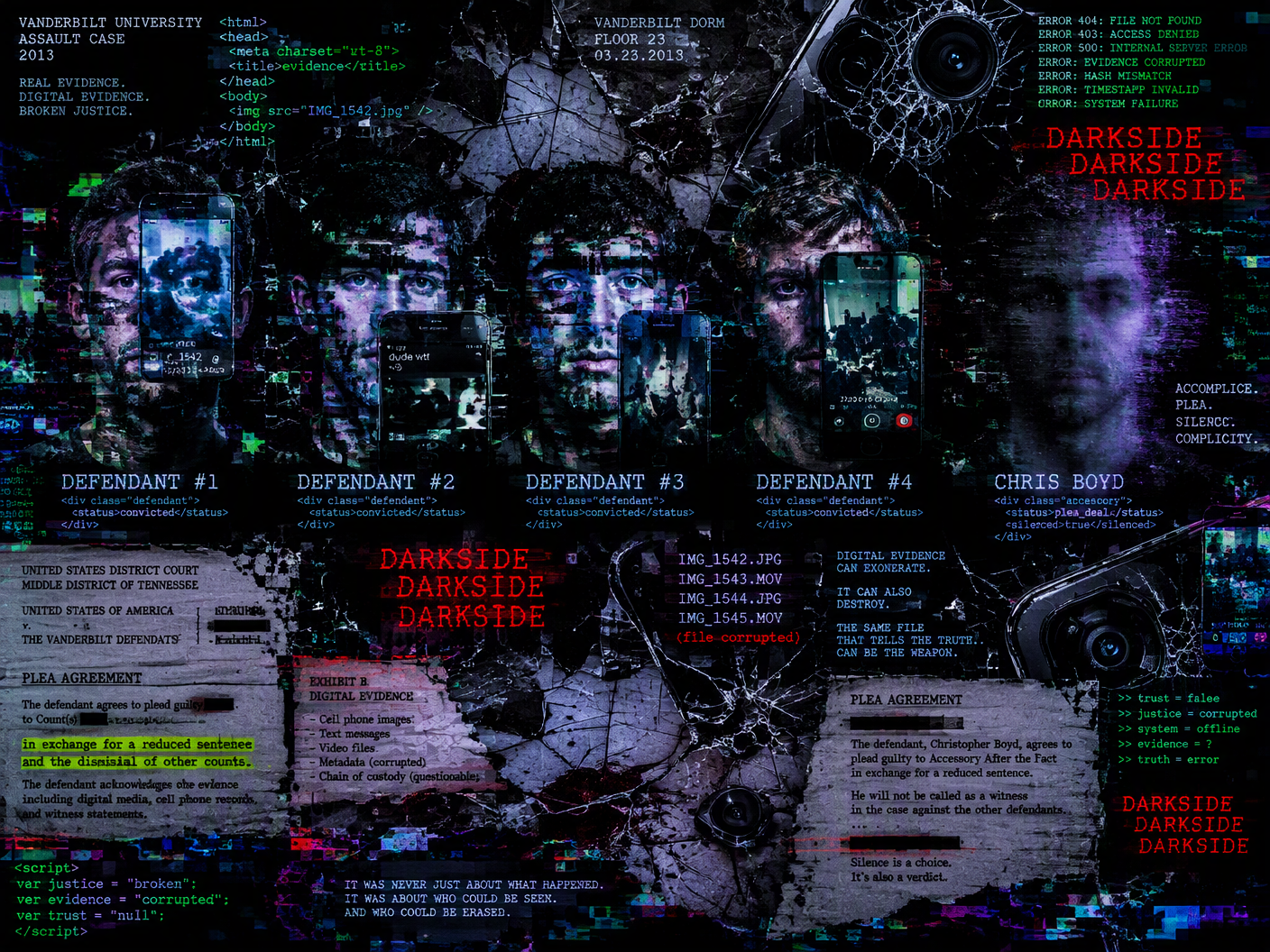
On August 9, 2013, Nashville police arrested Brandon Vandenburg, Cory Batey, Brandon Banks, and Jaborian McKenzie. A Davidson County grand jury indicted the four Vanderbilt football players on aggravated rape and sexual battery charges, 47 days after a 21-year-old woman was carried into a dorm room at Gillette Hall. The arrests converted a campus incident into a criminal case with named defendants, felony charges, and the prospect of trial. The legal process would later separate the four men, but it began with one allegation and one shared location.
The incident occurred on June 23, 2013, in a Vanderbilt residence hall in Nashville. Four players were accused of carrying the unconscious woman into a dorm room. The prosecution that followed centered on what happened inside and on the conduct surrounding it. The woman’s account became part of the trial testimony, alongside testimony from other witnesses. The case did not depend solely on recollections formed after the fact. The phones carried by the players supplied investigators with images made during the incident.
At trial, prosecutors introduced photographs and videos taken on players’ cellphones. The recovered media gave the state a digital chronology of the room and the people connected to it. Prosecutors used the files with testimony to establish the sequence of the assault and the surrounding conduct. The images were not a peripheral detail in the proceedings. They became exhibits that jurors could examine directly, placing the defendants’ own devices inside the evidentiary chain.
The four defendants entered the same criminal case, but the indictment did not determine an identical result for each of them. Vandenburg, Batey, Banks, and McKenzie faced charges arising from the same June 23 incident. Their cases moved through separate hearings, trials, negotiations, and testimony. That distinction became important as the prosecution continued. The state would secure convictions against some defendants, accept a plea from another, and pursue accessory liability against a teammate whose conduct centered on what happened after the assault.
Between January and April 2015, Davidson County Criminal Court heard testimony about the woman’s account, the defendants’ conduct, and the cellphone media. A jury proceeding was later nullified, and Batey was retried. The retrial kept the case tied to the same physical and digital evidence while changing the procedural path by which a verdict could be reached. In the courtroom, the case was no longer only about the accusation in a dormitory. It was about whether testimony and recorded images met the criminal standard required for conviction.
Batey was convicted of aggravated rape and related counts. On July 14 and 15, 2016, Judge Monte Watkins sentenced him to 15 years in prison. The sentence followed the retrial and gave the verdict a fixed institutional consequence: a state prison term rather than another round of unresolved proceedings. Watkins imposed the minimum sentence available under the verdict described in the sentencing coverage. The judge’s order placed Batey’s conduct within the most serious criminal consequences produced by the case.
Watkins also addressed what would follow Batey beyond the prison term. After release, he said Batey and the other defendants would remain on the sex-offender registry for the rest of their lives. Registration created a consequence separate from incarceration, extending the case into employment, housing, public records, and daily supervision long after a sentence ended. The judge’s statement made clear that the punishment would not be measured only by the number of years inside prison.
Vandenburg’s case proceeded separately, and a jury found him guilty in a separate trial in the Vanderbilt case. That verdict was an individual jury finding, distinct from Batey’s retrial and from any collective proceeding involving the four original defendants. Banks, who had also been charged in the Vanderbilt case, later received a 15-year prison sentence. The separate proceedings produced different records for different defendants. In 2019, appeals by Batey, Vandenburg, and Banks were unsuccessful. Their challenges did not overturn the convictions and sentences that had survived the trial courts.
McKenzie’s case took a different route. In May 2018, he accepted a plea agreement that imposed 10 years of probation and lifetime sex-offender registration. He also testified against co-defendants. A plea agreement is not the same legal event as a jury verdict, and McKenzie’s disposition reflected that difference. His cooperation placed his testimony inside the prosecution’s broader effort to establish what happened in the room and what the players did afterward.
Chris Boyd faced a separate accessory charge. He pleaded guilty to being an accessory after the fact for encouraging teammates to keep quiet and destroy evidence. The charge concerned conduct after the alleged assault rather than an identical finding that he had committed the acts at the center of the rape prosecution. His plea nevertheless established a criminal consequence for efforts to suppress information and eliminate proof. Silence and destruction were not abstract themes in the case; they became the basis of a guilty plea.
That post-assault conduct changed the shape of the prosecution. The case involved not only the woman’s account and the defendants’ alleged actions inside the dorm room, but also the treatment of evidence after the event. Cellphones, photographs, videos, testimony, and cooperation agreements moved through separate legal proceedings. Each item carried a different function: the media documented conduct, witnesses supplied accounts, verdicts assigned criminal liability, and pleas fixed consequences without requiring the same trial path for everyone involved.
By 2019, the appellate process had rejected challenges from Batey, Vandenburg, and Banks. The case’s final public shape was therefore divided among a 15-year sentence for Batey, a separate guilty verdict against Vandenburg, a 15-year sentence for Banks, McKenzie’s 10-year probationary plea with lifetime registration, and Boyd’s accessory plea tied to silence and destroyed evidence. The criminal system did not assign one uniform answer to the four original defendants. It preserved a sequence of separate findings, and the cellphone record remained at the center of the proceedings that produced them.
Investigative Dossier & Evidence
Read the companion investigation notes, verified source claims, and primary documents.
Read the Companion Notes & Evidence Record →