
Tragedy · 1990s
The Crossing Before the Ceremony
When a temporary bridge collapsed at the 1997 Maccabiah Games, four Australians died and responsibility passed through municipal scrutiny, criminal court, and a separate commission.
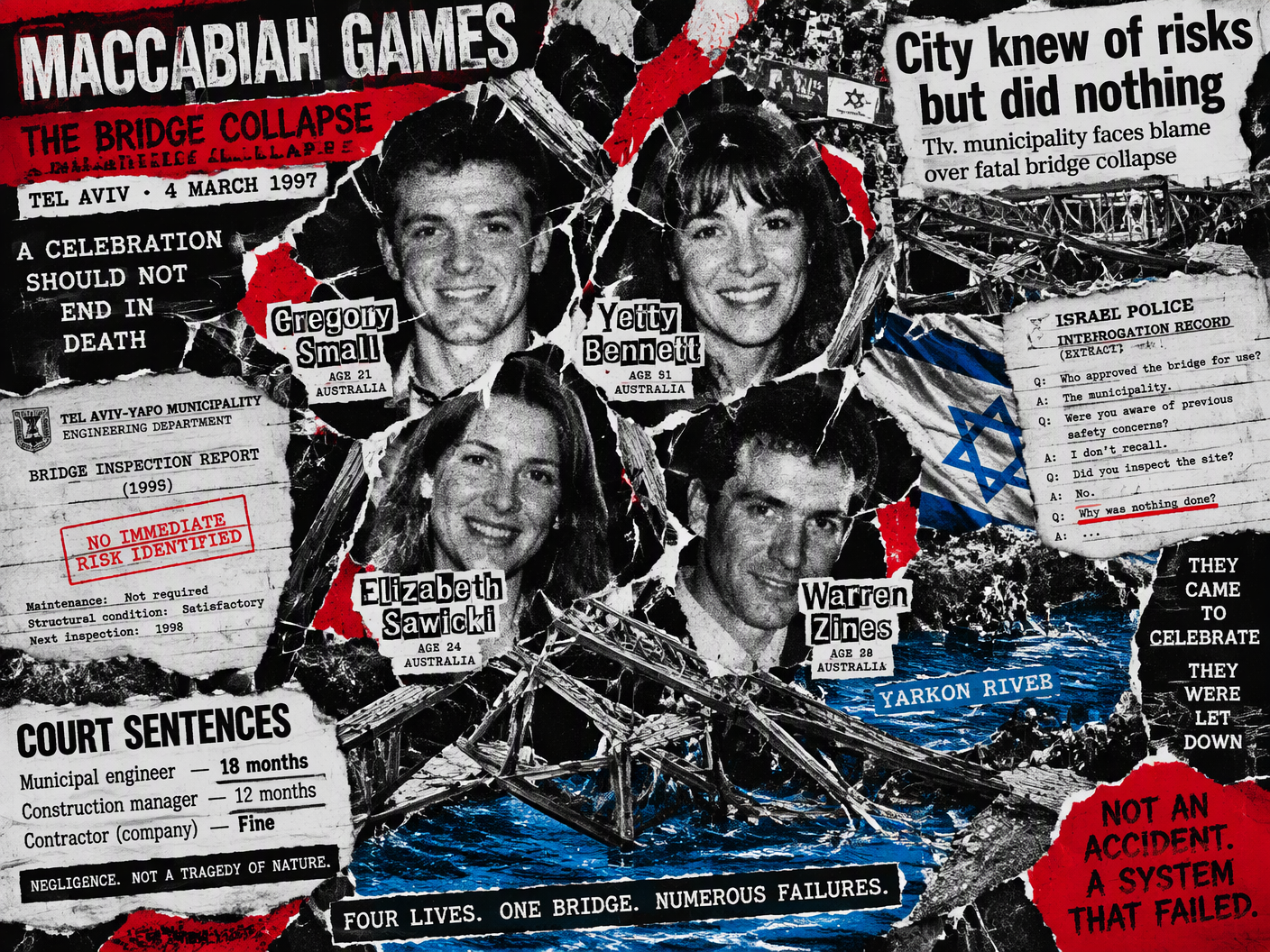
Minutes before 8:00 p.m. on 14 July 1997, a makeshift wooden bridge leading to Ramat Gan stadium collapsed. It had been erected so delegations could cross to the opening ceremony of the 15th Maccabiah. Most of the 373-member Australian delegation fell into the Yarkon River. The bridge's ceremonial purpose lasted until the crossing itself became the event's defining rupture.
Four members of the Australian delegation died as a result of the disaster. BBC reported that two athletes died immediately and two later from infections caused by toxins. Officials initially thought heavy metals in the river might have caused the deaths. Later laboratory tests in Israel found that the river did not contain enough heavy metals to be harmful to humans, leaving the reported medical sequence alongside the death toll.
The opening ceremony continued after a half-hour delay, at the urging of President Ezer Weizman. At the same time, police questioned Ramat Gan Mayor Zvi Bar in connection with allegations that the municipality had failed to supervise the bridge's approval properly. The questioning documented an official action and an allegation, not a proven finding of wrongdoing.
The criminal court supplied a narrower determination. An Israeli court sentenced four officials for their part in the bridge collapse, including the engineer and three contractors. The sentence addressed the conduct of those defendants; it did not turn the police allegation concerning municipal supervision into a proven finding.
A separate commission was authorized to investigate matters that were not part of the criminal and civil proceedings already being conducted in court. Its mandate preserved a different institutional route for examining the collapse and its approval, while the criminal case had already produced sentences for four officials. The event consequently entered the record through a court's judgment and a commission's distinct authority.
Investigative Dossier & Evidence
Read the companion investigation notes, verified source claims, and primary documents.
Read the Companion Notes & Evidence Record →