
Violence & Brawls · 1830s-1880s
The Thirty Seconds That Governed a Bare-Knuckle Round
The London Prize Ring Rules turned a knockdown into a measured sequence: thirty seconds of recovery, followed by eight seconds to return to the scratch. The code also defined the fouls that separated permitted violence from conduct that could end a contest.
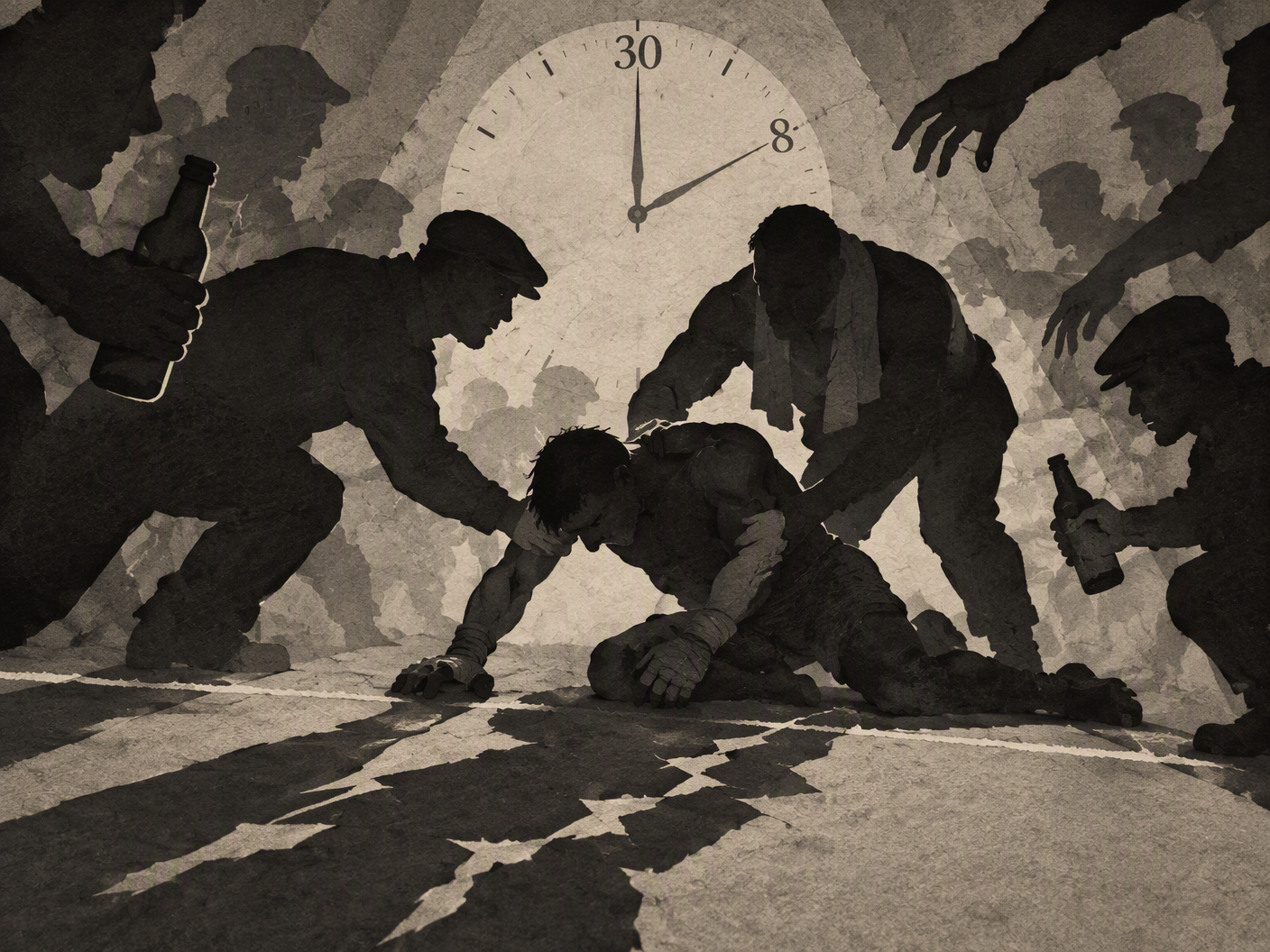
A man thrown or struck to the ground did not simply rise when he could. Under the London Prize Ring Rules, his fall ended the round and started a clock. He received thirty seconds to rest. Then came the second demand: eight additional seconds to reach the scratch, the marked line where the fighters met again. If he failed to arrive in time, the contest was over. Bare-knuckle fighting placed the exhausted body inside a procedure that treated recovery not as mercy, but as a timed obligation.
The rules were published in England in 1838 and revised in 1853. Between those dates, they gave prize fighting a written structure that could be carried from one contest to another. The code did not remove the violence of the sport. It organized that violence around a sequence of actions: a blow or throw, a fall, a pause, a return, and another engagement. For the fighter who had gone down, the difference between continuing and losing rested on seconds measured after the impact.
The eight-second return made endurance visible to everyone with a role at the ring. A fighter could spend the thirty-second interval recovering, but he could not remain where he had fallen. He had to come to scratch within the next eight seconds or be declared the loser. The rule converted a private physical crisis into a public decision. Weakness became a failure of movement, and failure of movement became the official end of a working fighter’s day.
Between rounds, the fighter did not necessarily walk to his corner under his own power. The rules allowed seconds and bottle-holders to carry or conduct him there. Those attendants occupied a practical position between the regulations and the injured or exhausted body: they moved him, supplied him, and prepared him for the next demand. The arrangement acknowledged that a contest could leave a man unable to manage the distance himself, while preserving the expectation that he would return when the interval expired.
The code also drew boundaries around the violence it permitted. Butting with the head was foul. So was striking a man while he was down. Gouging and biting were foul as well. These prohibitions did not make the ring safe; they defined which methods belonged inside the contest and which crossed its line. A fighter could be knocked down by a punch or throw, but the moment of vulnerability itself carried protection under the written rules.
That distinction mattered because the rules distributed responsibility among several people. The fighter had to rise and return. His seconds and bottle-holders could get him to the corner. The officials and participants had to recognize the end of a round, the expiration of the rest, the return to scratch, and the prohibited conduct. The written code therefore made a bare-knuckle contest less a continuous brawl than a sequence of assigned duties, each attached to a body, a location, or a count.
In 1841, Vincent George Dowling’s prizefighting handbook, Fistiana, reproduced this rule structure in a form that could be consulted beyond the immediate ring. The thirty-second rest and eight-second scratch interval appeared together as a practical formula. A fighter’s recovery was given a limit; the route back to competition was given another. The handbook helped preserve the language of a sport whose outcomes depended not only on strength, but on the officials and attendants who translated written terms into physical action.
The round-ending rule also changed the meaning of a knockdown. A man on the ground was not simply losing an exchange. His fall closed one unit of the fight and opened a short period in which his body could be assessed by time rather than by score. The next question was not whether he had been hurt in some abstract sense. It was whether thirty seconds of rest and eight seconds of movement were enough to bring him back to the scratch.
When the rules were revised in 1853, the scratch-line recovery framework remained. That continuity gave the procedure a life beyond its first publication. The language carried forward the same pressure: rest briefly, move when called, and accept defeat if the return did not happen within the prescribed interval. The named fouls remained part of that structure too, preserving a boundary against head-butting, blows to a downed man, gouging, and biting.
What remained in the ring was a contest governed by the condition of a human body. The rules permitted a fighter to be thrown down, then required him to re-enter the fight on schedule. They allowed assistance to the corner, but not indefinite recovery. They recognized dangerous acts as fouls, but left the permitted contest built around repeated physical punishment. For the man who could not cross the scratch in eight seconds, the attendants, the clock, and the written code all delivered the same result: the fight had moved on without him.
Investigative Dossier & Evidence
Read the companion investigation notes, verified source claims, and primary documents.
Read the Companion Notes & Evidence Record →